Photos by Ralph Freso
Supercomputers can devour mathematical equations at lightning speed, chewing through more calculations per second – more than a quintillion of them – than a single laptop ever could.
These titans of the computing world, groups of networked computers, can warp speed through weather data to forecast extreme storms. They can model fluid dynamics to design fuel-efficient aircraft or simulate molecule behavior to design new medicines.
And John Kalua wanted to build one.
Not only did the Grand Canyon University assistant vice president of campus technology dare to tackle this Herculean task as its architect, but he wanted students to do the heavy lifting.
“When I told them about this idea, I got kicked out of the room. They thought I was nuts,” Kalua said of his pitch to campus leaders.
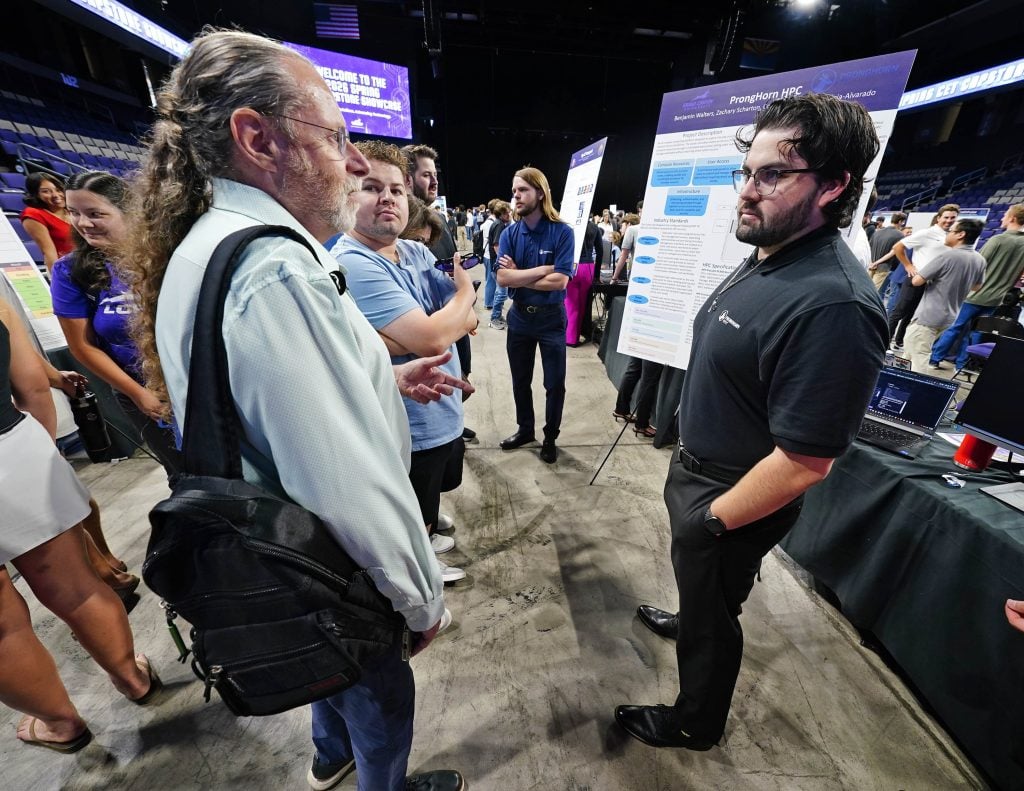
He knew a supercomputer – or high-performance computing cluster – is the secret sauce to any university leveling up when it comes to research. Though GCU is not Tier 1 research university, it has made undergraduate research an academic cornerstone.
Kalua saw the HPC project as not only an invaluable tool for research, but as a way to offer hands-on experience to students in the world of HPC infrastructure, and after conversations with Dr. Scott Greenberger, associate vice president of research and grants, it would up the game for GCU when it came to grant eligibility.
Those talks were the start of GCU’s HPC Project. But here's the pickle: Supercomputers are super expensive.

Elon Musk’s Phase 1 Colossus AI supercomputer is estimated to have cost $3 billion to $7 billion. University clusters generally cost a few million. If you build your own personal computing cluster, expect to shell out $5,000 to $20,000.
“Most people on this campus thought that this was absolutely insane,” Kalua said, “because even by today’s standards, the idea of building an HPC for less than a few million dollars seemed like an absolutely impossible feat.”
But Kalua and his team of students looked at what was possible.
They built a starter HPC for tens of thousands of dollars, and although it can’t do what the million or billion dollar clusters can, it proved one thing: the power of determination.
After securing university funding, “I’ll be honest. I was nervous,” Kalua said. The first month was like, ‘Oh no. What have I done?’ … Nobody’s ever done this before. And on top of nobody’s ever done this before, nobody knew how to do it,” including his student design team.
“They put us together. We didn’t have any idea we were going to be doing it,” said Colby Collier of himself and fellow-cyber/IT students Zachary Scharton, Ben Walters and Mario Garcia Alvarado. After checking an Excel spreadsheet sent to everyone in his capstone class, “… At the bottom, it was just, LOPES 1 HPC Project, with the four of us on it.”
College of Engineering and Technology faculty in fall 2025 handed them a 40-page document with all the requirements.
Game on.
Collier had heard about supercomputers in the news, like when they would break a speed computing record.
Beyond that, “None of us knew what high-performance computing was, even in my six years of working in this industry, it hadn’t crossed my mind once,” said Scharton, who worked in Silicon Valley for five years before enrolling at GCU for his bachelor’s in IT.
That 40-page document was overwhelming.
“I had to regroup the boys and say, ‘Here’s the deal,’” Kalua said. “We just need to get focused. ‘Let’s complete the first task, and here’s how to do it.’”
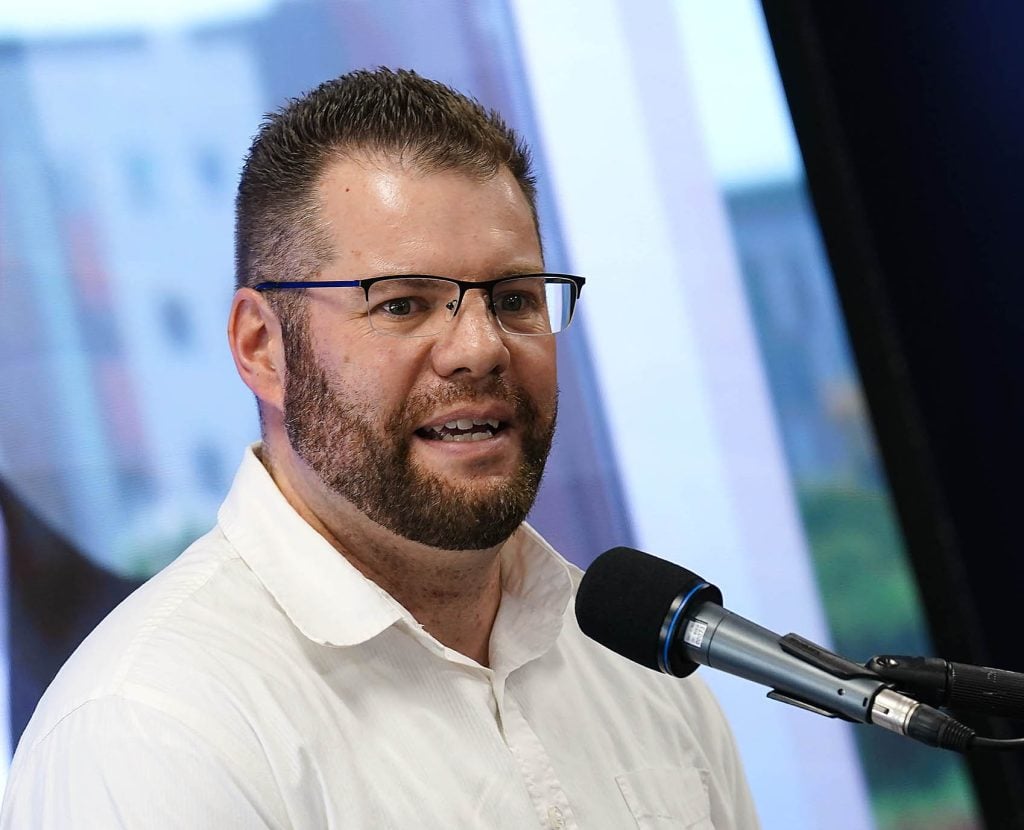
After that, the team told Kalua, “I think we can do this.”
A month later, the students had completed Task 2.
“We’d been informed many times about how they were doubting us. We were told months ahead that regardless of the outcome, we would all pass the class and that we would all graduate,” Scharton said.
They would get the grade because of the steep learning curve to build the HPC, which Collier describes as this: You have a workload no single computer can handle because it’s so complex, “so you spread it out over a lot of computers – tons of them – and each one processes a little chunk of it.”
Scharton said the day they found out they would pass the class, he told Kalua, "I came to tell you that it's working, two months ahead of schedule."
Collier won’t forget the day he got a call and a slew of text messages from Scharton, saying, “The HPC processed a workload!”
“It was super exciting,” Collier said. “It was the middle of the night. It was pretty late in the library while they (Scharton and Walters) were doing this. They were working on it for hours and hours.”
And not just that night.
“We were crazy. We spent about 14 hours a day working on it,” said Scharton, now an IT consultant for Bionix International Corp. in San Francisco. “We clocked about 800-ish hours combined. We faded out of the social realm to work on it.”
The team would later toy around with stock market analyses and Monte Carlo simulations, which run a scenario thousands of times using random variables to calculate probability. An example would be determining the odds you’d roll a six in Monopoly. The HPC “rolls” the dice tens of thousands of times in a few seconds and records the outcomes.
What the team built, over nine months, was GCU’s Pronghorn HPC Cluster out of mostly used technology.
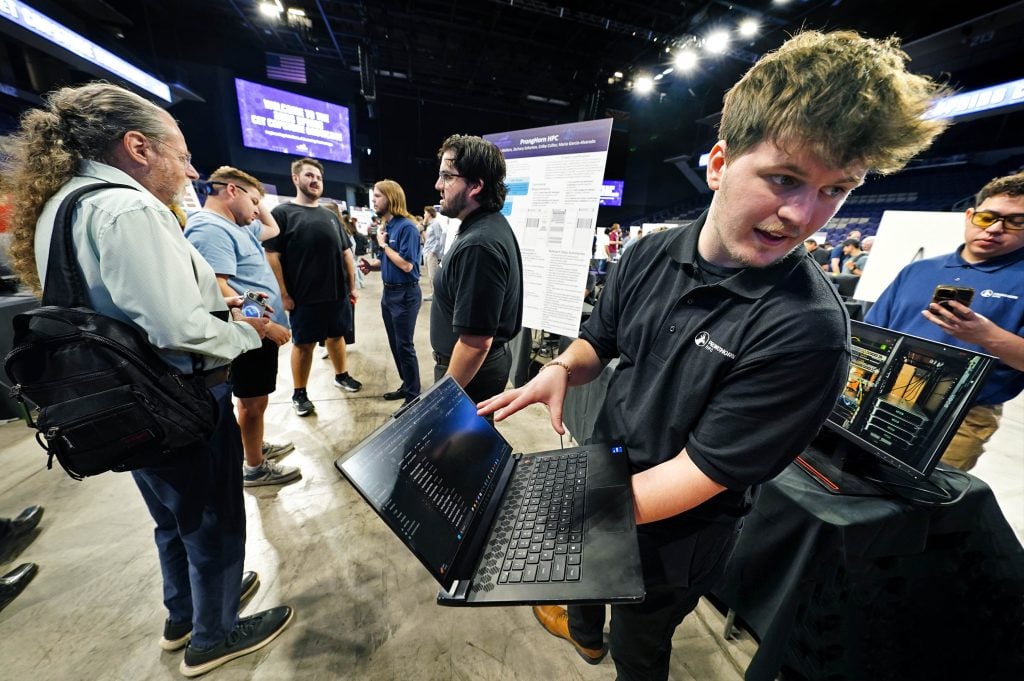
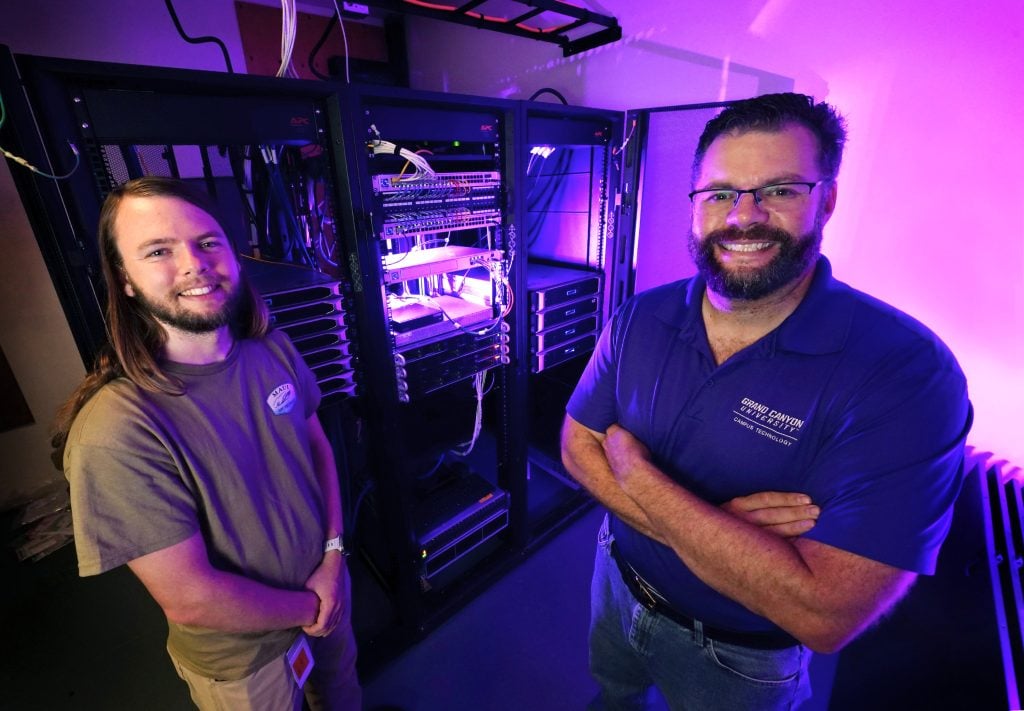
Its eight compute-heavy nodes, or multiple computers, and four GPU-heavy nodes (graphics processing units), occupy three server racks. That’s a drop in the bucket compared to other supercomputers that occupy entire buildings.
Built on a modest budget, the Pronghorn HPC Cluster is limited. For one, it can’t run multiple projects simultaneously.
But what the students learned was invaluable.
They delved into parallel processing, in which complex tasks are broken down into subtasks executed simultaneously across multiple processors. They worked with remote direct memory access, which supports large-scale parallel processing.
They used a job processor called SLURM, or Simple Linux Utility for Resource Management. And Walters mastered Ansible, an IT tool that automates repetitive tasks across multiple computers simultaneously.
We were crazy. We spent about 14 hours a day working on it. We clocked about 800-ish hours combined. We faded out of the
social realm to work on it.– Zachary Scharton, part of the team that built GCU’s first supercomputer
“We taught each other all the different things we needed to think about,” said Collier, a technician at the Grand Canyon Education Operations Center.
Beyond that, three of the students, all now alumni – Collier, Scharton and Walters – started their own company, Westwind Consulting Group, to continue the HPC project.
“This is the first iteration of the GCU HPC, and it is very much a proof of concept,” Kalua said. “We wanted to know if we could do it.”
It’s something to build on.
Paul Lambertson, College of Engineering and Technology dean, told Kalua what his team did is essentially an introduction into data center architecture.
More than that, “We laid down the foundation for GCU to push into research much further,” Scharton said. “That’s something we will carry with us all the way to the end.”
GCU News Manager of Internal Communications Lana Sweeten-Shults can be reached at [email protected].
***
Also from the magazine:
In demand: Why employers keep coming back to GCU
How AI is helping integrate Christian worldview authentically into GCU's curriculum
From embassy work to a Holy Land visit, Lopes lived large this summer
Five questions with GCU's Dr. Andrea Hogan
Online student expands domain from sports blogosphere to city hall