EDITOR'S NOTE: This story was originally published in the August issue of GCU Magazine, which is available in the purple magazine bins across campus or digitally.
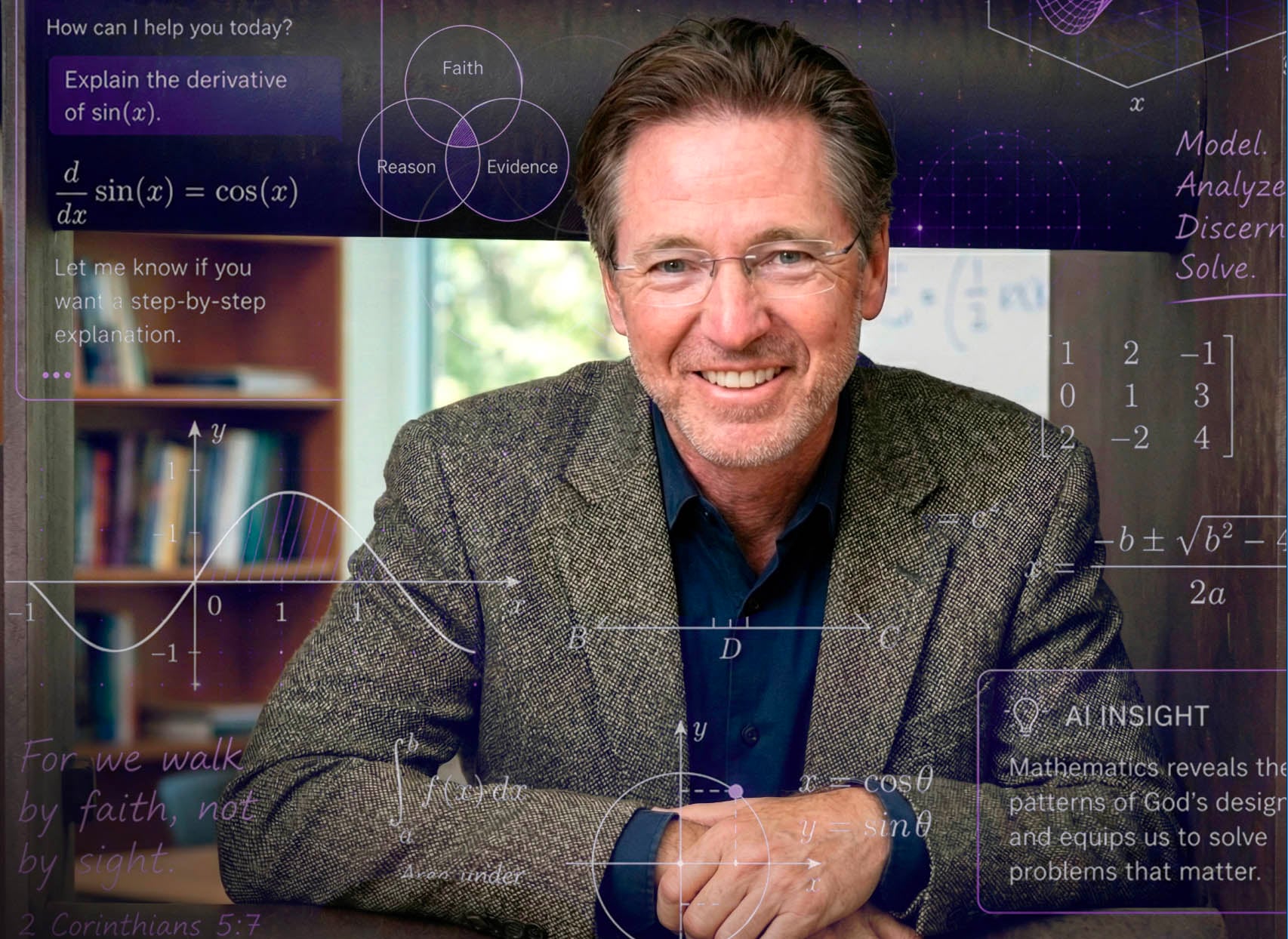
Dr. Richard Ketchersid doesn’t just ask students about compound interest.
The Grand Canyon University mathematics instructor is more ambitious than that.
In a weekly post, he assigns online students in his general education math class to build a simple budget, and while they’re at it, include three conversions relevant to life, such as hours worked to dollars earned. Then he digs deeper.
“Should budgeting be private or shared?” and follows up with: “In relationships, is it wiser to share budgets openly for unity or keep finances private for autonomy?” and “How do values, such as honesty, respect and wise counsel, shape what should be disclosed?”
Ketchersid then quotes Luke 14:28, which gives wise counsel on how we should consider the cost of an action before making a commitment:
“Suppose one of you wants to build a tower,” goes the verse. “Won’t you first sit down and estimate the cost to see if you have enough money to complete it?”
He said, for him, converting hours worked to dollars earned is the easy part of the lesson.
“That’s the mathy part, right?” said Ketchersid, who can rhapsodize all day about data sets and compound interest. “But throwing this extra bit here (those philosophical questions about ethics and character), that’s something that I wouldn’t have done on my own.”

They were something artificial intelligence created for him via FAITH+, an in-house tool to help instructional designers, and now faculty, incorporate faith into the curriculum.
“One of the things the curriculum team has been doing since 2013 is look for ways to authentically integrate the Christian worldview into assessments in various courses,” said Sean Sullivan, executive director of curriculum and publishing for GCU’s education partner, Grand Canyon Education.
So when ChatGPT debuted in 2022, GCU immediately started looking for ways to leverage AI. The university turned to GCE, which created Mosaic, an AI interface that houses the university’s AI tools, including FAITH+.
It was one of the first AI tools rolled out for GCU.

“The AWS (Academic Web Services) team was looking for some other ways that we can use AI to be more productive and efficient and help with what we need to do,” said Sullivan of the tool. "That was one of the first ideas that our team came up with. We thought, 'Hey, if we could have an AI, where we could look at a course or objectives or assessments in the course and find a natural fit for Christian worldview integration, that would be fantastic.’”
FAITH+ has since been expanded to include not just faith integration but the incorporation of Christian character, ethics and faith in free markets.
“That’s the plus (part of the name),” said Sullivan of FAITH+.
“There was a great deal of testing and training this tool went through to ensure that it does represent the university’s mission and theological stance,” said Miranda Hildebrand, executive director of AWS, the team that worked with Curriculum Design and Development to create the tool. She related how the College of Theology played a central role in assuring it “was representing GCU’s Christian faith in the most positive way.”
The curriculum team has been using FAITH+ for two years. It was expanded for faculty use a few months ago.
Kelly Palese, senior vice president of faculty operations, sees FAITH+ as especially helpful to faculty in disciplines such as math or science, where it might be more challenging to incorporate faith, compared to vocations or service disciplines, such as theology, nursing or social work.
While incorporating Christian worldview into the curriculum is something faculty have been doing for decades, the hope, Palese said, is to deepen what they already have been doing – to incorporate faith into topics in ways faculty might not have thought of before.
Hildebrand added that she hopes FAITH+ provides faculty with greater support and confidence.
“This just levels them up ... We provide tools to support our students in their learning. But we’re also looking to provide tools to support our faculty in their teaching and to create a better experience for our students,” Hildebrand said.
Georgette Gorman, who teaches undergraduate psychology, said she used FAITH+ recently to help her ease into a classroom conversation about reproductive rights. Is it a basic human right? Or, as some philosophers argue, should society require a license to prove a person can be a responsible parent?

She asked FAITH+ to help her acknowledge this is a sensitive conversation and that students could choose their level of participation. She also asked it to share a verse meaningful to the conversation.
FAITH+ chose James 1:19, “My dear brothers and sisters, take note of this: Everyone should be quick to listen, slow to speak and slow to become angry.”
Gorman broke that down for her students:
Quick to listen – “That encourages me to be open-minded.”
Slow to speak – “That encourages me to understand where my beliefs come from and support them with research.”
Slow to become angry – “That encourages me to challenge my beliefs and perspective.”
With FAITH+, Gorman said, “I’m not just throwing in a Bible verse. I’m connecting it to the content, so it feels authentic. It feels meaningful.”
What Gorman loves most about FAITH+ is that she’s learning, too, about faith and character right alongside her students.
“It can be a little intimidating as faculty to try to incorporate faith, because I certainly am not a theologian. … But we just want to make sure we get it right and encourage that good conversation for our students in helping them apply faith to whatever the discussion is."
Manager of Internal Communications Lana Sweeten-Shults can be reached at [email protected].
***
Related content:
GCU News/GCU Magazine: GCU programming a dynamic education landscape with help of new AI tools
Jewish News: GCU professor uses AI to build Torah study tool
GCU News/GCU Magazine: Teaching A.I.de: How GCU is leveraging artificial intelligence in learning