EDITOR'S NOTE: This article was originally published in the April issue of GCU Magazine, available in the purple bins on campus or digitally.
Dr. Armando Peelman is digging for information, gingerly and with intent.
His patient is grappling with gambling addiction, though he hasn’t admitted how deep it goes.
Peelman leans in, “But would your wife say you have it under control?”
The patient smirks.
“She thinks I’m over the line already. Too much money. Too many nights out. She’s tired of excuses, I guess.” His voice softens. “She doesn’t even recognize me sometimes.”
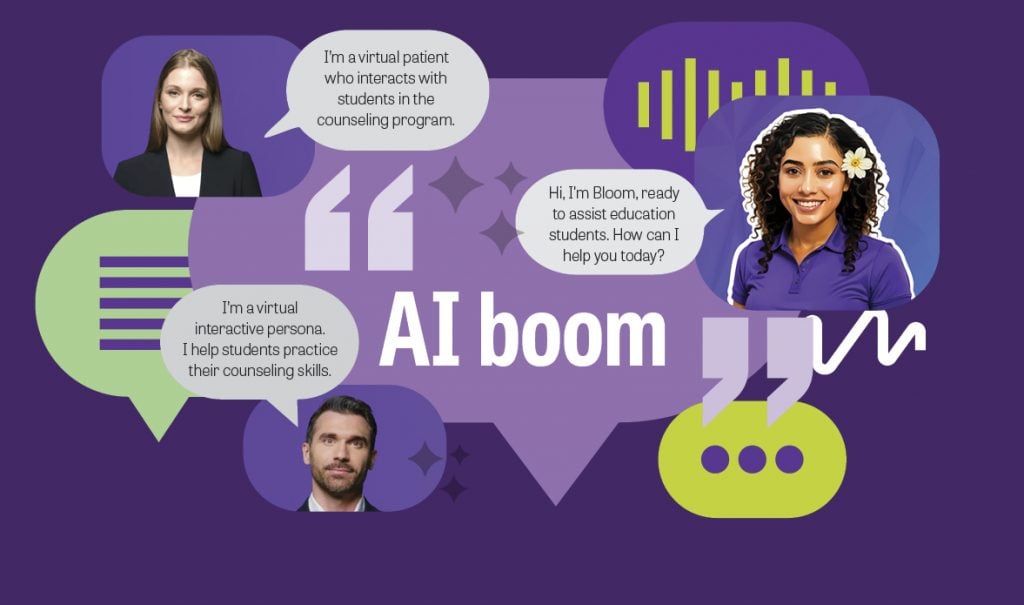
Then Peelman stops speaking, ending his video interaction with his patient – not a real person but a virtual patient, one of four Virtual Interactive Personas, or VIPs, grappling with addictions developed for Grand Canyon University’s counseling students.

“Through these personalities, we are able to develop these low-stakes, scalable opportunities for students to practice, from theory to application, in a really safe way,” said Peelman, program coordinator for the graduate addictions counseling programs in the College of Humanities and Social Sciences. “They’re able to practice these skills with this virtual personality and make mistakes that are of no risk to anybody.”
Engaging with these VIPs, which mimic real-life scenarios, is a more authentic experience than old-school role-play with a classmate who might have difficulty conveying the complexities of, say, addictions or anxiety, said Peelman. He teamed with assistant professor Dr. Dean Aslinia and Academic Web Services’ Ricky Whitehead and Chris Neikirk to move the AI tool forward.
“We’re able to program these VIPs to better illustrate what an addiction client might look like, what someone with gambling issues might look like, someone with eating disorders. … With some guardrails, safeguards, some ethical guidelines in place,” Peelman said.
In the future, faculty will be able to change the virtual interaction to incorporate specific theories, interventions and skills so students can practice and receive feedback around those specific competencies.
That's the best kind of training we can give our students (authentic situations with authentic feedback). That's why we're opening a new door to really dynamic education.
Tyler Kozimor, College of Education senior academic program specialist
These VIPs are integrated into the curriculum, with online undergraduate counseling students engaging with virtual patients in their classes.
The plan is to incorporate VIPs into other courses and programs, including on the graduate level.
“It really allows students to increase their exposure to this work,” Peelman said, adding that practicing those scenarios in a safe virtual environment is invaluable, so that when those difficult conversations happen in their professional careers, “that’s not a moment they will run from but a moment they will run to.”
The VIPs are just one of about 16 GCU-specific, artificial intelligence tools introduced at the university since rolling out its first AI chatbot, nursing and science tutor Mira, in 2023.
While some are internal, six of those AI tools, housed on a secure platform called Mosaic, are designed to help students sharpen their academic skills.

“To understand how big of an initiative AI is, it involves all leaders from all across the university,” said Miranda Hildebrand, executive director of Academic Web Services, which collaborates with GCU’s colleges in creating these AI tools, made in-house so they can be scaled, secure and reflect the university’s Christian worldview. “GCU leadership is invested in this and sees preparing our students with the AI skills needed after graduation as a priority.”
And that goes beyond AI tools.
Sean Sullivan, director of Curriculum Design and Development, said his team is continually looking at ways to help students learn how to use AI. When a course is developed, his team asks, “How can we integrate it into their assignment? … That’s something that’s been championed by our provost and the academic leadership team.
“They want to see that throughout the colleges. They want to see AI literacy infused in each of the degree programs.”
Including in the College of Education.
In January, the college launched Bloom, named after the Bloom Taxonomy, an educational framework that helps educators structure lessons from simplest to most complex.
Bloom prepares students for their licensure exams: the basic skills exam (reading, writing, ’rithmetic); content exam, which assesses teachers’ knowledge in the subject they’ll teach; and professional knowledge exam, which tests students’ knowledge on how to teach, so classroom management, for example.
The college already uses 240 Tutoring, a third-party licensure exam preparation application in which students complete modules and practice assessments.

Bloom, a unique tool built specifically for the college, was designed to enhance what COE already does to prepare its students.
Dr. Jeremy Hayden, the college’s director of outreach and student success, is hoping Bloom can help students better their scores on their content exams, the one GCU students struggle with the most.
“That’s really where our focus is, to help provide support for that content exam,” he said.
Students can choose which exam to prepare for, and Bloom – its avatar is a smiling woman with a flower in her hair – will ask them multiple-choice questions. If they don’t answer correctly after two tries, Bloom will tell them. “Oh, you got that one wrong. Here’s the correct answer and why.”
What is exciting about Bloom, Hayden said, is not only is it free, but a student can log in at 2 a.m.
“It’s autonomous and asynchronous. They can use it anywhere, anytime,” Hayden said. “It’s convenient for them, and it just provides additional support to all the other resources available to them.”
The education college also introduced role-playing chatbot Aiden this spring.
It’s in the curriculum for graduate students studying to be technology coaches, which are teachers who coach other teachers in technology.
Aiden, for example, can portray a teacher who’s feeling anxious about a parent-teacher conference. The student can guide Aiden through that situation in a safe space outside the pressure of role play with a peer or professor.

Following the scenario, the chatbot provides feedback.
“They can create their own prompt, and Aiden would follow that same structure of being Aiden, switching role play and providing feedback, all within the lens of COE core values and competencies and what makes us us,” said assistant professor Jillian Hartman, who helped train Aiden.
“We wanted it to have the heart of COE and those things are what drive us as educators. That’s the kind of communication and care and interaction we want our students to have.”
The college wants to expand Aiden to be used by any education student.
It also is helping the college with student assessment. Students can copy and paste their conversations and send it to their professors.
“These are our first steps looking at authentic assessment via AI,” said Tyler Kozimor, COE senior academic program specialist. “How do we know they are showing us they can do the thing that they say they can do? This is ensuring that we can do that (confirm those skills), and that’s huge for us.”

Kozimor is excited about the possibilities of AI in the education landscape. He mentions “authentic situations with authentic feedback.”
“That’s the best kind of training we can give our students,” he said. “That’s why we’re opening a new door to really dynamic education.”
COE Dean Dr. Meredith Critchfield, who had the idea for Bloom, said these projects couldn’t have come to fruition without college faculty and Academic Web Services “unabashedly diving into this idea with me.”
She said, “We are lucky to work at an organization where a big idea can come to life in a month’s time and where we don’t see innovation as something to fear, but something to embrace."