
Dr. Jessica Carter, pursuing a 2nd doctorate, aims to change 50% dropout rate
Organizational behavior specialist Dr. Jessica Carter, who's pursuing her second doctoral degree, this time from Grand Canyon University, has a particular mindset that has helped her achieve her academic goals: “I think what it comes down to is because I think I can,” she said.

That kind of mental attitude, or behavioral mindset, is something she studied when writing her dissertation for her master’s degree in business administration at Angelo State University in Texas. She studied differences in leadership styles and different personalities associated with them.
She viewed leadership and personality with a psychology lens. She wanted to change the perception that performance psychology can be applied solely to sports athletes.
Then, while working on her post-doctorate in behavior analysis at Trident University International, where she later became a professor and doctoral committee chair, she learned the behavior analysis program was limited to autism.
“It’s needed, but I thought all of these principles (when it comes to behavior analysis) can be applied to anyone, especially in business and how we deal with stress and perceive our world,” Carter said.
While pushing through all her academic pursuits, Carter was stunned to see fellow learners struggle for years before they eventually dropped out of the program.
“Was it that they didn't have the support? Was it that they didn't have a connection with someone? An accountability partner? Was it that they just felt isolated? What are those things that keep students from finishing?
“If I can shine a flashlight to say, ‘Hey, man, I did it. And not only did I do it once, but I can do it twice and do it in a very short amount of time,’ it can be done.
“I'm showing that it can be done.”

Carter successfully defended her first doctoral dissertation in organizational leadership ("The Effect of Personality and Leadership Style on Leadership Effectiveness and Job Satisfaction") in two years – an incredible feat. And she’s entering her dissertation at GCU in psychology after only nine months, well before most learners enter their residency phase.
“I really wish that Grand Canyon had been my first Ph.D. because the amount of support and all of the different student associations,” said Carter, who plans to talk to more learners in her College of Doctoral Studies classes about the resources GCU offers when “they get into the weeds” of their studies.
Her efforts have been recognized by GCU’s College of Doctoral Studies leadership.
“We appreciate Dr. Carter's humility and service to her fellow students,” College of Doctoral Studies Assistant Dean Dr. Nicholas Markette said. “She willingly volunteers as a student leader of our Doctoral Community that meets every Tuesday.”
Carter was running two businesses while working at Medical University at South Carolina and embarking on her doctoral degree when the COVID-19 pandemic struck.
That shifted her business pursuits to more of a consulting role and helping others.
“I've gotten to the point in my career where I like seeing other people succeed,” said Carter, who didn’t envision herself working in the academic world before embarking on her first doctoral degree because of her businesses.
The turning point was when she was told, while preparing for her first dissertation, that “you're good at this, and you explain really abstract concepts in a way to students that makes it digestible.”
“My kind of project management brain also was really advantageous to helping students figure out what do I need to do next in my doctoral program, and so I would lay out their math, and these are the steps we've got to complete.”
Carter is motivated to change a trend in which the completion rate of learners in the United States who complete their doctoral programs hovers around 50%.
“I'm showing that it can be done,” Carter said. “So let me help you get there, and I think that is by far the most rewarding, being able to catch some of those students."
Carter said she can relate to doctoral learners who fear not advancing to their final class or completing an assignment.
“I know what comes first and next and last, and the order of things, and how quickly things can move, and so on,” Carter said. “And I think having that perspective of, ‘Oh my gosh, you have no idea. The finish line is literally right in front of you. All we've got to do is walk across it. 'Let's walk across it.'”
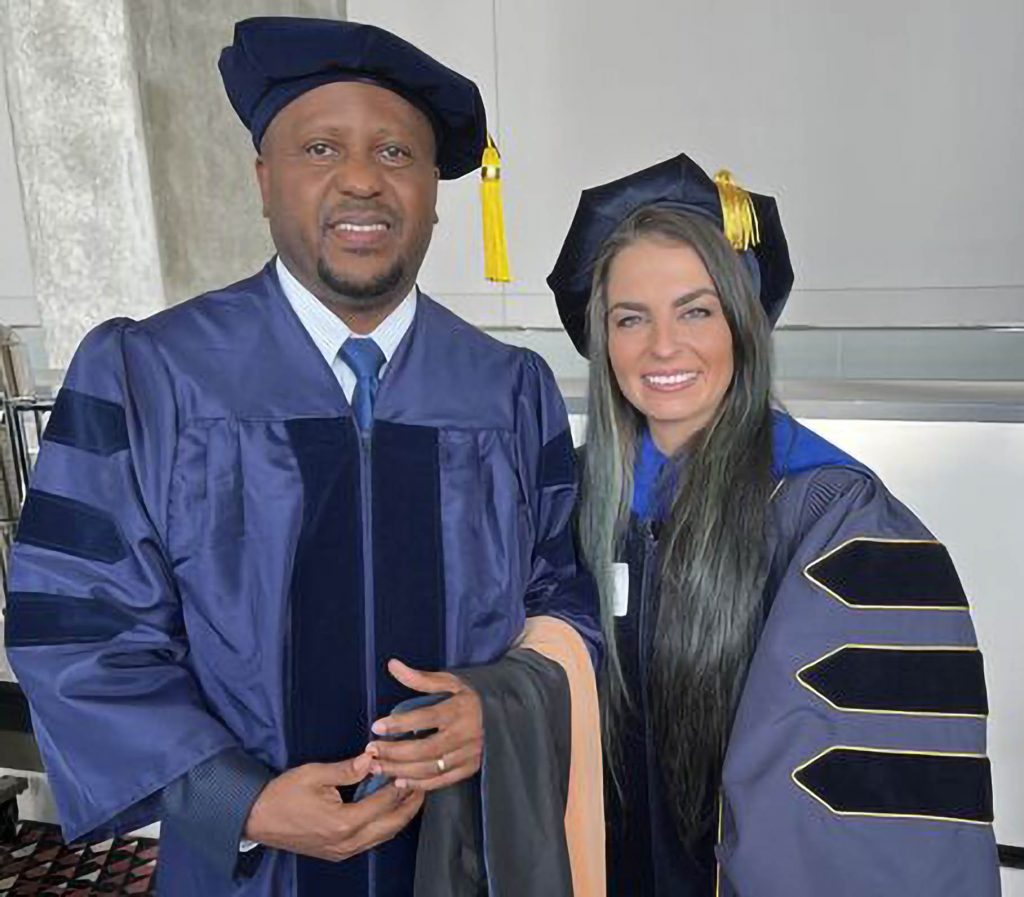
In addition to her GCU commitments, Carter also is an adjunct faculty member in the Department of Leadership Studies at The Citadel, a military college in Charleston, South Carolina. Carter has worked in The Citadel’s Right Path program, which enables veterans to switch from active-duty military to a civilian education.
Carter understands the military mindset but remains true to her own style.
“I come in with a different approach to say you can't, as a leader, just say ‘I am a dictator, and you will do what I say.’ People just aren't going to do that. Do what you want them to do.
“There are different ways to lead to be an effective leader, to be more aware as a leader. That's what I try to incorporate in all the courses that I teach there. “
GCU News senior writer Mark Gonzales can be reached at [email protected]
***
Related content:
GCU News: No burnout for College of Doctoral Studies' Dissertation of the Year recipient
GCU News: GCU doctoral student harvests produce – and hope – for less fortunate