Grand Canyon University timeline

EDITOR'S NOTE: This timeline is part of GCU's history page. All the stories can be found here:
GCU History Page | The GCU story | Grand 'Construction' University | A campus culture like no other | GCU timeline | Then and now | Did you know…? | Brian Mueller and the 'Phoenix 50' | Pioneering online education | Rise of athletics | The next 75 years
The Formative Years
1949: In the Beginning
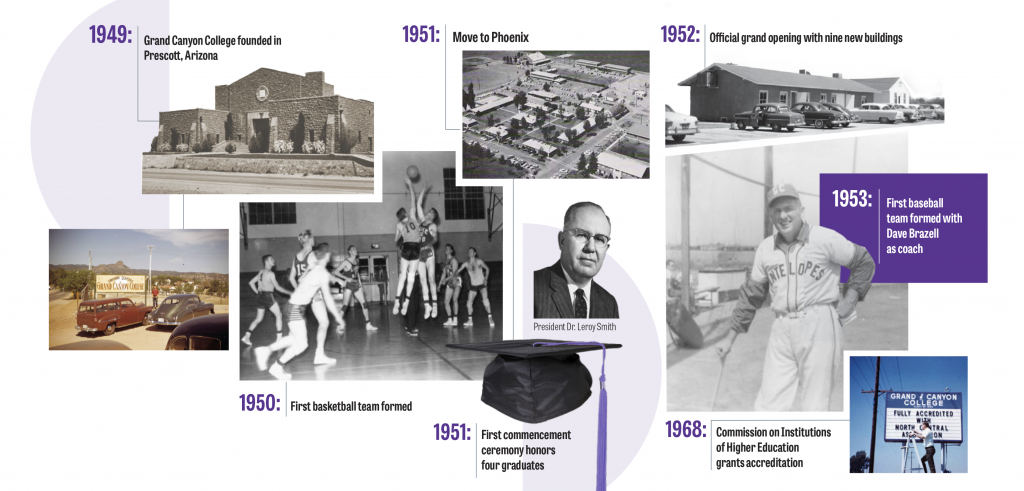
After years of raising funds, the Arizona Southern Baptist Convention secured enough capital to open Arizona’s first four-year, private Christian liberal arts college in Prescott, Arizona. Originally Grand Canyon College, the institution opened on Sept. 13, 1949, with a celebratory parade and barbecue. Ninety-five students enrolled from 11 states that first semester. Students gathered in temporary classrooms at the Prescott National Guard Armory to begin their studies.
1951: Move to Phoenix
Shortly after the college opened in Prescott, university leadership concluded that the small town could not sustain the campus population. The majority of students needed to work throughout college, and Prescott did not provide a large enough job market to allow for growth. Under the leadership of Dr. Leroy Smith, the college moved to its current home in the Valley of the Sun. Construction began on nine new buildings at the end of August 1951 and was completed just two months later in October. Classes were temporarily held at First Southern Baptist and North Phoenix Baptist churches for those first two months.
1970s: Rise of athletics
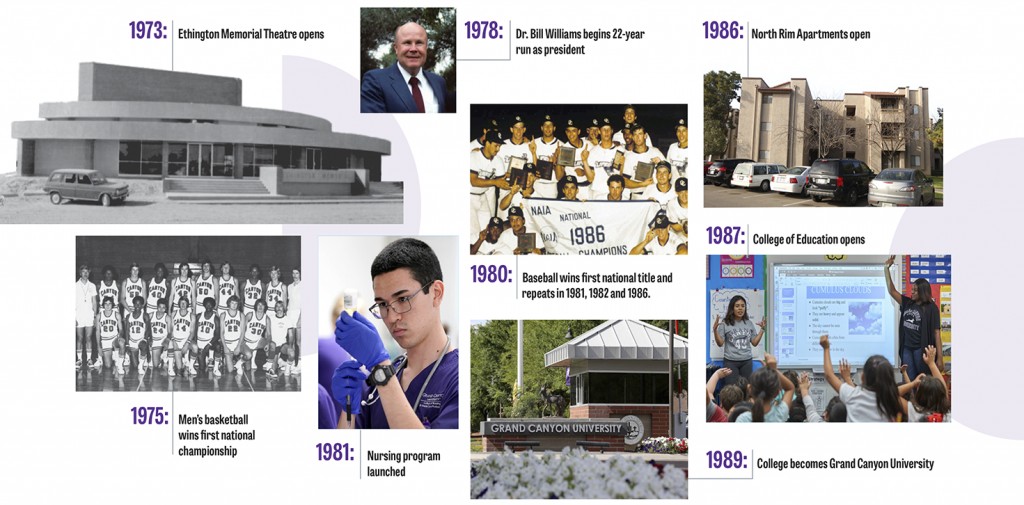
By the 1970s, the Lopes athletic programs were a force to be reckoned with. After three consecutive trips to the NAIA National Tournament and a 30-3 season, the men’s basketball team claimed its first National Championship in 1975. The team went on to win the Championship again in 1978 and 1988 . Not to be outdone, GCU’s baseball program was making a name for itself. In 1980, Dave Brazell’s last year as coach, the team won its first NAIA National Championship. The team won again in 1981, 1982 and 1986 . Women’s tennis also scored its first NAIA National Championship in 1981.
1989: Grand Canyon becomes a university
In the early ’80s, the administration and faculty began to discuss changing the institution’s name from Grand Canyon College to Grand Canyon University. However, they didn't want to do that without good reason. The new name, they thought, should represent the evolution of the school. They decided being a university, as opposed to a college, meant expanding the offerings to include master’s degrees and having separate colleges with individual deans. By 1989, when the name change became official, the university was divided into five colleges that offered more than 50 majors and two master’s degree programs, both in education.
1992: College of Fine Arts and Communications opens
After the school moved to university status, the College of Performing Arts was renamed the College of Fine Arts and Communications. It included programs in music, theatre, journalism and communications, and it mounted the annual presentation of “Messiah,” a Christmas tradition that continues today.

The Transition Years
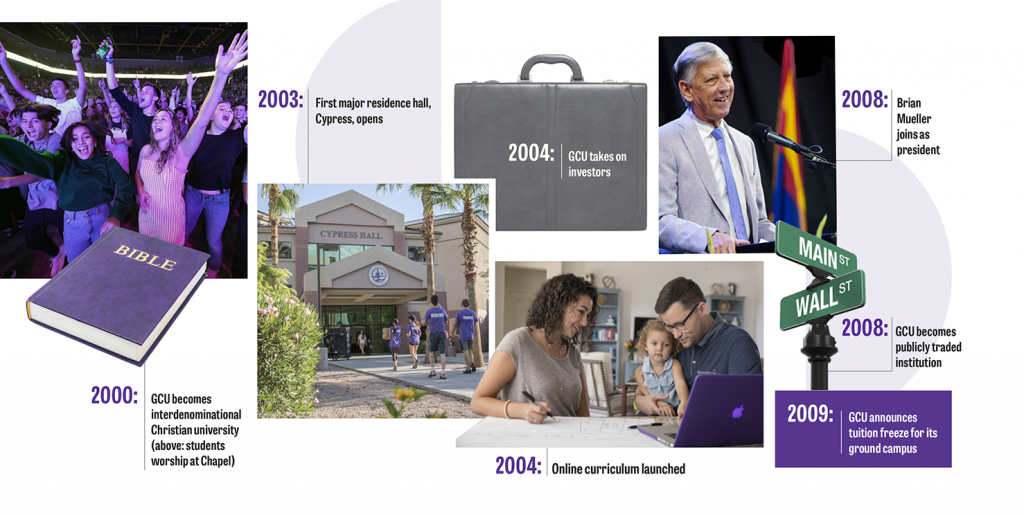
2004: Taking on investors
On the brink of bankruptcy with $20 million in debt and less than 1,000 traditional students, GCU was on the verge of closing its doors. Without a large donor base to turn to or the ability to rely on tax dollars, the university remained afloat by becoming a for-profit institution, securing investor funding and adding an online component to its academic offerings. A few years later, to grow out the ground campus and ensure long-term stability, GCU went to the public markets for an infusion of capital to invest into the university.
2008: A visionary new leader
Brian Mueller joined GCU as the President and CEO in 2008 to usher in a new era for the institution. Taking the success he experienced as a teacher and coach at the high school and small college level, as well as his 22 years of experience at the Apollo Group (the parent company of the University of Phoenix), Mueller took GCU from a financially struggling university to one that is a driving force in higher education. Under his leadership, the ground campus has grown from less than 1,000 students to around 25,000 students, and online enrollment has grown exponentially to nearly 90,000, with nearly half of those studying at the graduate level.
The Transformational Years
2010: Construction boom begins
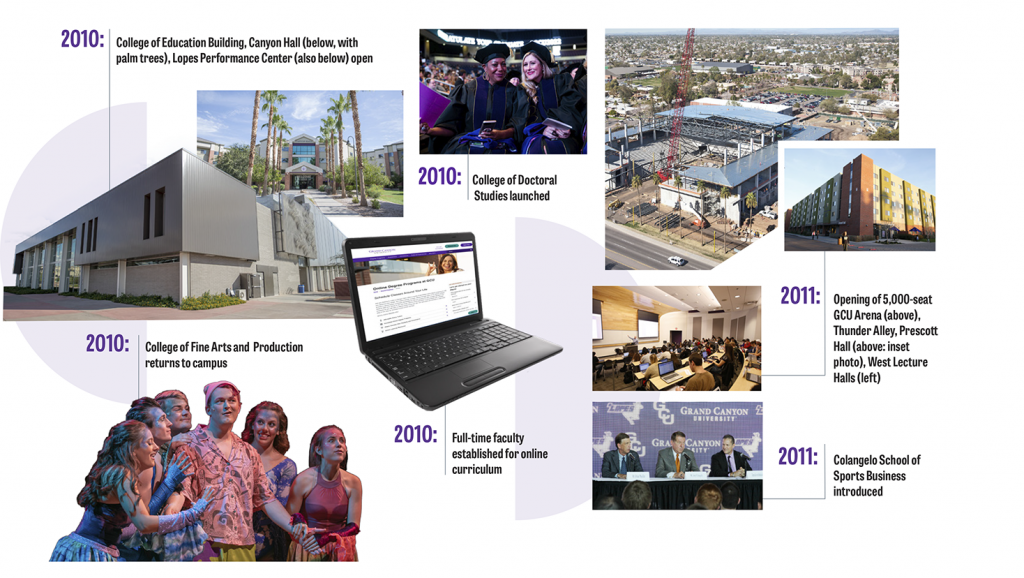
The start of this decade kicked his off the era students affectionally called “Grand Construction University.” With newfound capital from going to the public markets, GCU was able to focus on expanding the campus. In 2010 and 2011, seven buildings were opened, including Canyon and Prescott halls, the College of Education, the Lopes Performance Center, Thunder Alley, West Lecture Halls and the 5,000-seat GCU Arena (before its expansion to 7,000 seats a few years later). The new arena became home to the men’s and women’s basketball teams, Chapel, a variety of campus events and even concerts.
2012: Creating safe neighborhoods
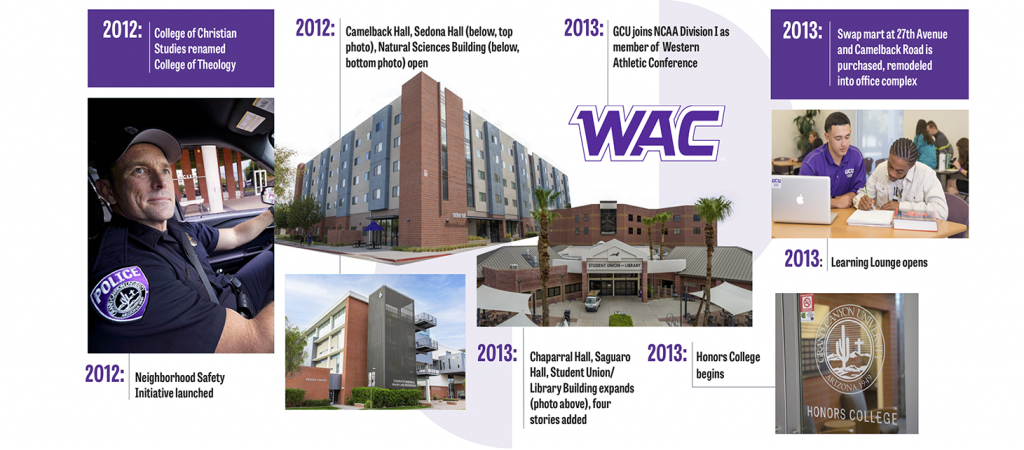
Considered the most significant initiative of its kind in the city of Phoenix’s history, the university and the city pledged $100,000 annually to support Phoenix Police Department crime-suppression programs from Indian School to Bethany Home roads between Interstate 17 and 43rd Avenue. The increase of patrols and proactive enforcement dramatically reduced crime in the targeted areas while building a stronger neighborhood around campus. This unique public-private partnership has continued to grow to an 11-year, $2.2 million agreement and serves as a model for other cities to follow.
2013: Learning Lounge explodes
What began as a space on campus where students at nearby Alhambra High School could receive free tutoring, GCU’s Learning Lounge quickly evolved into an academic assistance program. It now serves 5,500-plus K-12 students and supports 320 schools. Those students have visited the center over 70,000 times and have invested in 165,000-plus hours of study. In addition to the campus space, an off-campus Learning Lounge occupies the nearby Milwaukee Brewers spring training facility. The program provides help to underperforming and advanced students at neighboring K-12 schools and is having a significant impact in the community.
2013: Honors College forms
The Honors Institute debuted in the fall with 59 students. With strong student programming and a commitment to social and academic support resources, the program transitioned two years later to become GCU’s ninth college – the Honors College. Students in fall 2022 touted an average incoming weighted GPA of 4.1, with the program celebrating its 2,500th graduate in December 2023.
2014-15: Engineering/Technology expand STEM offerings
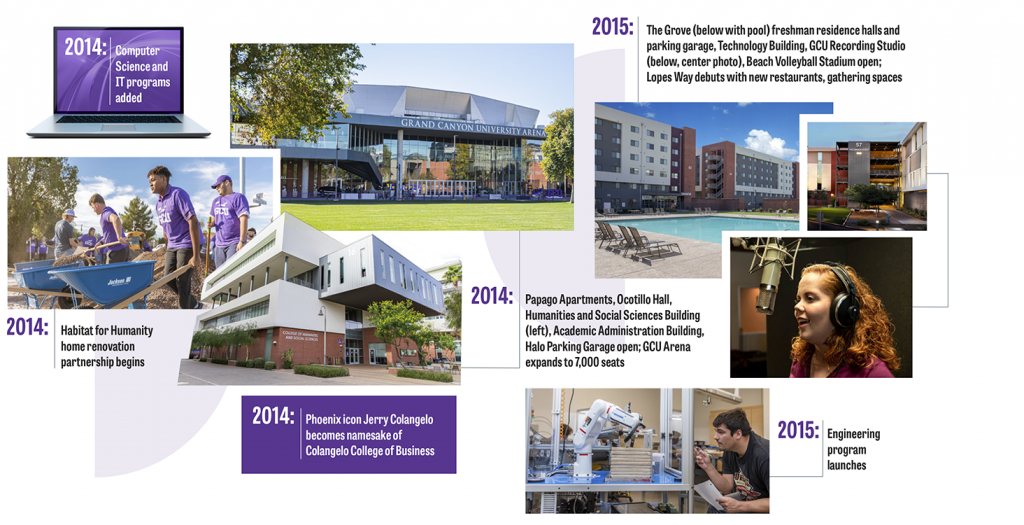
GCU's College of Arts and Sciences split into two in 2014. The College of Science, Engineering and Technology was created to better align its academic offerings with the university’s focus on STEM education and workforce needs. Lab-based sciences, technology and engineering programs now fall under CSET. Traditional liberal arts programs become part of the College of Humanities and Social Sciences.
2014: Habitat partnership forms
In this first-of-its-kind partnership, GCU teamed with nonprofit Christian housing ministry Habitat for Humanity Central Arizona to provide the funding and manpower to renovate neighboring homes, with the first project completed in January 2015. Together, the GCU-Habitat partnership has become one of the largest neighborhood revitalization projects of its kind in the nation and, block by block, the collaboration has resulted in the renovation of home for over 480 families. More than $5.4 million has been raised and more than 33,000 volunteer hours have been served by students, faculty and staff to date.
2016: GCU opens golf course and hotel
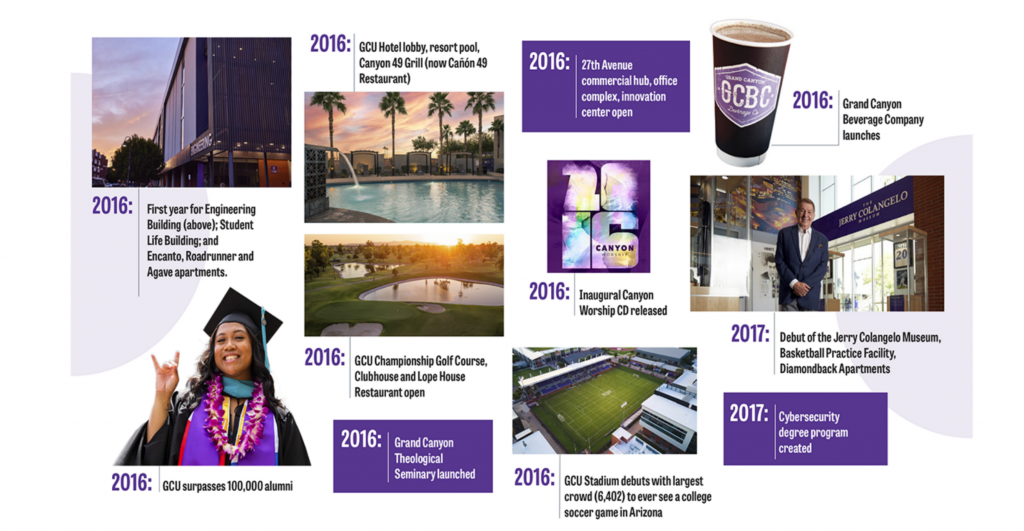
Because what great university doesn’t have a hotel and golf course? GCU bought and renovated a 152-room Quality Inn and Suites, then added a resort-style pool and adjoining 200-seat Canyon 49 Grill restaurant (now called Cañón 49). The property serves as a training ground for students in the Hospitality Management program. GCU also put $10 million in renovations into a failing city-owned Maryvale Golf Course, turning it into a destination spot as the GCU Golf Course and clubhouse, which the university now manages.
2016: A Grand Seminary
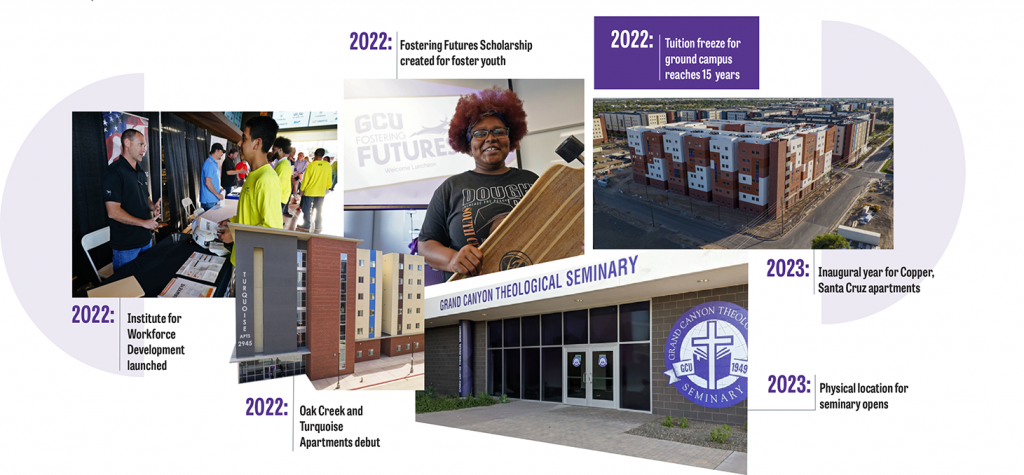
Graduate-level courses GCU had been offering for six years became part of a more refined Grand Canyon Theological Seminary to go beyond academic training and truly prepare students to become ministers. The seminary's mission is to develop leaders, ministers and scholars who rightly handle God's Word, teach what accords with sound doctrine and equip the people of God for missional service within a rapidly changing world. GCTS offers graduate-level programs both in person and online.
2016: Students Inspiring Students
As an extension of the Learning Lounge, GCU raised money to create the full-tuition SIS scholarships for high-achieving, low-income high school students who otherwise may not have been able to go to college. A college education is the great equalizer in society, and this SIS scholarship (now called Canyon Rising Scholarship) has now been awarded to over 1,000 students.
2018: A nonprofit again
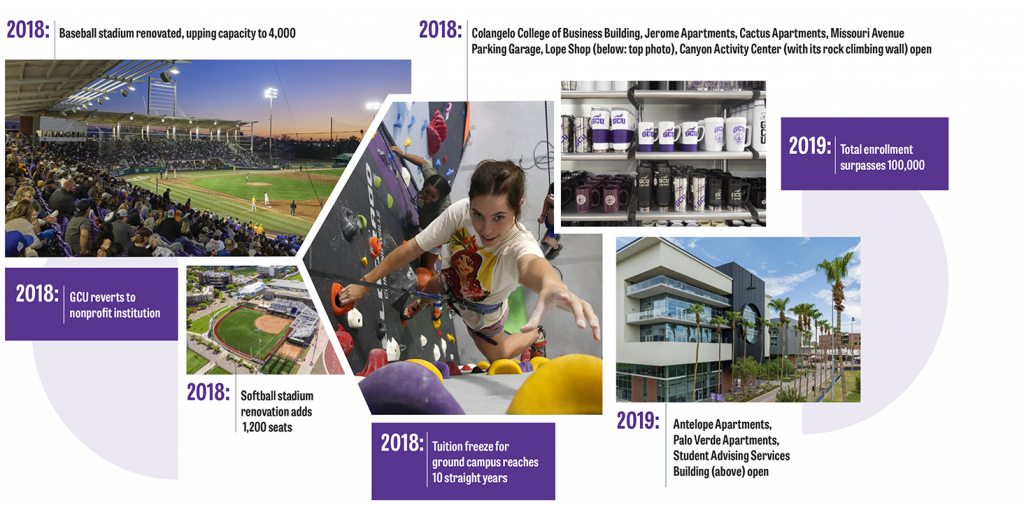
After an incredible transformation of a university on the brink of closing, to a thriving university with over 20,000 students on campus , leadership decided it was time the school returned to the historical nonprofit roots it held from 1949-2004. The conversation was made to open up the world of nonprofit philanthropic giving, grant writing and research opportunities. Additionally, it has helped the university keep tuition frozen and continue to invest millions into infrastructure.
2018-19: Enrollment milestones
GCU’s meteoric rise hit two milestones when campus enrollment surpassed 20,000 in 2018 – up from less than 1,000 traditional students just 10 years earlier. Meanwhile, total enrollment (ground and online) eclipsed 100,000 in 2019.
2021: GCU a first for CityServe
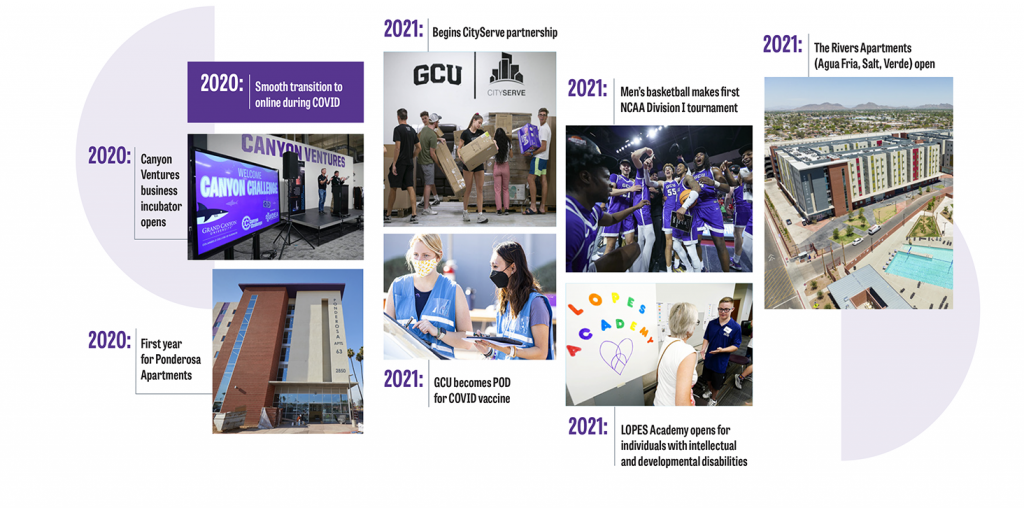
GCU became the first university in the country to serve as a HUB for CityServe, a network of faith-based nonprofits, corporate retail, farm and food supply partners that provides free household goods to families in need. GCU created 87,000 feet of warehouse space on campus, which in less than two years has distributed $9.6 million worth of beds, furniture, food boxes and other essential items to more than 23,100 families in Arizona.
2021: A unique COVID POD
GCU became a public Point of Dispensing for the COVID vaccine unlike any other in Arizona in that it was operated almost completely by the university’s staff and student/employee volunteers for free — saving taxpayers considerable money. The site administered more than 113,000 vaccines in its three months of operation. The GCU POD also had significant impact because of its efforts to reach more vulnerable populations by including walk-up options for individuals who lacked vehicles or relied on public transportation. It also enabled onsite registration for those without computers or the internet or simply had difficulty navigating technology.
2022: 15 years of frozen tuition
To make higher education affordable to all socioeconomic classes, GCU has frozen tuition at $16,500 for the past 15 years. In addition, in 2021-22, more than 90% of GCU students qualify for institutional scholarships that bring the cost down even more. According to data from the College Board’s “Trends in College Pricing and Student Aid Report,” since 2008-09 when GCU began its tuition freeze, the average cost for in-state tuition and fees at four-year public colleges has risen 66% to $10,940, while it has risen 56.5% to $39,400 at four-year private institutions. Keeping tuition affordable also has resulted in a high-quality student body that is diverse. In 2021-22, more than 40% of the student body was students of color.
2022: Another pathway for workforce jobs
To help create additional learning modalities for high-need jobs, GCU created the Institute for Workforce Development. The Pre-Apprenticeship for Electricians, in partnership with Rosendin Electric and Maricopa County, is the first pathway to be created under the new institute. The one-semester, four-course offering helps students master key concepts, especially in math, that prepare them to enter a paid apprentice program and quickly embark on a high-need career.