Photos by Ralph Freso
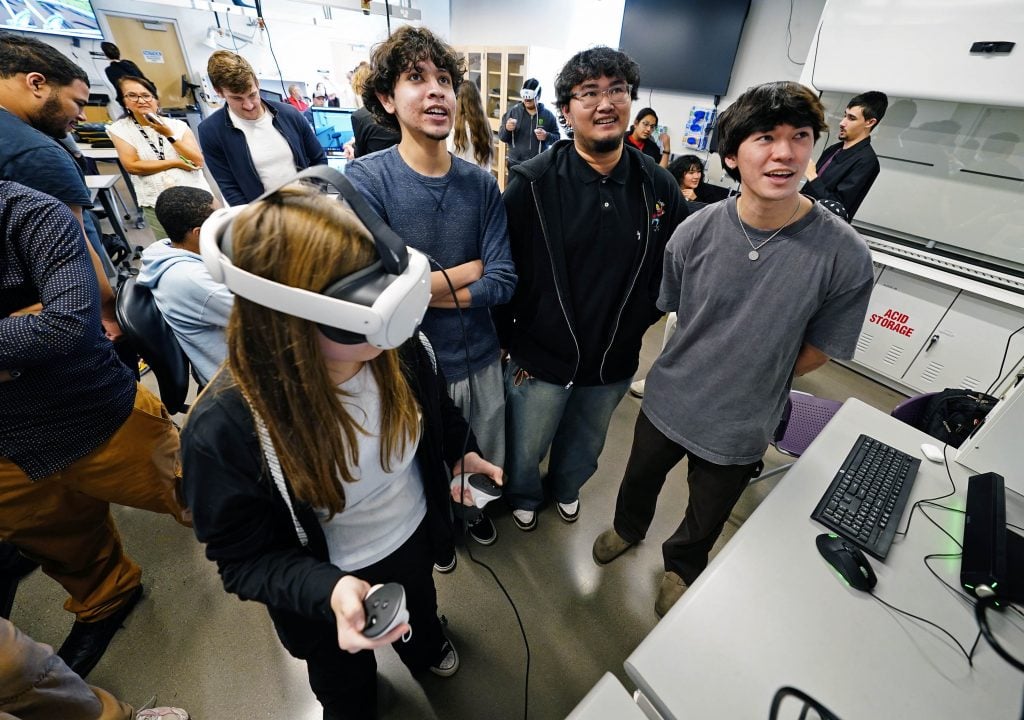
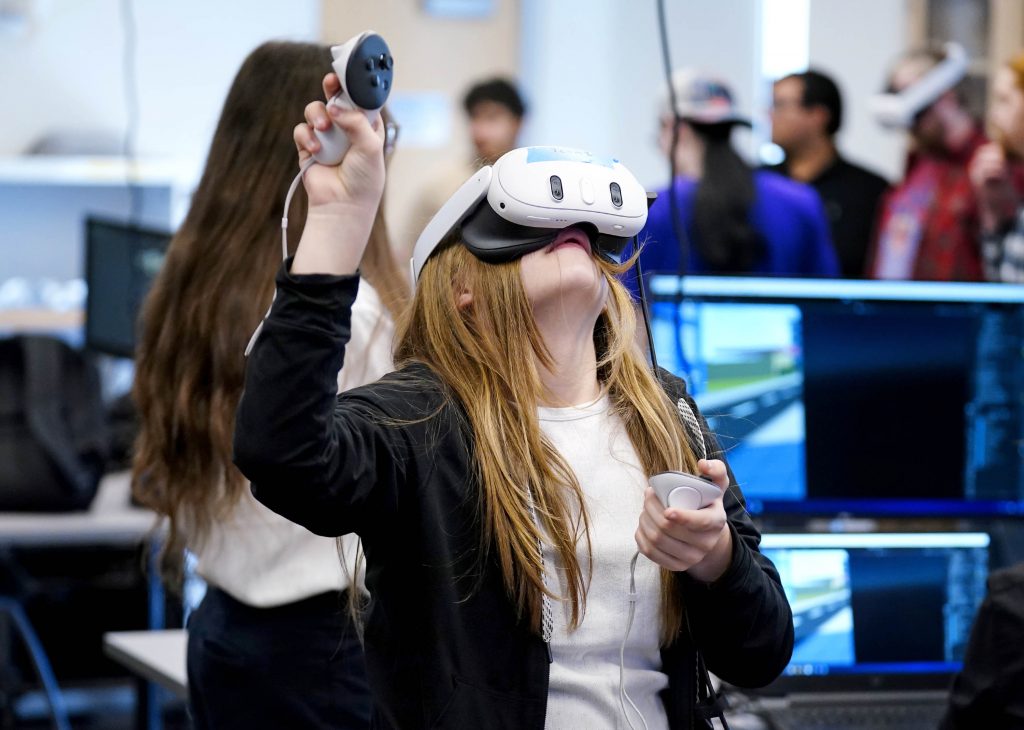
Seventh grader Rylee Godinez looked other-worldly-spacey as she donned a shiny white plastic virtual reality headset in the Grand Canyon University Engineering Building.
She roamed in a world inspired by Percy Jackson, the Greek demigod son of Poseidon – well, at least she did via that VR headset.
But the game she really loved was on the other side of the room called The Lady Who Drowns, based on La Llorona, or the Crying Woman, from Latin American folklore. It was built by GCU computer science major Andres Reyes and his team.
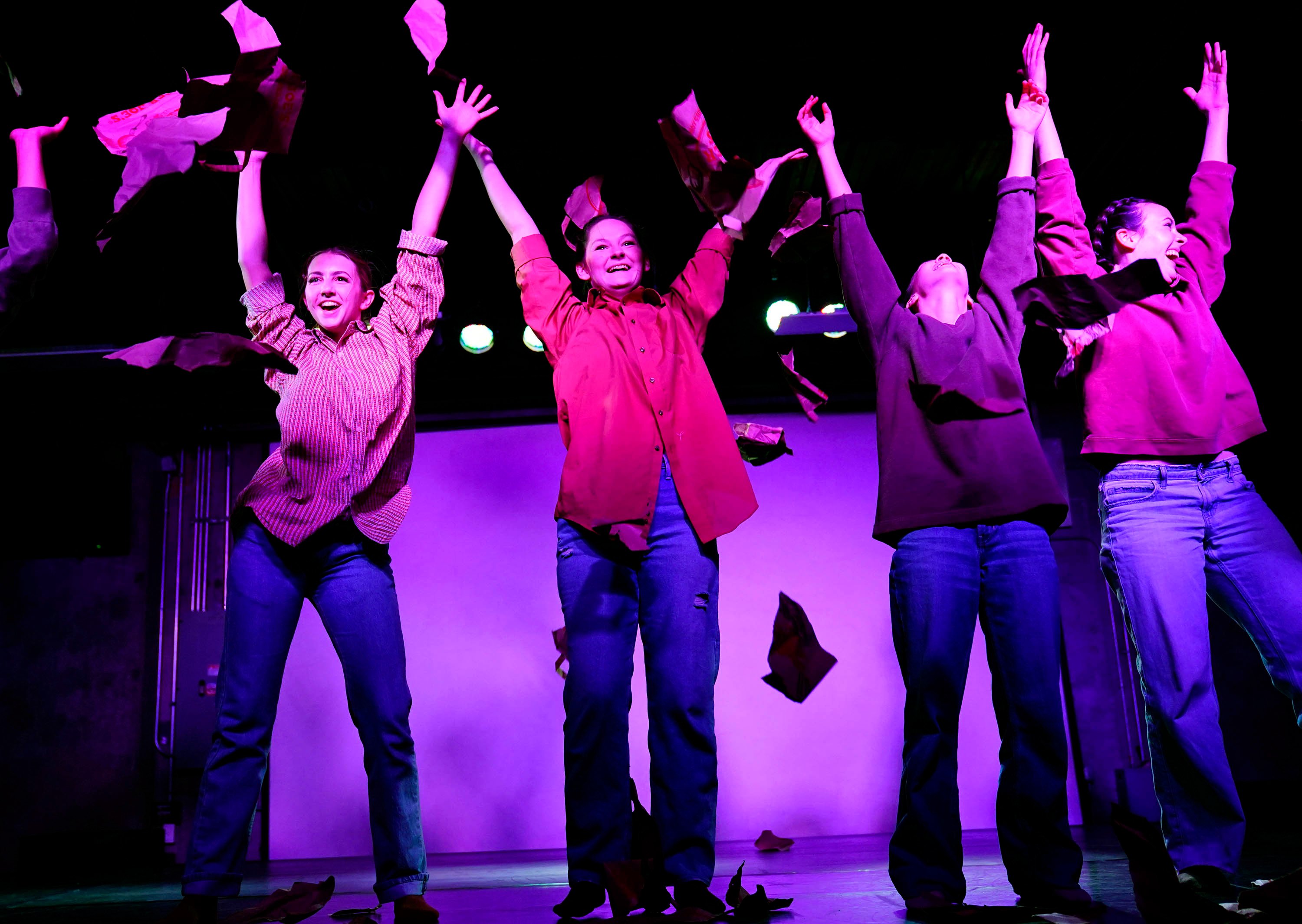
They were inspired by the novel “Summer of the Mariposas,” a reimagining of Homer’s “The Odyssey” as a magical Mexican-American adventure. In the book, five sisters are on a quest to return a dead man to his family in Mexico and encounter mythical creatures and folklore along the way.
“I LOVE horror games and movies,” she said at the College of Engineering and Technology’s VR Showcase on Thursday.
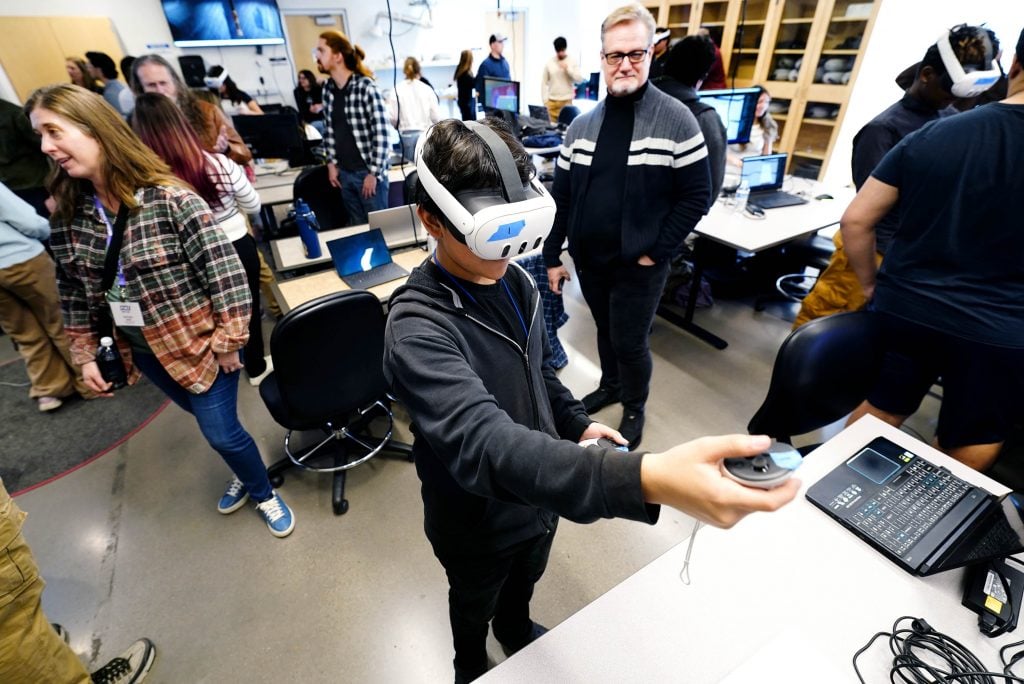
She wasn’t the only K-12 student at the event, designed for Dr. Isac Artzi’s VR students to showcase their projects.
GCU students created games inspired by the literature sixth and seventh grade students from Phoenix’s Villa de Paz school are studying, such as “Percy Jackson and the Olympians: The Lightning Thief” by Rick Riordan and “Summer of the Mariposas” by Guadalupe Garcia McCall.
“We are doing some different virtual reality initiatives in my district. We have Dreamscape Learn virtual reality labs. But we want to be able to develop our own curriculum for our middle school students because Dreamscape Learn is designed for college-level students,” said Villa de Paz’s Sara Pearson, assistant director of innovative and experiential learning.
So, the superintendent of Pendergast Elementary School District reached out to GCU and worked with the K12 Educational Development team, which connects K-12 schools, educators and students with university resources.
And they were connected with Artzi, too.
Those stories the Villa de Paz students are reading?
“We brought them to life,” Artzi said.
Joshua Alvarez and teammates Fernando Godinez and Elijah Brandner, all senior software engineering majors, worked on a game called Medusa's Maze that's loosely inspired by “Percy Jackson and the Olympians: The Lightning Thief.”
It’s a strategy game where the players move through a maze while collecting as many pearls as they can and, at the same time, evading the snake-haired Gorgon, Medusa.
“None of us knew the software to make these games,” said Godinez. “Mostly computer science and game designers, they’re the ones that use Unity, the software we’re using. But since we’re all software engineers, none of us had any experience in that.”
But all that learning was worth it.
“Honestly, it feels better than I thought it would be,” said Brandner. “We were kind of more anxious about the showcase than anything. But now kids are coming up to us and saying it’s fun.”
Alvarez added, “It’s pretty rewarding to see what we put in, seeing everybody play our games and seeing the different perspectives of how different people learn.”
He said taking users’ feedback and improving their products is “pretty applicable to our major.”
Logan Dornon, a junior computer science major, worked with two other teammates on Apollo’s Quest, an exploration game based on Greek mythology that includes simple puzzles and enemies to interact with.
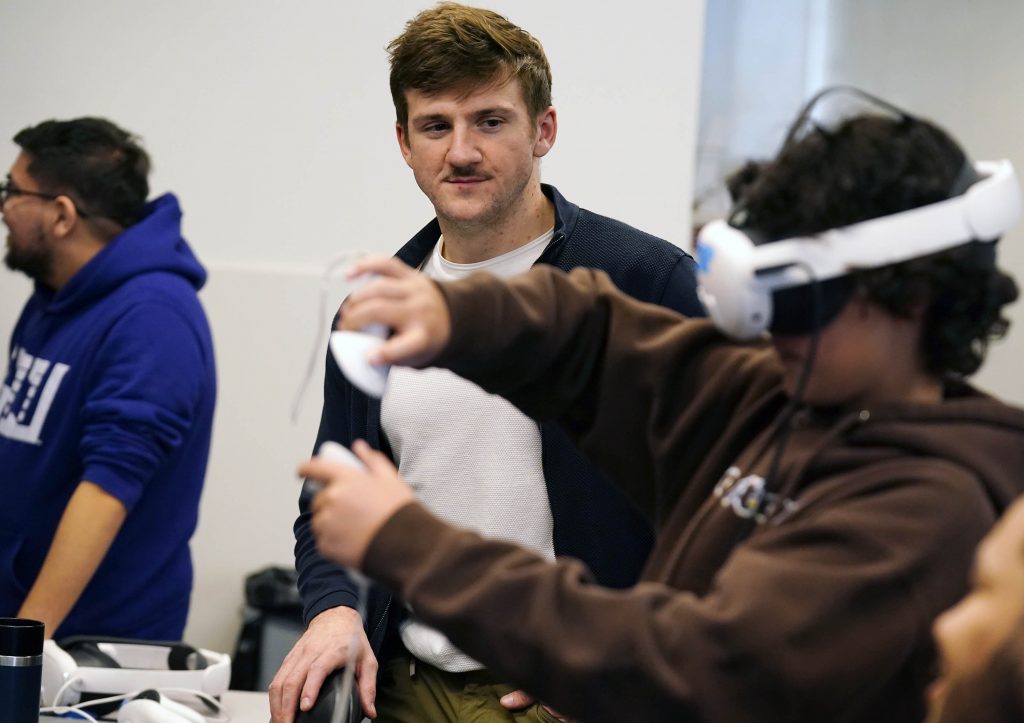
Although teams designed games based on a set list of books, “It was completely up to the team how they wanted to spin it,” he said of the creativity GCU students unleashed in the design of the games, although getting to showcase day was not an easy road.
“Just to get to that point where you have a virtual reality game, there’s a lot of stuff you have to do leading up to it,” he said. “ … Being able to move around in this virtual space, finally being able to interact with objects, having objects interact with you.”
Junior computer science major Gabriel Veltri and his team designed the game Mark of Aries, in which the gamer is whisked away to a camp of demigods to train and then seeks revenge for the death of his mother.
Veltri immediately spotted a problem as the middle school students played the game – there’s some confusion about where one of the signs in the game is directing the user to go.
“People have liked it,” he said. “But something we could have done better is made it more VR friendly.”
The biggest challenge for Veltri, like for other GCU student game designers, was working with Unity.
“Getting everything to mesh together was a lot of trial and error,” Veltri said, and fixing code took some doing. His team used ChatGPT to point out coding problems that the team addressed.
“You guys did a good job with this,” one of the Villa de Paz teachers told Veltri.
One high school student, Kyla Tucker, did more than just play the games GCU students brought to life.
The senior at Paradise Valley High School attended Artzi’s classes and worked on one of the projects, Patient Zero, alongside the university’s technology students as part of an internship. The goal of the game is to find patient zero – the first person infected with a disease – and save the world from what is now a pandemic.
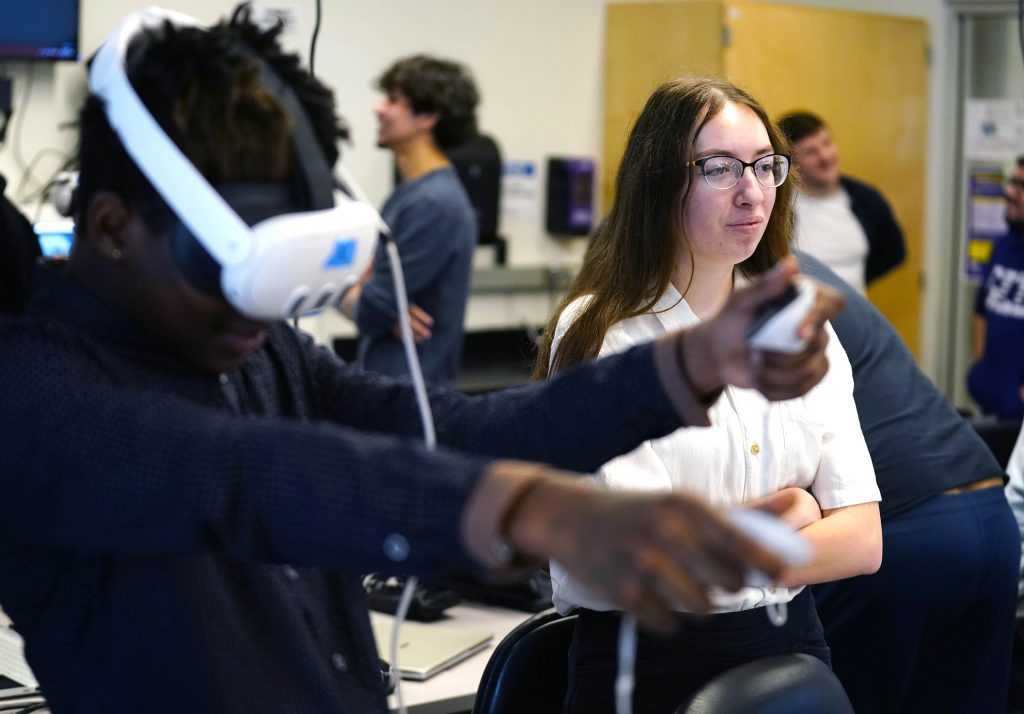
Gamers help patients, learn about the pandemic, then head to patient zero’s apartment to retrieve five items.
“It’s been really fun coming here and trying something new,” Tucker said. “I’d never done VR before.”
She and her GCU team members each were in charge of a certain scene.
“The biggest challenge for me was the VR headset wouldn’t work (with my computer),” she said, so she couldn’t test her work fully until she came to campus and could run her scene on a teammate’s computer.
Tucker, who wants to study computer science, said of the internship, “It was new and exciting.”
The best part of the GCU partnership with Villa de Paz is that the VR Showcase was just the launch event, when the K-12 students could see what’s in store for them next semester. The collaboration will ramp up in the spring, with the middle school students helping shape, develop, design and code the next projects.
“And they’ll be learning a little bit from the (GCU) students, as well,” said Pearson, who shared how increasingly challenging it is to keep up with students’ devices when it comes to occupying their time. “ … Our goal is, we want to make learning engaging for middle schoolers.”
GCU Manager of Internal Communications Lana Sweeten-Shults can be reached at [email protected].
***
Related content:
GCU News: IT, cyber capstones are on the case with forensic science projects, more
GCU News: From rock climbing to the NBA, students display their deep learning at AI event