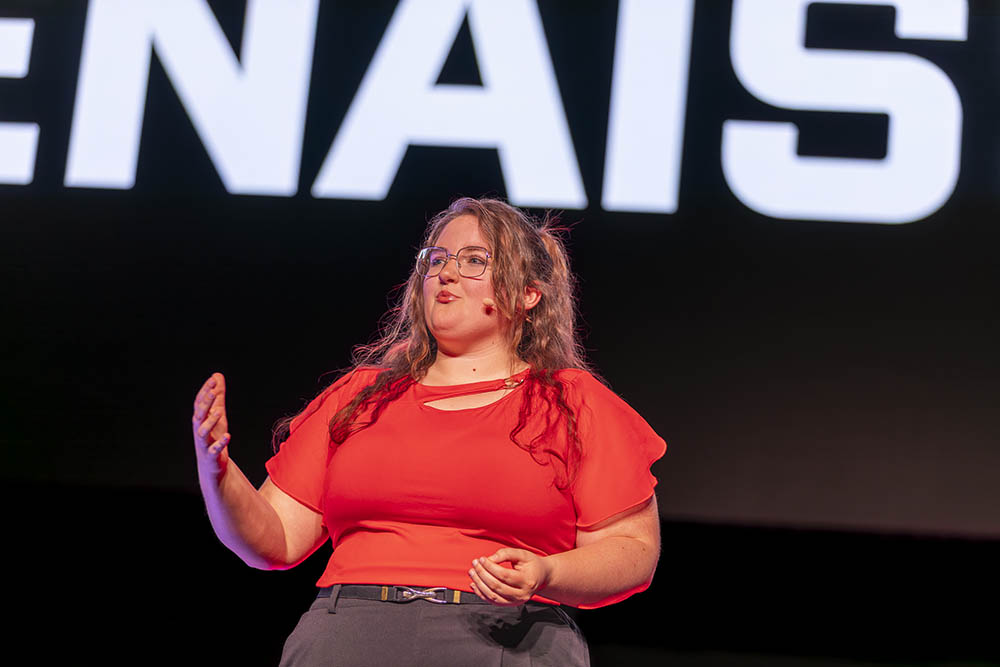
Photos by Bozhidar Evtimov / Slideshow
How do you eat an elephant?
Devin Flanagan knows.
The Grand Canyon University entrepreneurship and marketing student thought one day, “I’d like to pilot a hot air balloon.”
Then came the flurry of questions.
“Am I really up for that? How do I get there?”
She Googled. Took those first steps.
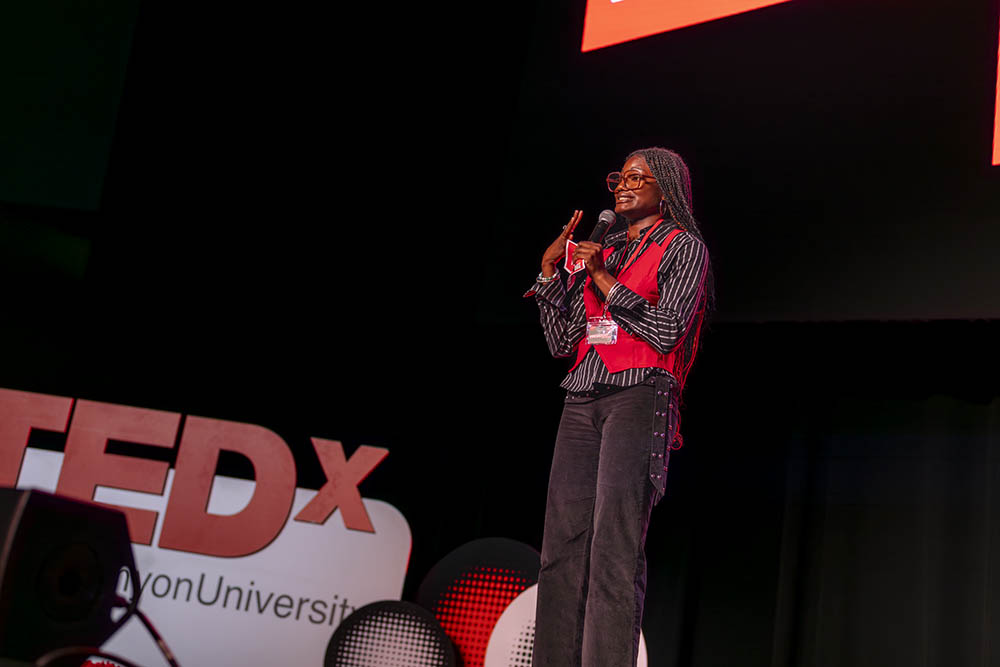
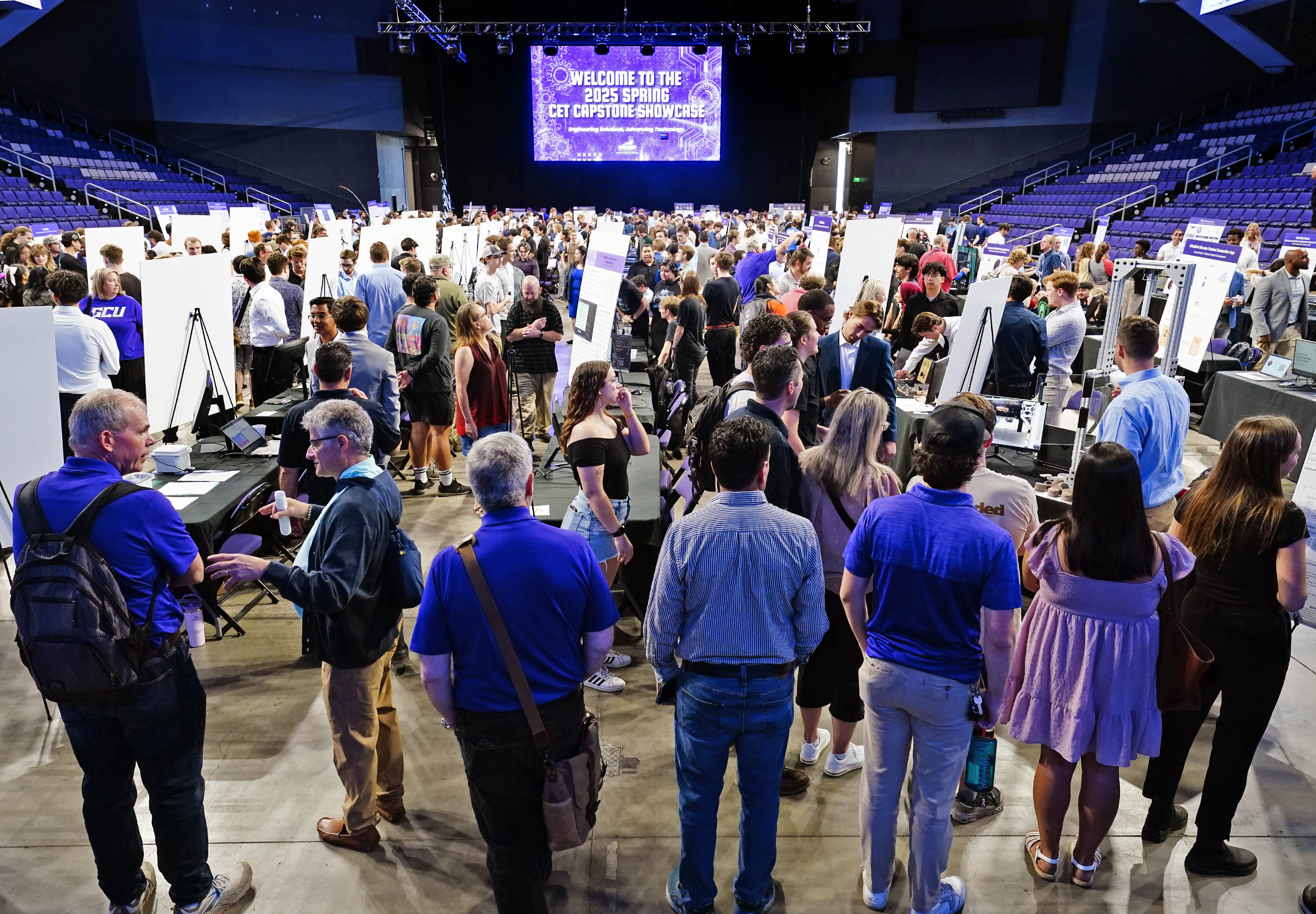
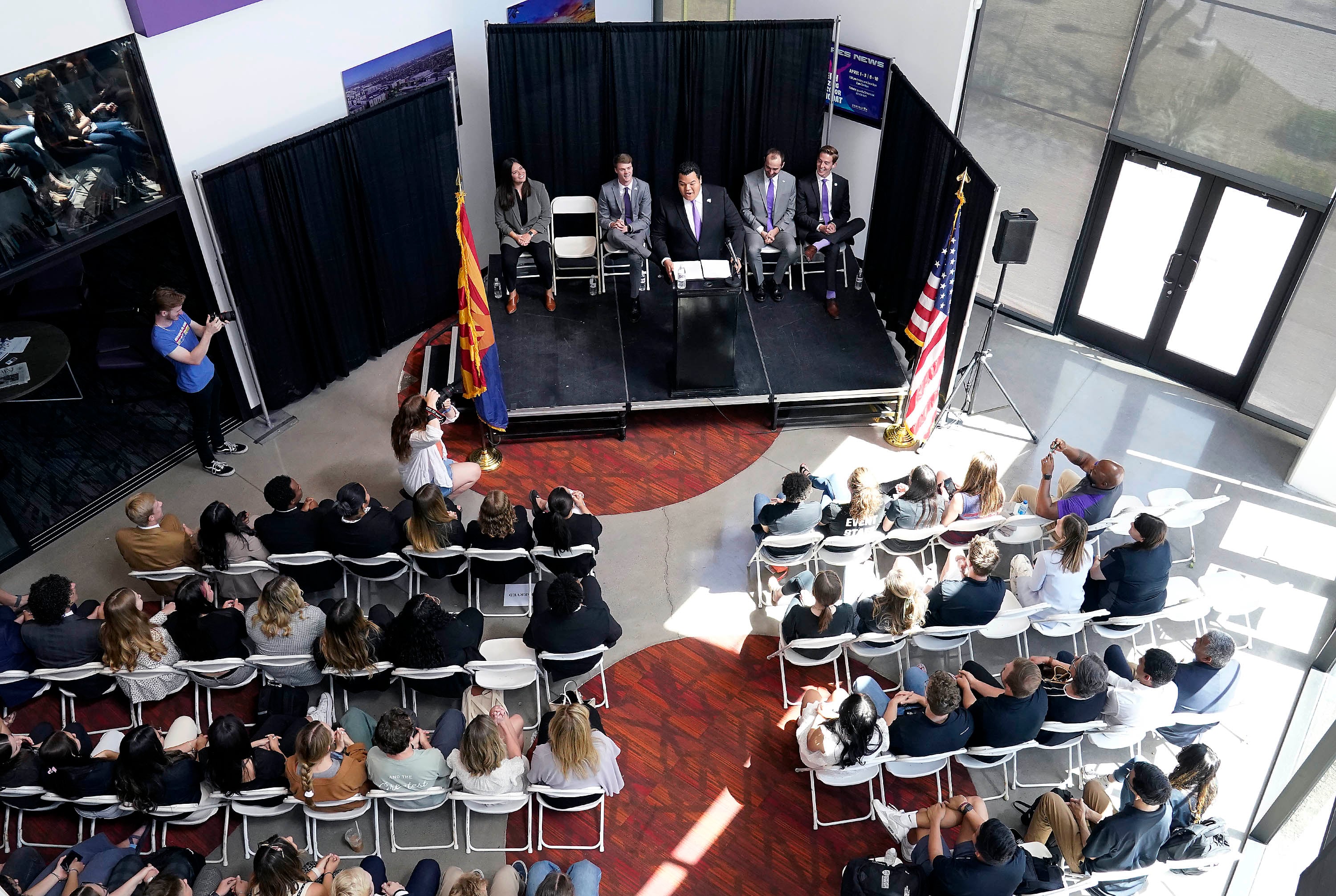
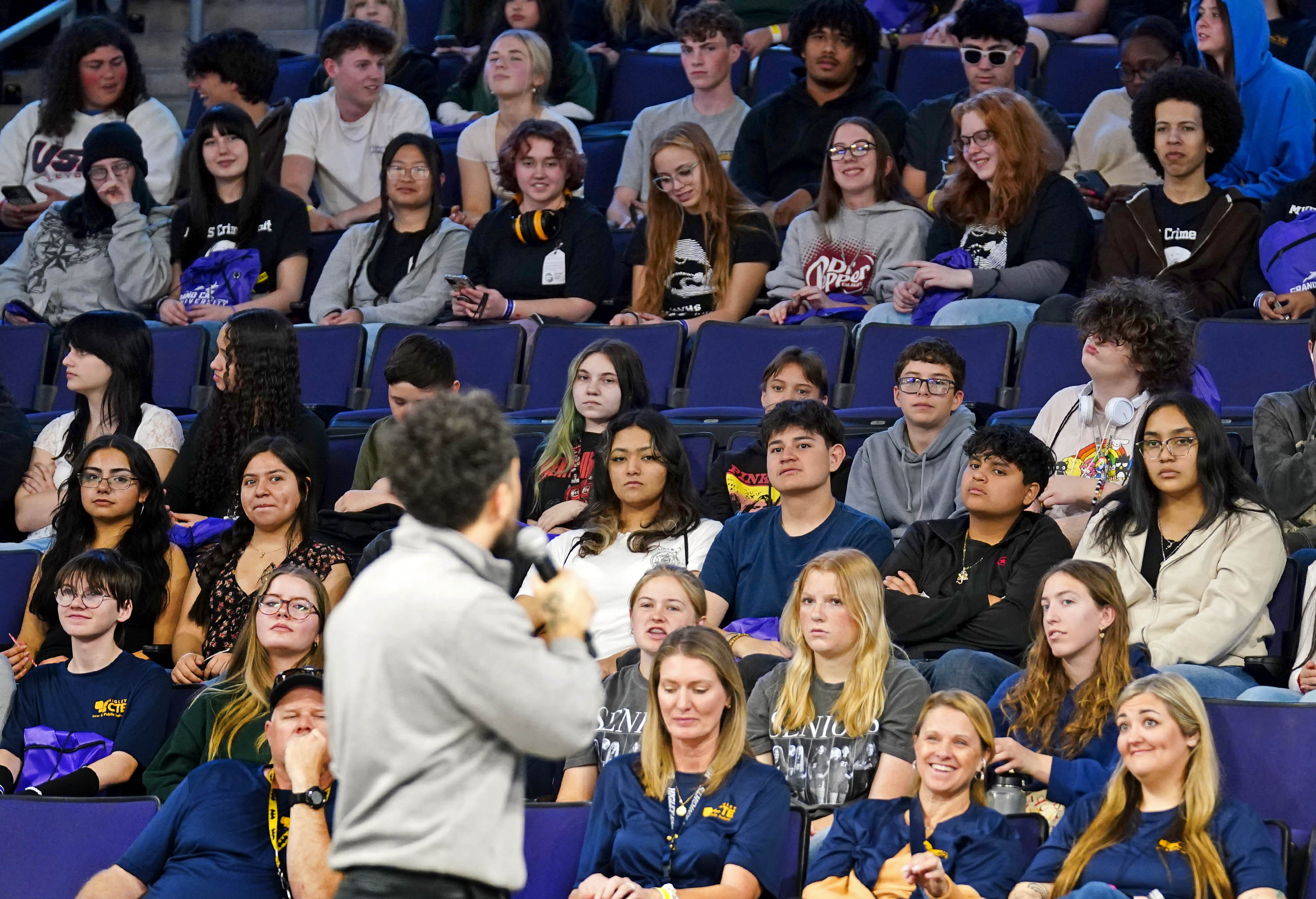
“In truth, it wasn’t that big … but from that moment on, my curiosity carried me,” she said to an audience of about 300 on Friday in Global Credit Union Arena during TEDxGCU, the annual presentation of talks designed to spark conversation and spread innovative ideas “meant to travel out with you in life,” said host Matthew Stout.
Hot air ballooning, Flanagan said, “opened the door.”
Once she took a bite out of that elephant, she took another.
She’s writing a children’s book.
“None of it was because I was an expert,” the private hot air balloon pilot said. “I asked a simple question: How?”
Flanagan talked about the importance of curiosity, even though our brains resist unfamiliar actions, according to research. Repetition, however, strengthens those pathways, much like going through a forest that’s dense and impossible to traverse at first, but over time, is easier to navigate.
“Curiosity is not a personality trait,” she said. “It’s a skill.”
She emphasized that the kind of curiosity she’s encouraging isn’t passive, the kind that scrolls to the next video, but active, which clicks and searches.
She encouraged the audience to take out their phones, think of something they’d love to do, then click search.
“Congratulations!” she exclaimed. “You gave curiosity a chance.”
How do you eat an elephant? (No elephants were harmed during her TEDx experience, she said with a smile).
“One bite at a time.”
***
TEDxGCU, themed “X: The Renaissance,” has been embracing curiosity, innovation and bold ideas for a decade now.
The nonprofit started in 2017, when professor Paul Waterman encouraged students Jedediah Woods and Austin Mosher to start the campus’s TEDx.
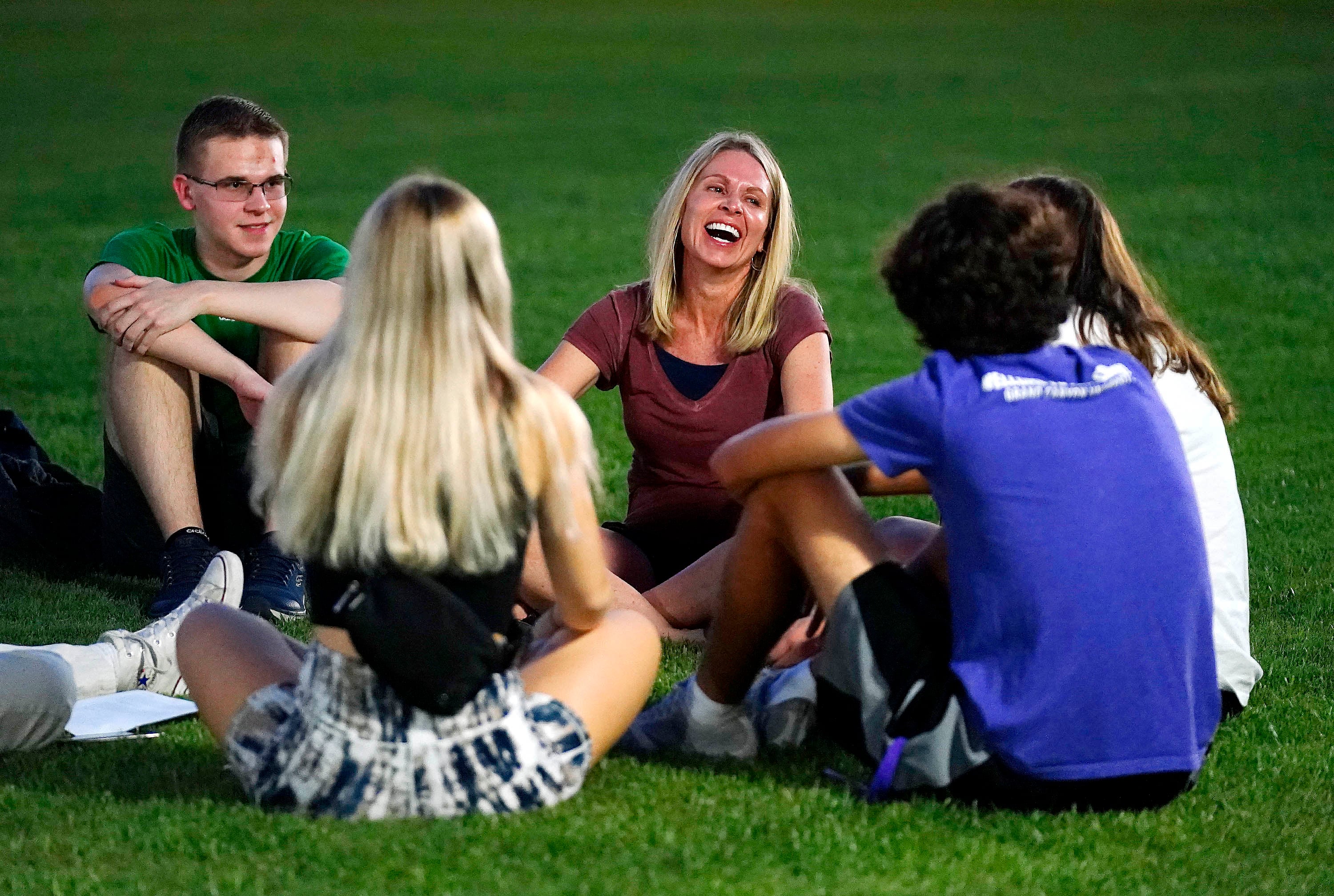
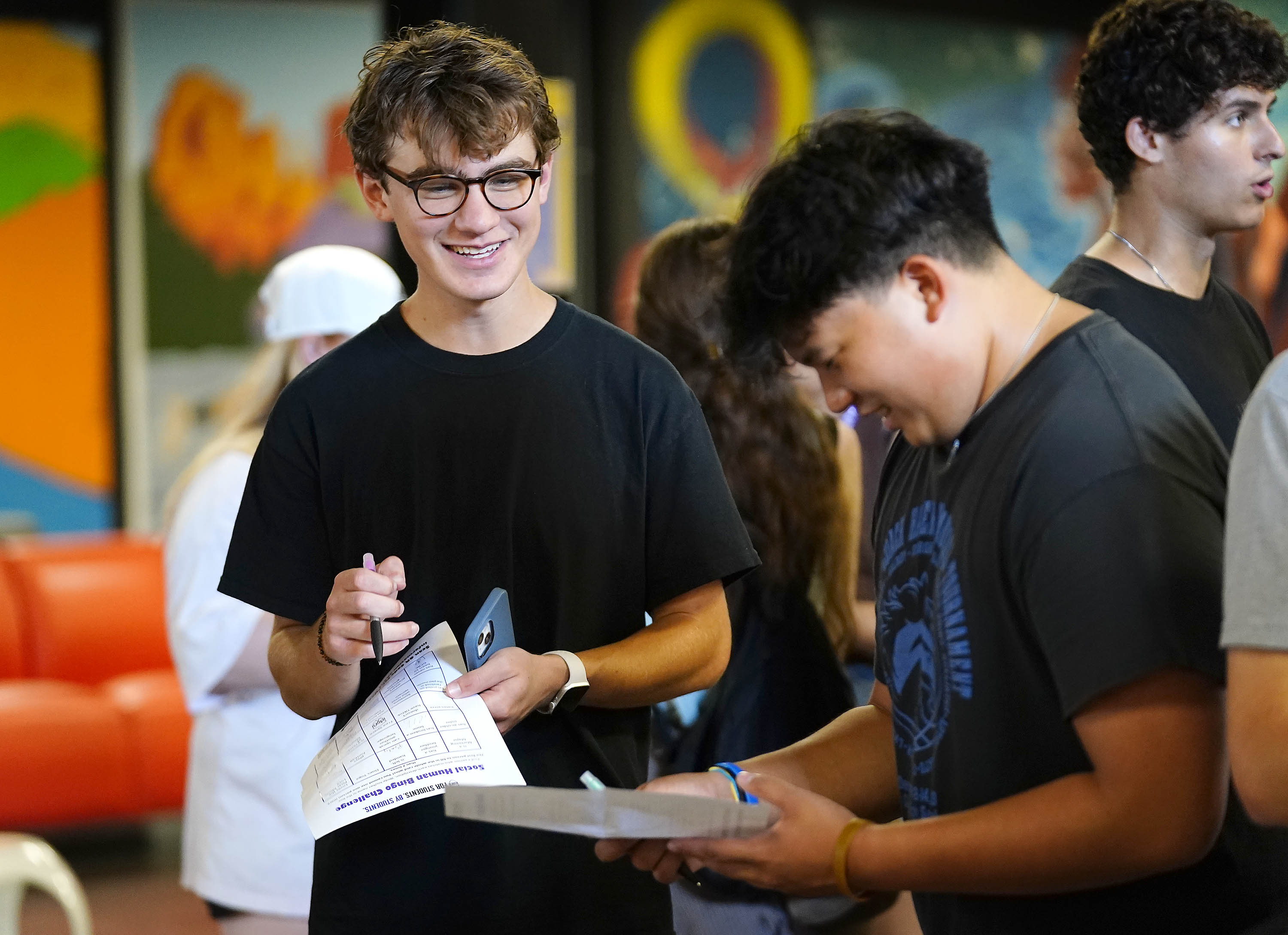
The nonprofit is unique because, unlike other TEDx events across the country, it is student-run, with a team of 52 students this year bringing it to fruition.
Over that decade, the group has sold 10,000 tickets and raised more than $115,000, said Jack Edlin, vice president of operations.

“Being able to manage all this and hold it in the arena is such an amazing opportunity,” said Edlin.
What amazes him beyond that is that the presentations live beyond one night.
“All the speeches are posted on YouTube and have millions of views,” he said.
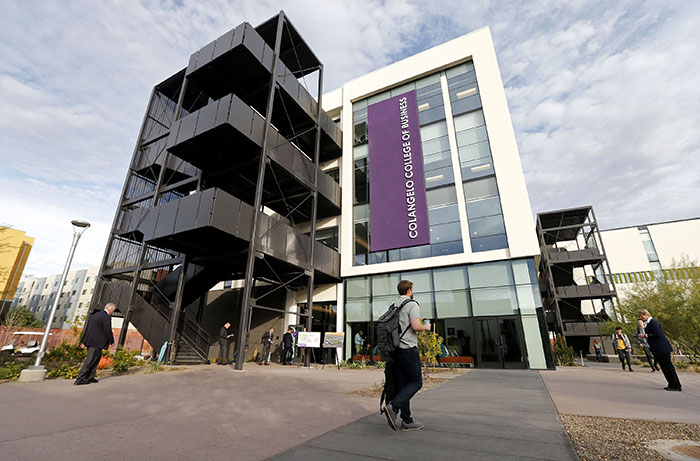
He also loves that the best students from finance, production, marketing and other disciplines make the magic happen. “It’s not just the (Colangelo College of Business) … It’s the best from every part of GCU who come together in one room and formulate something special.”
TEDxGCU President Madison Land said the best part of the experience for her has been “seeing my peers with such drive and passion. … It has inspired me to do the same thing.”
For the 10th anniversary, the team paid tribute to past years, with each of the evening’s eight speakers tailoring their talk to a past TEDx theme.
***
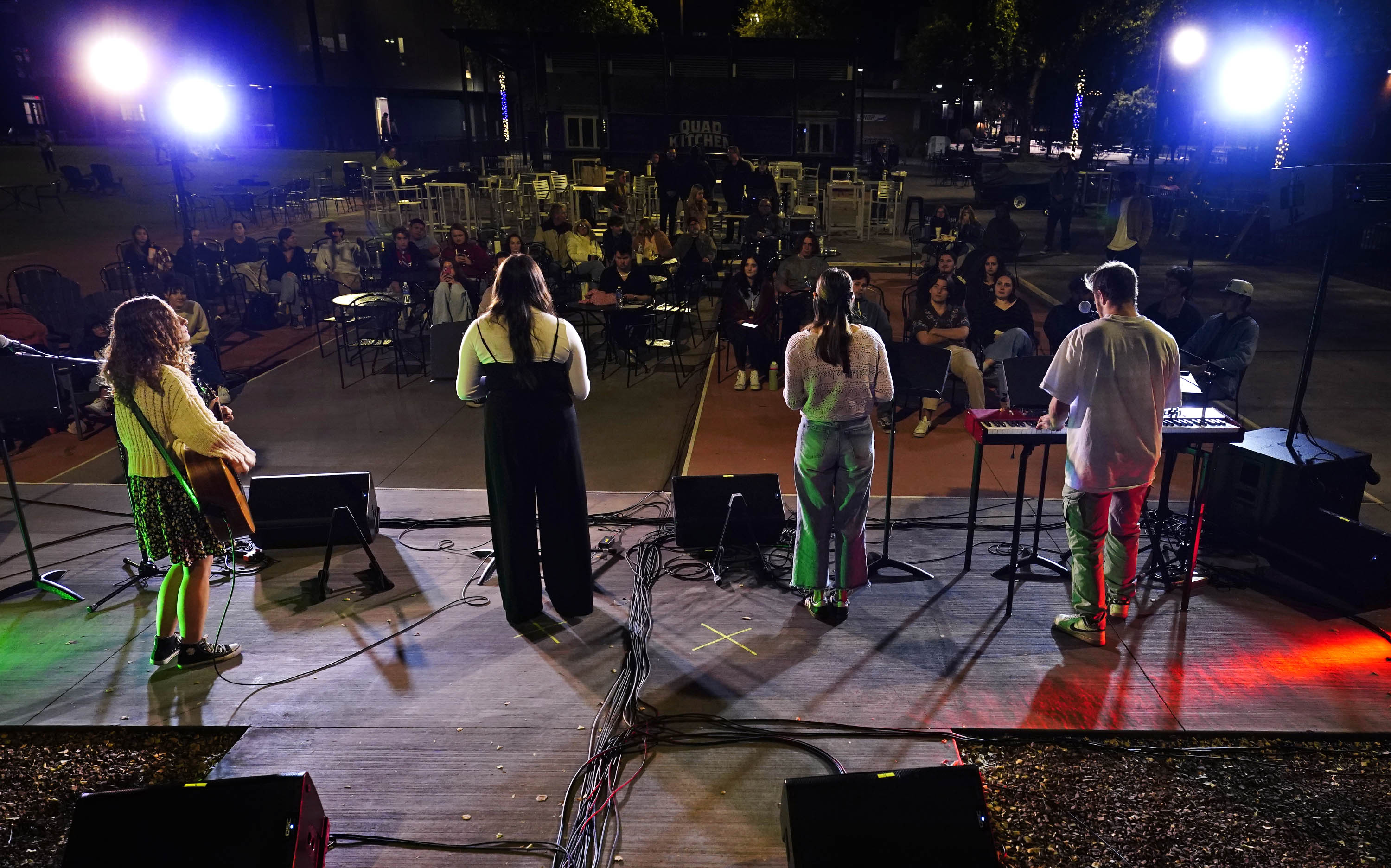
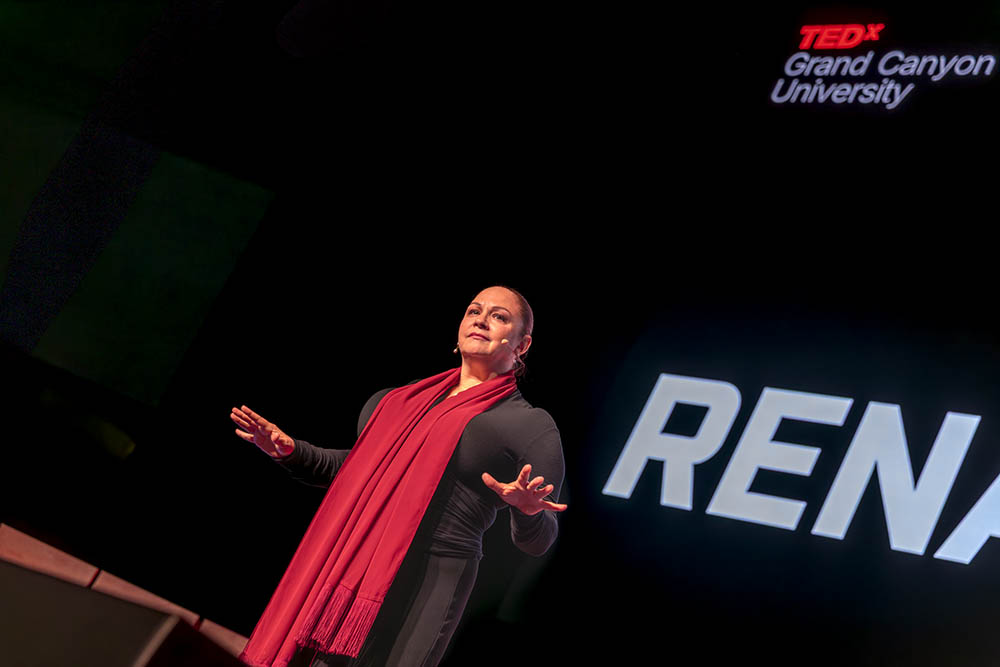
Themes like “Magnum Opus,” from TEDxGCU year two, embodied by flamenco dancer Julia Chacón. She shared how the artform connects people, while a guitarist and fellow dancer performed behind her.
Chacón remembered as a girl first watching a private flamenco lesson.
She had never seen something so expressive and … “fierce.”
It became more so when she saw the dancer’s mother translating the instructor’s corrections into sign language because the dancer was deaf.
“In that moment, my world shifted,” Chacón said. Flamenco had transcended sound, as the dancer transmitted emotion through rhythm and vibration.
After studying flamenco at the University of New Mexico, she spent time in Triana, a onetime Romani neighborhood in Spain legendary for producing flamenco artists.
But Triana wasn’t what it once was.
Families had been displaced in the 1960s and relocated to housing projects.
The culture – Arabic, Andalucian, Romani, Jewish and African, characterized as “undesirable by the dominant powers of their day” – was being lost.
That displacement stemmed back to the Inquisition, from the late 1400s to 1834. Chacón saw parallels between that time in Spain and in America. In 1834 alone, the U.S. relocated Native Americans during the Trail of Tears.
“It made the resistance of flamenco incredibly tangible to me,” she said.
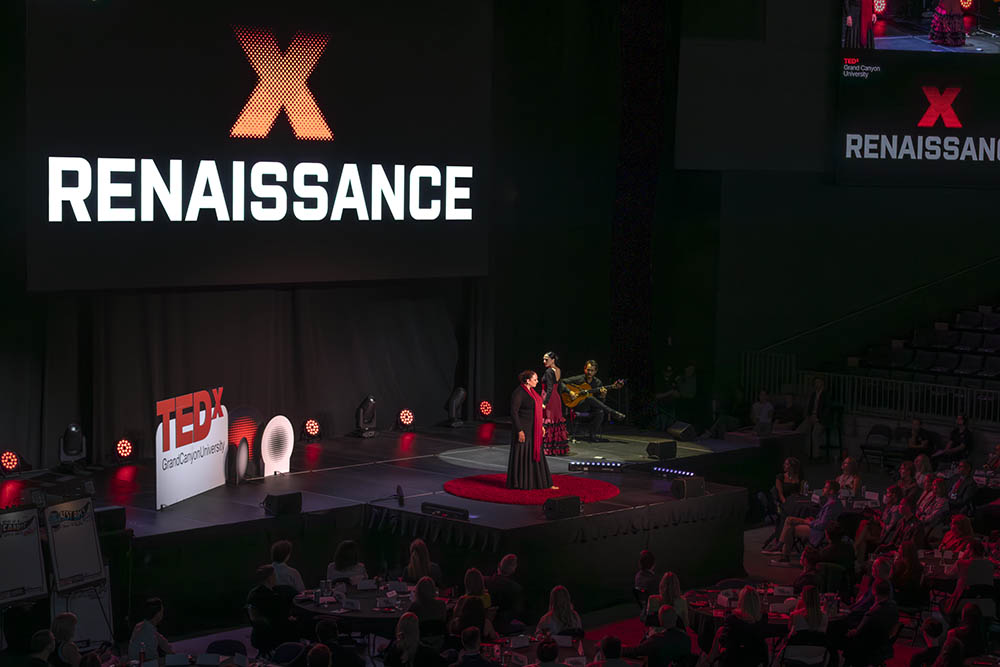
That trip wasn’t just about learning technique but about understanding flamenco as artistic resilience against centuries of generational struggle.
The beauty of flamenco as resistance, she said, is that it defies the norm – a norm that dictated who is accepted and who isn’t. Instead, flamenco builds bridges, she said, and recalled her time as a teacher in a community where established families resented newly arrived Spanish-speaking families.
Fights broke out daily among the students she taught. But by the end of the week, they were dancing together.
“Flamenco helped me to understand that complexity and entanglement is not something to resolve but is something to inhabit,” Chacón said. “… Contradictory histories can co-exist because complexity … is an opportunity for cultures to collide and create beauty.”
***
Hammad Abid, a fifth-generation textile designer descended from a weaving community in India, asked: “What if a fabric could hold a memory?”
Abid remembers the sounds of the looms clicking and clacking while growing up in his family’s textile mill.
“I watched artisans work for hours to weave a single yard of fabric. I saw the patience it required; the precision in every step, from spinning to dyeing to weaving.”
That informed him as an artist, as did his family’s story of displacement.
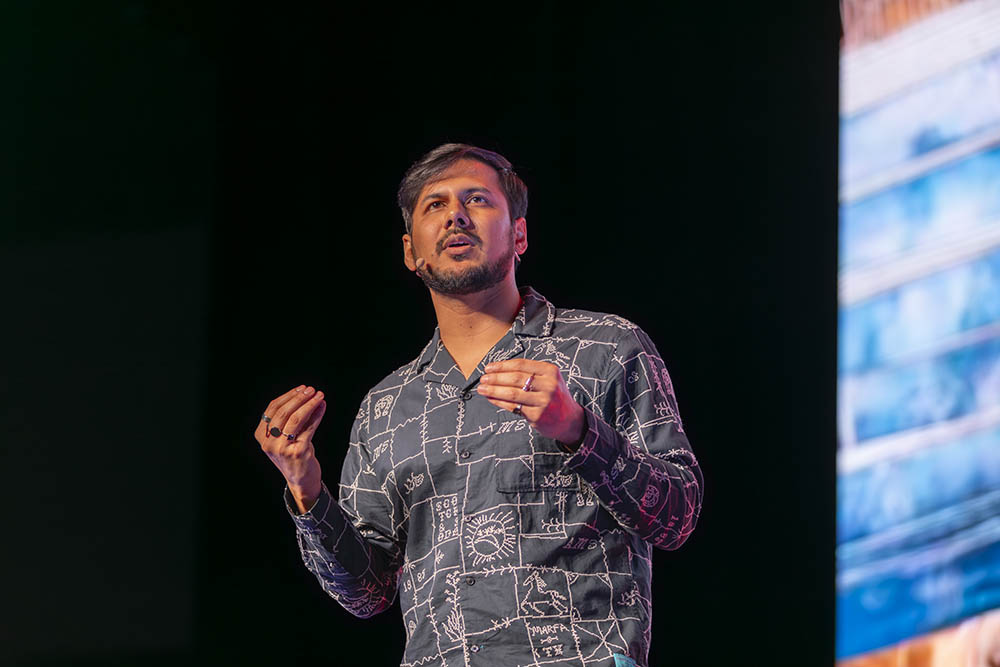
Abid has explored material, emotional and structural memory through his work, like in “Tracing Lineage,” which focused on material memory and spoke of his family’s migration from Pakistan in 1947.
Abid wove together five layers of different materials with the idea that, in time, threads would break. The artwork resembles a landscape, with the broken threads representing the transformation of the land because of mass migration.
“Fabric behaves just like memory does: conditional, layered and shaped by time,” he said.
There’s also emotional memory, “We all have clothes in our wardrobe we don’t want to throw away,” he said.
In “Glitched Recollection,” he forced a loom to glitch as it weaved. Each glitch represents memories that try to fit together but can’t. Abid sees emotional memory as something imperfect, blurred and glitchy.
And he addressed structural memory in “Architecture of Tangible Memory.” These pieces are made of soft and hard material, like plywood and wool, that would bend and become 3D once off the loom.

In Abid’s family, “We didn’t just ask how a fabric looked like. We asked how it behaved. … Every thread has a purpose … every mistake leaves a trace.”
Memory doesn’t just live in the mind, he said. Like in weaving, it lives in structure, in repetition, “in doing something again and again until it holds.”
Abid learned that the language he uses to talk about fabric – repetition, structure, break, release – are not just weaving terms, they’re human terms.
And he learned that creating comes from tension, curiosity and slowing down to see what’s in front of us. “When we design with intention instead of urgency, we create things … that mean something.”
***
Chelsie Baham, who won “Big Brother” in 2024, spoke about “The Hidden Skill that Separates Winners From Watchers.”
She spoke of the pressure she felt on the show, where she had to make hundreds of micro decisions. But you don’t need to be on national television to feel pressure; at some point in our lives, it will show up.
“Unfortunately, people will crumble under pressure,” she said, and there are moments where it decides for us, particularly if you don’t know who you are.

“Pressure didn’t decide who I wanted to be but revealed who I already was,” Baham said of how pressure doesn’t just build character but reveals it.
Although we can’t eliminate pressure altogether, we can master it through:
- The Power of Pause. Pressure tells us we have to respond immediately, but pausing can reduce emotional reactivity. “Silence in certain situations was the most powerful move I could make. That pause creates space to think.”
- Turning Feedback into Fuel. In the Big Brother House, criticism came fast. “Ask yourself, is this just noise, or if it’s truth, what can I do about it?”
- Value vision over validation. "Ask yourself, who are you? What values guide your decisions when no one is clapping?"
Baham shared there will be times when the nerves come, but “when the butterflies show up, don’t fight them. Teach them how to fly in formation.”
***
Other speakers included:
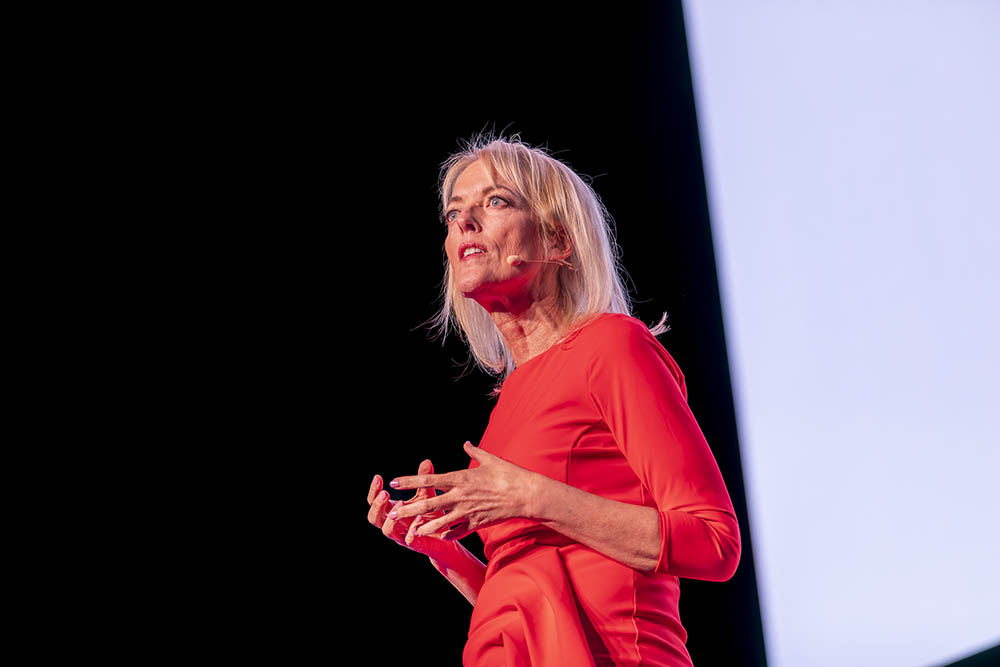
— Executive leadership coach Diane Scott, who spoke about the best bosses. In surveying more than 1,000 people, the best bosses were the ones who helped others see what they were capable of and “believed in me before I believed in myself.”
— Dr. Nikola Markoski, a pharmacist and health care supply chain executive, emphasized the hidden fragility of the drug supply chain. Shortages continue to happen because of simple events. But drug shortages don’t have to be a surprise, he said. We can see stresses before it breaks. His question: “How do we start designing a system that holds under pressure?”
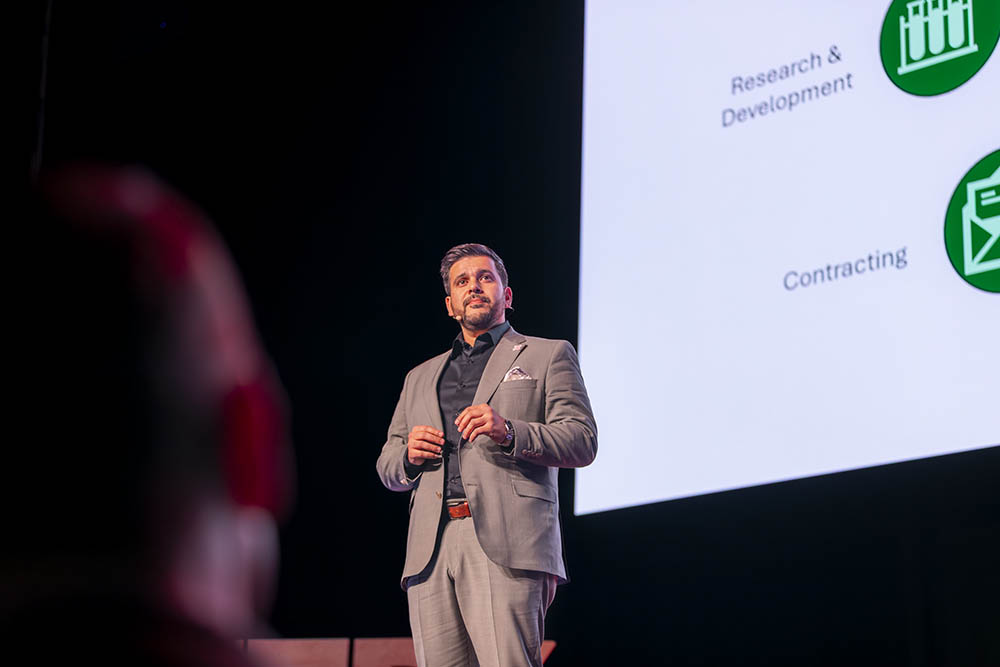
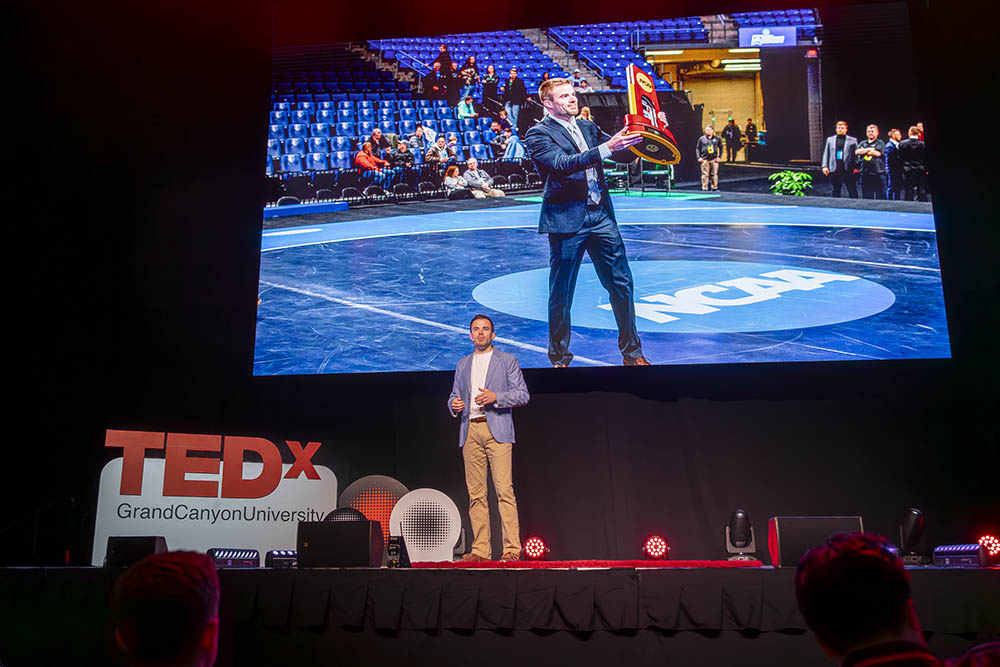
— Dalton Jensen, a three-time NCAA championship coach who is head wrestling coach at the University of Nebraska at Kearney, spoke on “Expectation vs. Reality: The Human Desire for Contentment.” He said there’s often a gap between reality and expectation. Closing that gap is how we reach contentment. He emphasized understanding the root of the goals we set, not getting lost in the moment and, after those big achievements, taking time to reflect and learn.
— Dr. Tonya Stafford, founder of It’s Going to Be OK, a nonprofit advocating for better care for survivors of human trafficking. “Human trafficking is not rare,” she said. “What you do next is rare. Each and every one of you in this room can do something. You can believe in a victim. You can invest in a victim. You can also know that, if you save one, you save a generation.”