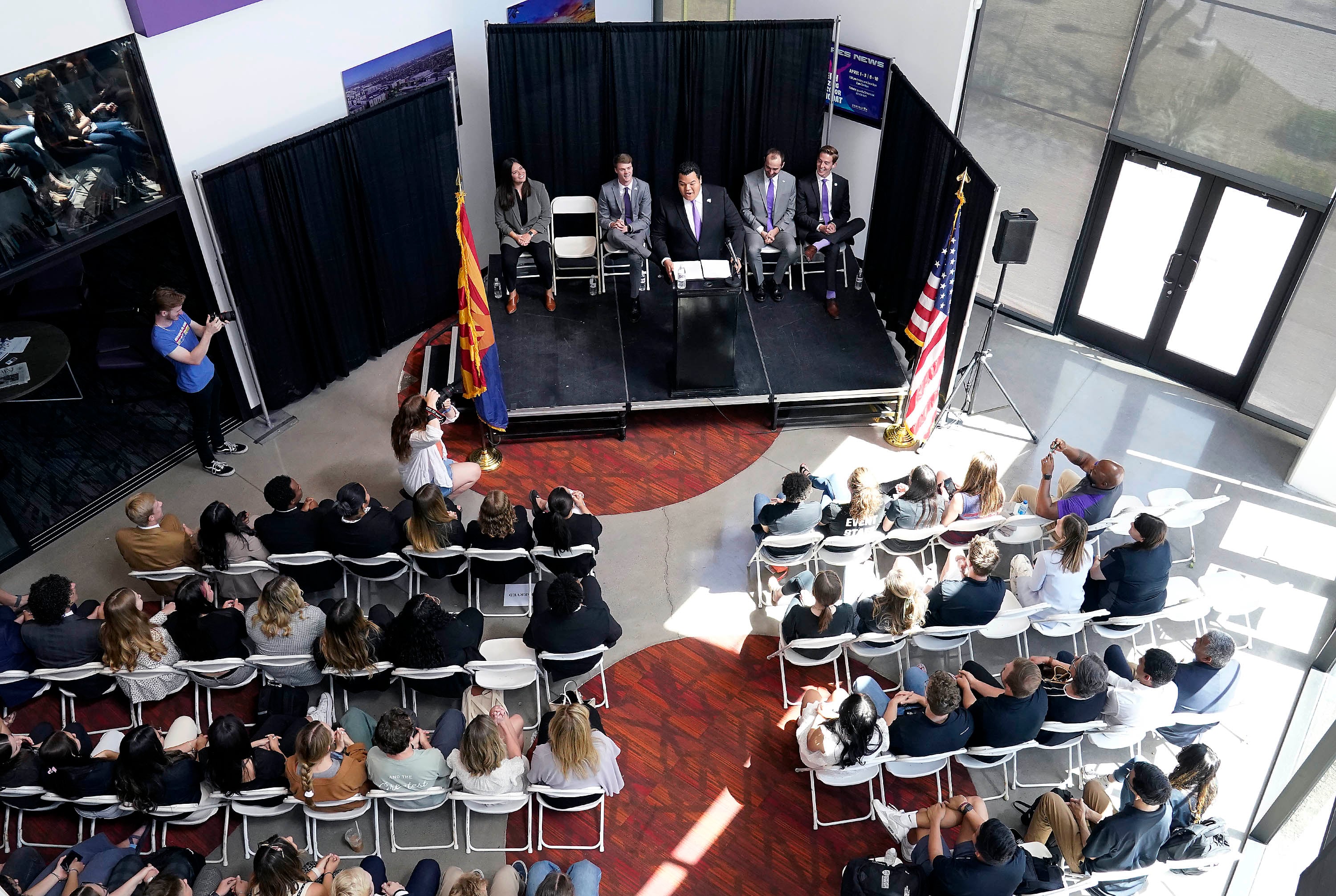
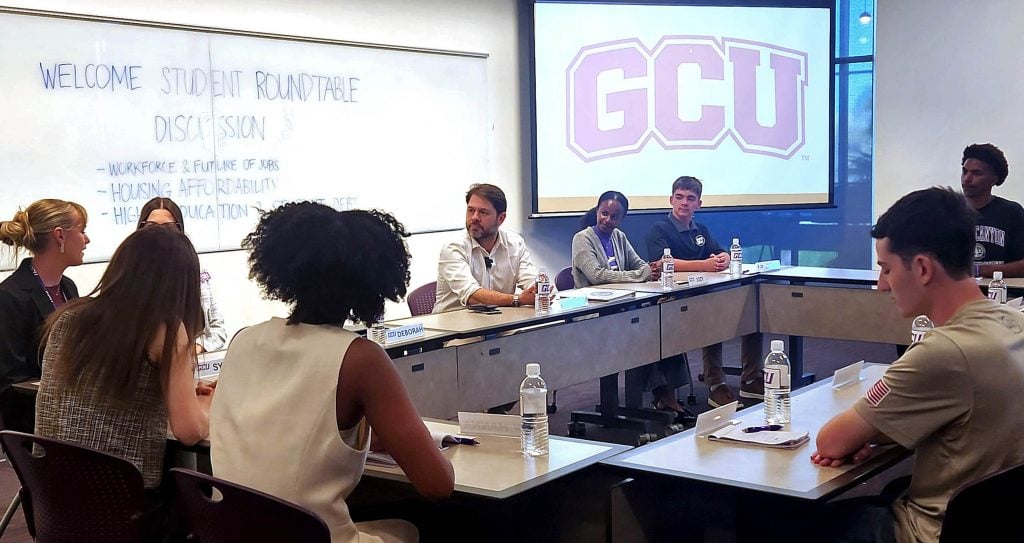
Deborah Costea never imagined she would be moderating a topical discussion between a U.S. senator and a panel of college students fully engaged in current events and how those issues might play into their future.
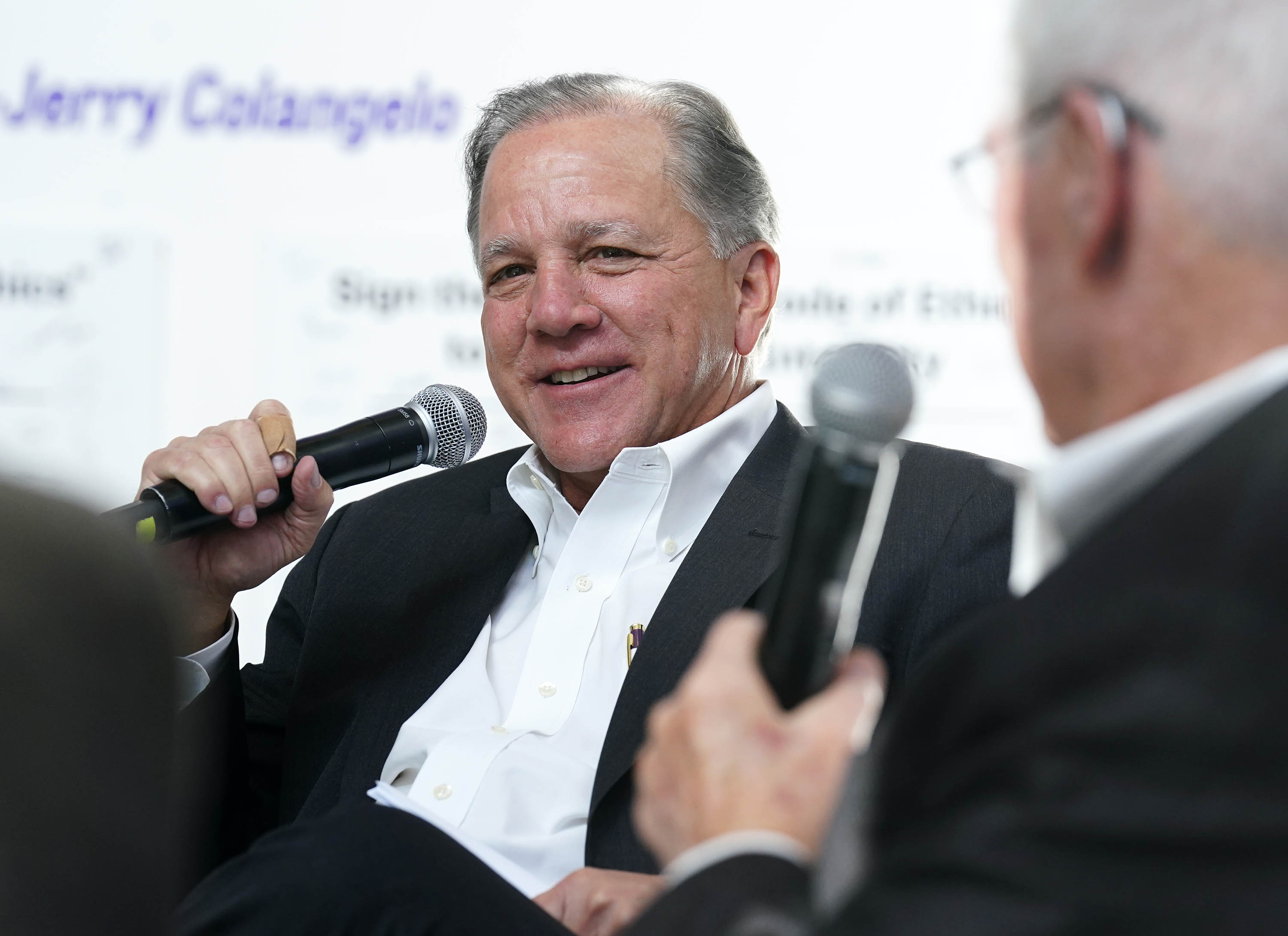
But the Grand Canyon University student did just that on Wednesday while seated next to Sen. Ruben Gallego (D-Ariz.) at an event that she, in large part, made happen.
For an hour, students articulated questions about housing affordability, student debt and the pressure of artificial intelligence on the job market.
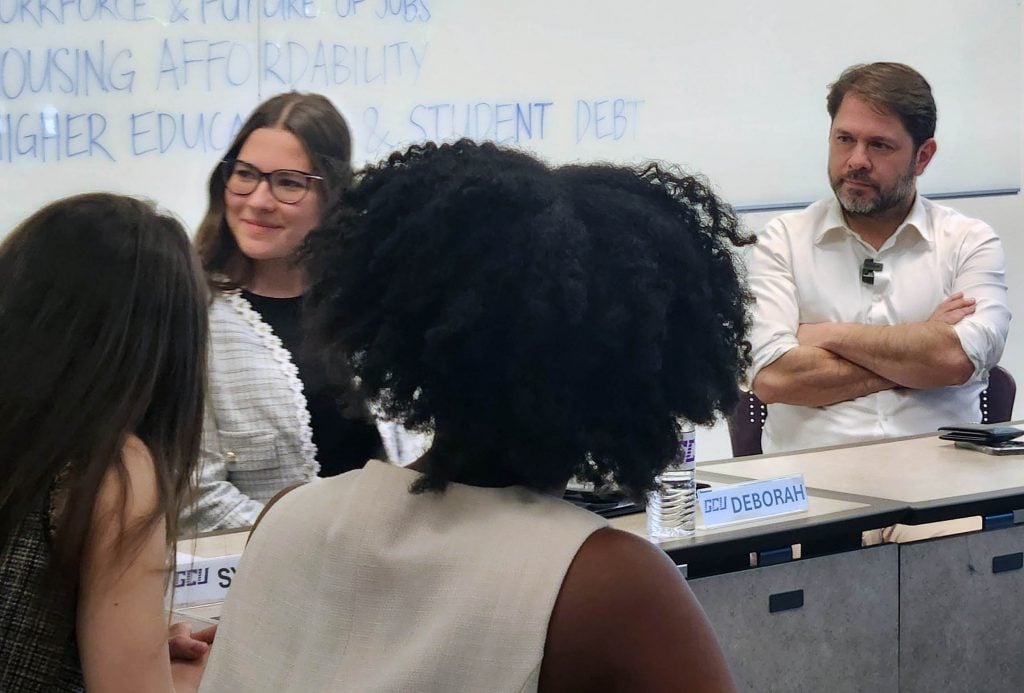
“Deep questions,” Gallego said.
Costea, who served as a legislative intern at the Arizona House of Representatives in 2025, met Gallego’s wife, Sydney, at an event. Costea mentioned to her that she’d love if the senator spoke at GCU.
Then came a flurry of emails to Gallego’s team.
Costea’s criminal justice professor, Quianna Brown, reached out to fellow professors to recommend students for a roundtable with Gallego – students with strong voices and perspectives. They researched what they wanted to ask, met to discuss their research, came up with topics that resonated with them and crafted questions for Gallego.
They wanted to focus on issues that really mattered to them, Brown said, like how buying a house – or even renting an apartment – is out of their reach.
“I’ve been looking for an apartment in Avondale, Scottsdale, Tempe, and they’ve all been fairly high – and I’m also a student paying tuition … and that’s pretty much like paying rent,” said Joshua Scott, a sociology student with a focus on public administration who can’t find rent much lower than $1,700 and $1,800 a month for a two-bedroom unit.
Danny Garcia, a freshman studying criminal justice, knows about the housing market more than the average college student.
His immigrant family buys abandoned houses and refurbishes them, but “materials cost a lot now,” he said, and these days it isn’t unusual for a five-bedroom house to cost more than half a million dollars.
“It was an illusion for me,” Garcia said. “But I thought I was going to buy my first house at 25. … I don’t think that’s going to happen.”
Business administration senior Peyton Yarbrough will be going home to California after graduating from GCU: “My concern is, for Americans like me, stuck in places like California, where things are so expensive and there are so many regulations, how effective will these federal legislations be?” he asked of the ROAD to Housing Act and attempts to deregulate the housing market.
It was an illusion for me. But I thought I was going to buy my first house at 25. ... I don't think that's going to happen."
Danny Garcia, criminal justice freshman
The bipartisan 21st Century ROAD to Housing Act, which is aimed at improving housing affordability, seeks to boost the housing supply by cutting regulatory red tape that delays construction. Its goal is also to restrict large institutional investors – companies that rent out the hundreds of homes they’ve bought – from dominating the single-family home market.
The median cost of an existing home in the U.S. in Oct. 2025 was $415,000, according to Yahoo Finance. That cost is unaffordable to many and is driven in part by a housing shortage. Estimates of the U.S. deficit in houses is 4.7 million units, relates a Zillow analysis from 2025. And the National Association of REALTORS last year noted that the typical age of first-time homebuyers is 40 years old.
Gallego, a supporter and author of the ROAD Act and sensible deregulation, said rents are coming down “because we’re putting more supply on the market, but we may not be able to catch up.”
He spoke of other challenges affecting housing affordability: the cost of construction supplies increasing with tariff increases, and workers in the housing industry upscaling to work in other industries, such as at the Taiwan Semiconductor Manufacturing Co., which recently opened a $65 billion, multifab semiconductor complex in Phoenix.
Gallego said he’s working on a bill to help create a 1% down payment loan payment program for a federally backed loan reminiscent of the low-interest VA home loans that powered the post-World War II housing boom and created generational wealth.
Back then, Americans bought two-bedroom starter homes and built on that.
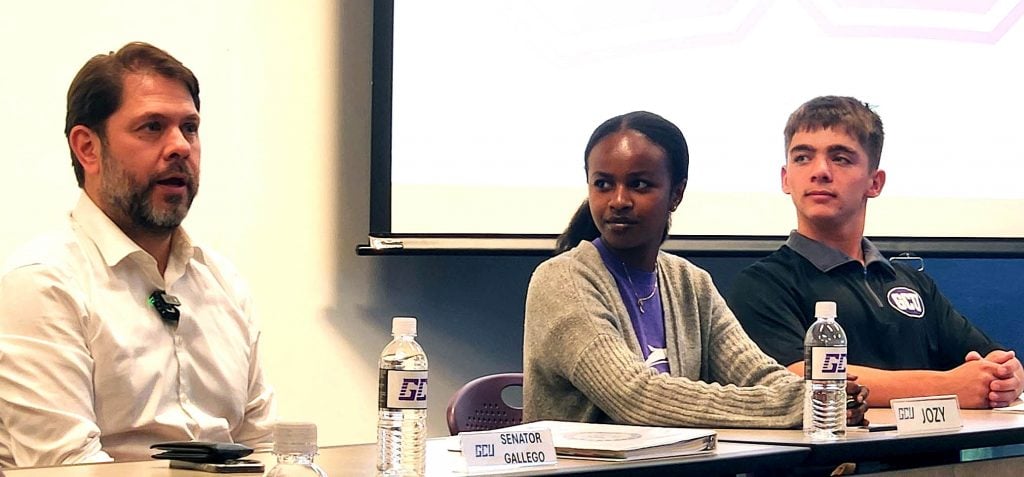
“We need to get back to the concept of the starter home,” Gallego said.
With those low percentage home loans, “What we think is, that will actually create demand for both starter houses, which is what we really need, and, number 2, for people who can afford it, to go get that five-bedroom house.”
Prelaw sophomore Makayla Rosscup spoke about how her mom, who served in the military and went to nursing school, is still paying off her college debts after more than a decade.
“Higher education, it seems necessary to succeed, but there’s a lot of financial uncertainty that comes with it,” Rosscup said. “… How do you think policy should balance keeping higher education accessible while making sure students aren’t taking on debt without a clear path or understanding to repayment and long-term stability?”
Sydney Whittall, who’s in her final year at GCU and plans to become an attorney, shared her story. She lives off campus and, to afford rent and school, works two jobs – 60 hours a week – while being a full-time student.
“It’s a lot,” Whittall said, “but I’m kind of barely scraping by. It’s very difficult, and it’s a little disheartening to know that that’s what my future is going to look like.”
And forensic psychology senior Hannah Hayes, whose minor is prelaw, expressed her concerns about AI taking entry-level jobs.
Gallego said he has heard talk of a 32-hour work week being a possibility, if A.I. is truly making us more efficient.
“And I’m going to give you something that’s going to blow your mind. There are going to be hundreds of one- to two-person companies, billion-dollar companies, because A.I. is going to help scale so much.”
Gallego said, despite all the challenges, “Even through all those ups and downs, people who have college degrees have always consistently ended up being on the upper side of the middle class.”
That wasn’t the only positive for Costea, the student who was the force behind the roundtable and praised all the long hours students put into it: “It was a top-tier experience.”
Manager of internal communications Lana Sweeten-Shults can be reached at [email protected].