Photos by Ralph Freso / Slideshow
Imagine you’re a freshman. It’s the first day of class at your new school, Grand Canyon University. You’re far from home. You don’t quite know where everything is. To be honest, you’re super lost.
Then you see a robot donning a GCU purple T-shirt, and you do it: “Hey, I’m looking for Building 57.” And, bam!
The robot gives you directions, and you’re on your way.
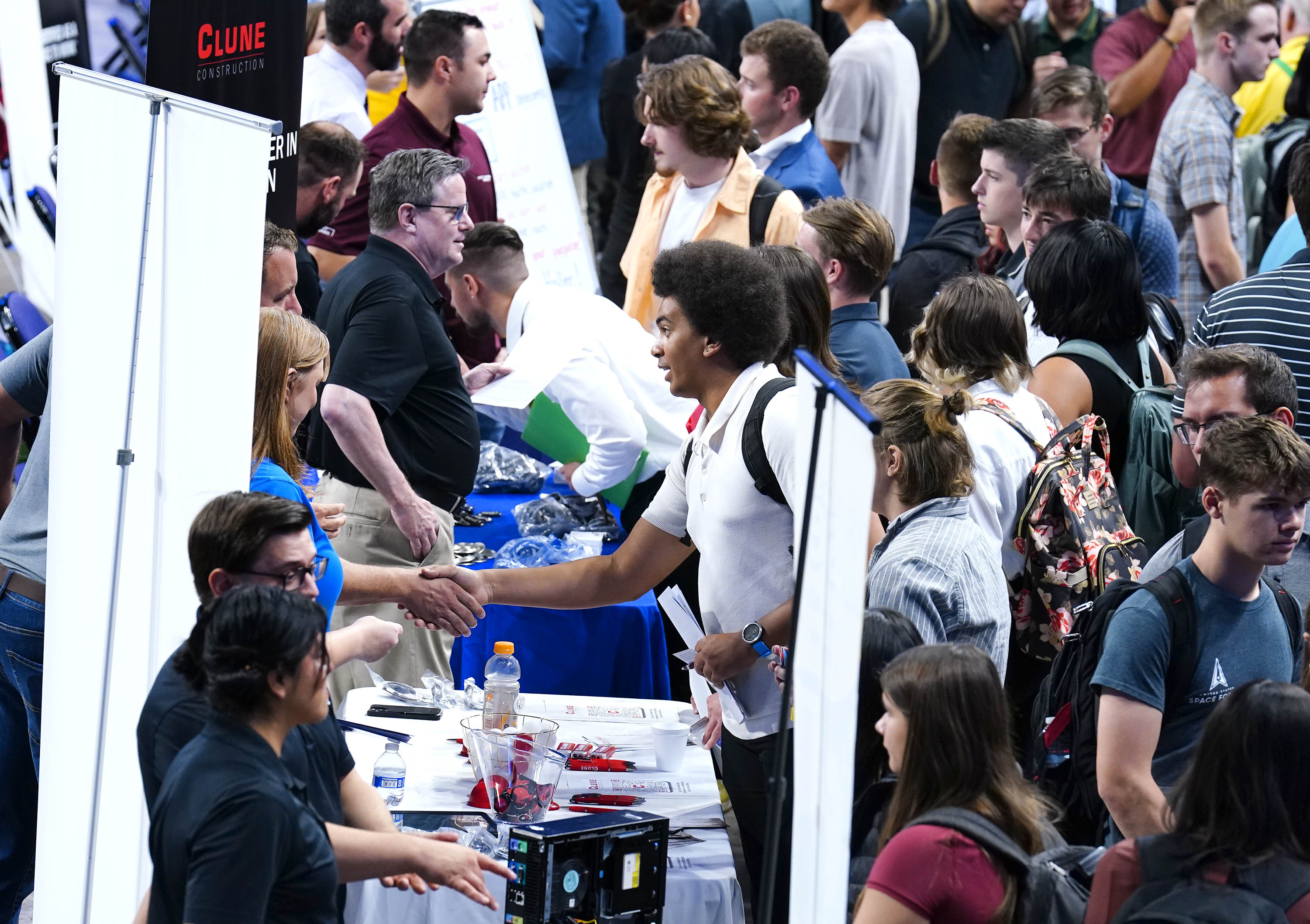
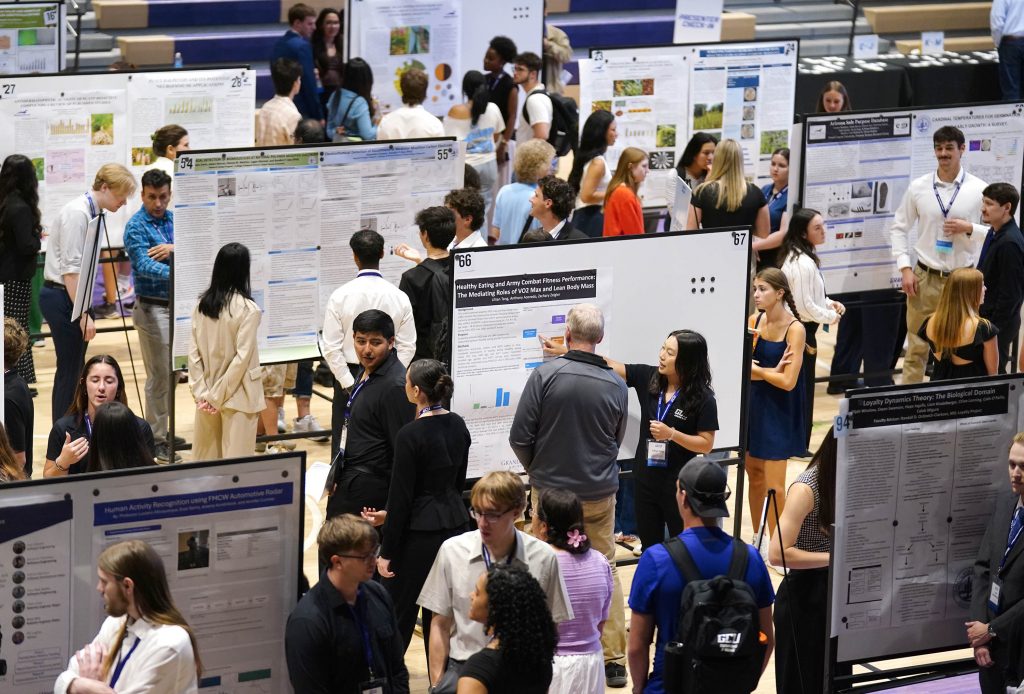
That’s the idea for Project Follow Me, one of more than 110 poster presentations packing the floor of Antelope Gymnasium on Monday whose wide swath covered everything from microbiology and cancer research projects to chemistry, forensic science, engineering and technology, and organismal biology.
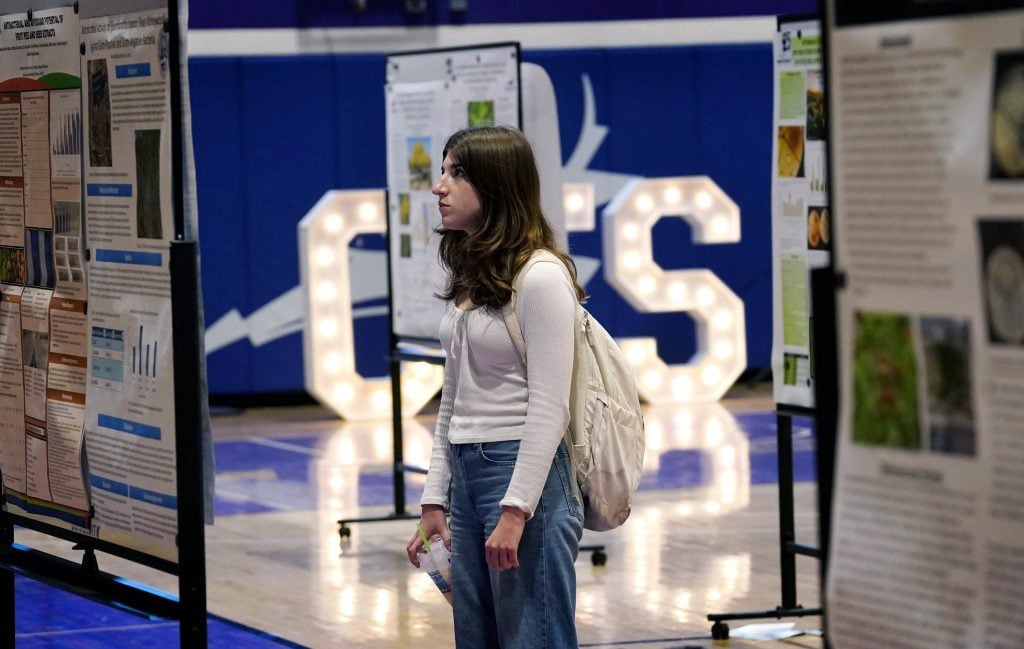
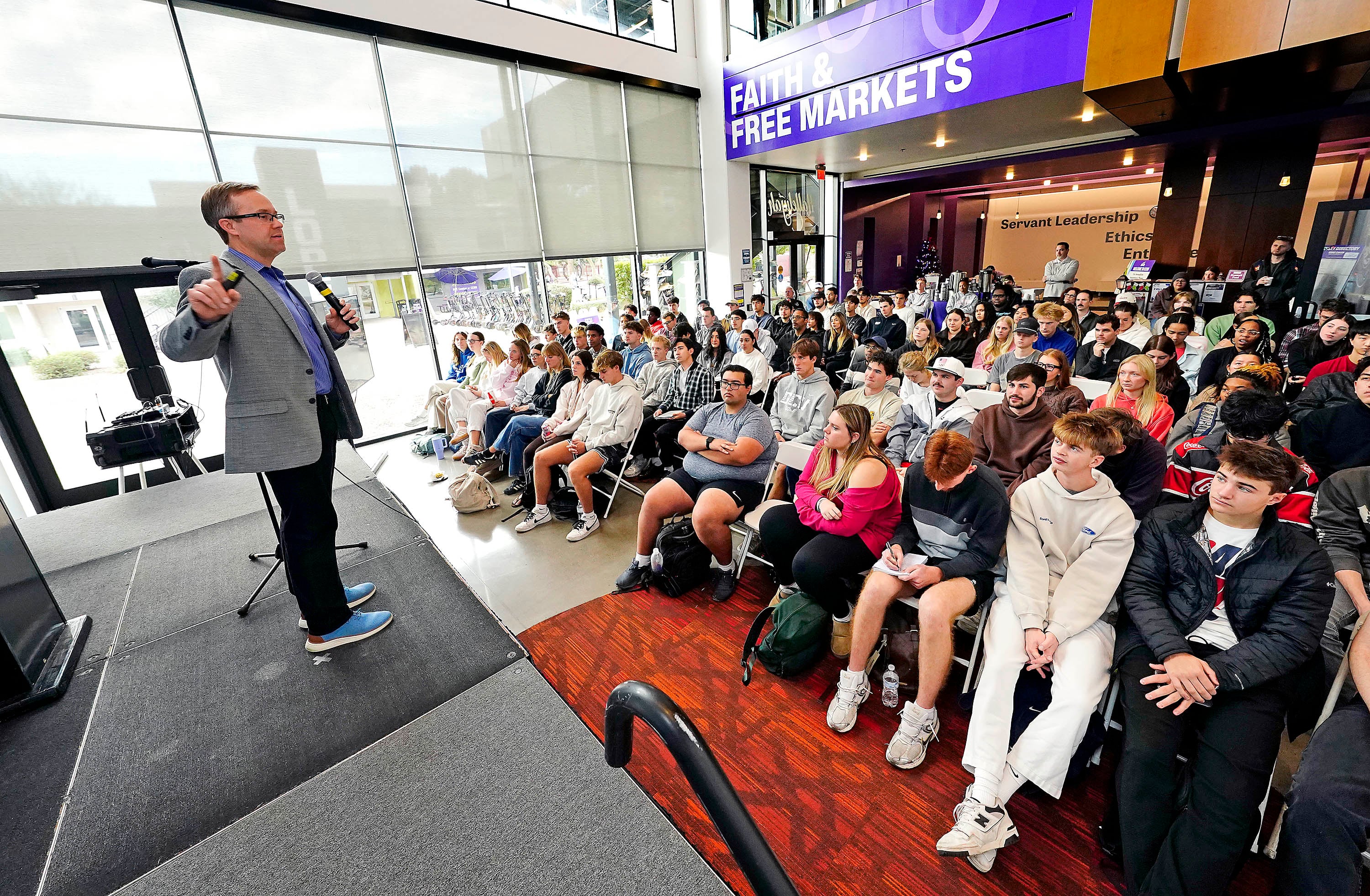
The poster presentations were part of the three-part, four-hour Canyon Undergraduate Research Conference. The goal is to spotlight the academic prowess of GCU’s students across the university’s 10 colleges through their research and other projects.
The conference’s other two parts, which followed the poster presentations, included the Canyon Undergraduate Research Symposium and the juried Honors Showcase, both featuring oral presentations of student work.
Project Follow Me
The team of six students in Project Follow Me aim to build a full-scale autonomous companion robot that will interact with students and enhance the campus experience.
“The idea is that it’s able to answer any questions about campus or GCU,” said Evan Klaasen, a junior software engineering major.
The team already has built the base of the robot, capable of following students around, and has a lot of components in hand. The sophomores and juniors will continue to build the robot next academic year.
“Our biggest hurdle is not having an electrical engineer on our team,” said Klaasen, which means having to learn and tackle the electrical engineering portions of the project using their own gumption.
But those challenges are what Klaasen loves.
“The most fun is the new technologies and the sensors and learning how each sensor works,” he said.
Effects of microplastics
Juniors Morgan Dirks and sophomore Raylene Silva, both biology majors studying to become physician’s assistants, wanted to see if microplastics had any effect on brain cancer cells in their cancer research project, “Investigating the Effects of Microplastics on Pediatric Anaplastic Astrocytoma.”
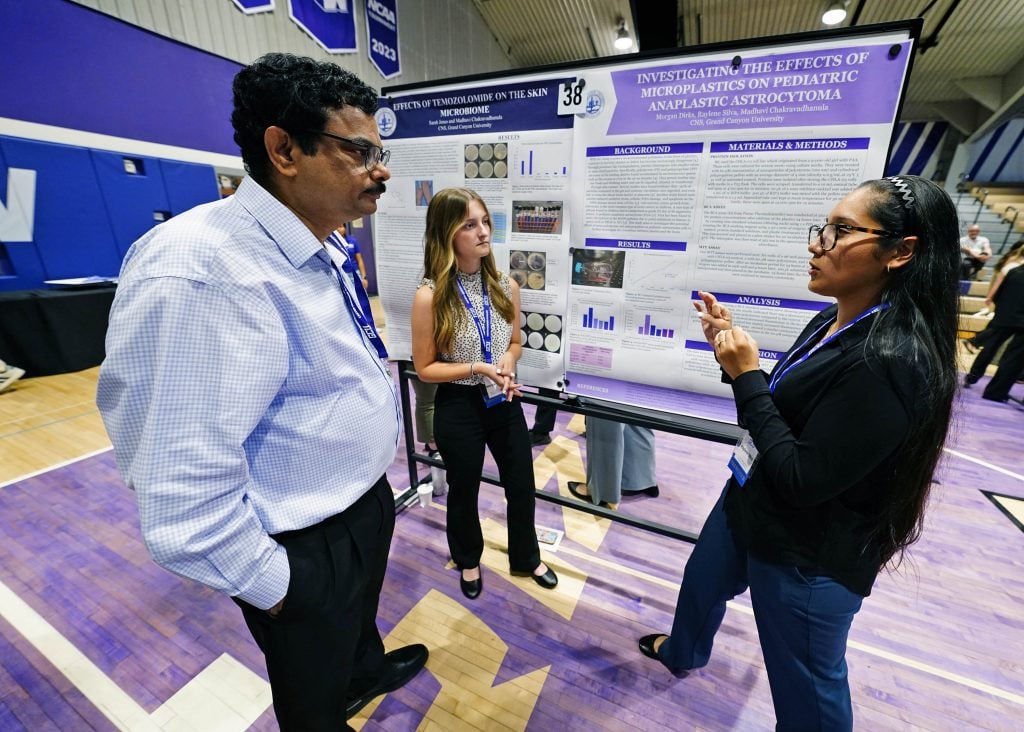
The team, which includes Madhavi Chakravadhanula, grew cancer cells in flasks and exposed them to nanosized amounts of polystyrene and pellet-sized polypropylene, some of the leading plastics that have accumulated in the environment.
Those microplastics – they’re in everyday objects, such as takeout containers, laptops, packing pellets and craft foam – are found in the oceans and the air. Research has shown, according to the team's poster, that once ingested, those microplastics are able to cross the blood-brain barrier or placenta.
The team then conducted an MTT assay, a laboratory test used to measure cellular metabolic activity.
“We found polypropylene encouraged cancer cell growth. We showed that polypropylene can have an effect on cancer cells,” said Dirks. The plastics, in short, interfered with the normal processes of the cells.
This research was important to Dirks, she said, because “I have several types of cancer that run in my family, so I wanted to understand more about how cancer spreads.”
Added Silva, "I want to go into pediatric oncology, so I think it’s good to expose yourself to research early.”
Electric scooter take-away
Kambry Tutty, an honors student and exercise science pre-physical therapy junior, presented her team’s study, “Effects of Discontinuing Electric Scooter Use on Cardiovascular Fitness and Health Outcomes.”
“We wanted to take away people’s electric scooters for a semester to see if there was any difference,” said Tutty.
The team sought volunteers who gave up their electric scooters for 10 weeks. Although the study isn’t quite complete, Tutty said what they’ve seen so far is the test subjects improving on VO2 max, someone’s maximum capacity for using and transporting oxygen in the body. It is a reflection of someone’s physical fitness.
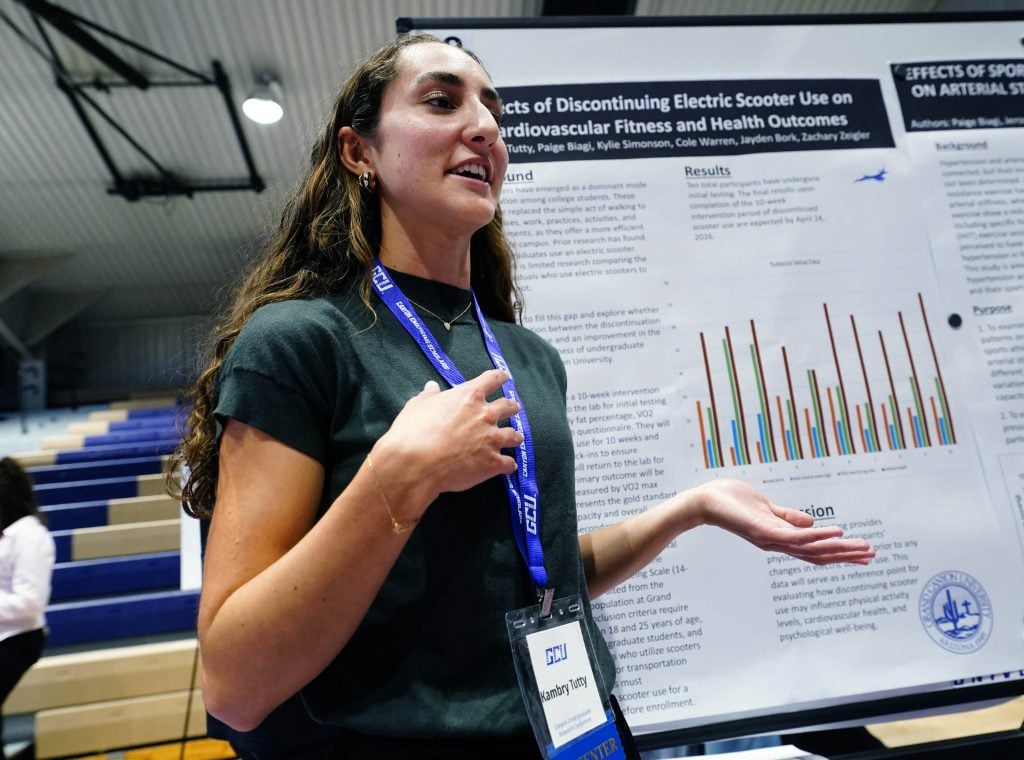
There were also improvements in lean muscle and mental health.
Tutty said the team would do weekly check-ins with their subjects to make sure they weren’t secretly hopping on those scooters.
What surprised Tutty in this project, she said, was not the physical results, but the mental results.
“They were telling me, ‘Oh, it was helping me improve my time management,' since they had to leave their residence hall rooms earlier to get to class. And I felt more connected with the community.”
She said the subjects commented on bumping into friends during their walks, visiting more with them and enjoying the sunshine.
“They said, ‘It helped me take a smaller pause of life,’ ” Tutty said.
Athletes and arterial stiffness
Paige Biagi, a third-year pre-athletic training student, spoke about another team project, “Effects of Sports-Specific Muscle Contractions on Arterial Stiffness in Club Sports Collegiate Athletes.”
“We were trying to see if they (club sports athletes) have more hypertension and arterial stiffness compared to aerobic athletes,” said Biagi, noting that even though athletes are perceived to be healthy because of high levels of physical activity, they’re not protected from cardiovascular risk.
Weight resistance exercises have been shown to increase arterial stiffness (arterial stiffness increases cardiovascular risk) whereas acute bouts of aerobic exercise show a reduction in arterial stiffness.
“Power lifters have higher blood pressure and the blood vessels are less compliant than aerobic athletes,” for example, said Biagi.
The team studied 37 subjects across 12 sports.
But the team concluded that, at this time, that isn’t a big enough sample size for a statistically significant conclusion, so the study is ongoing and expected to conclude in 2027.
A super plant?
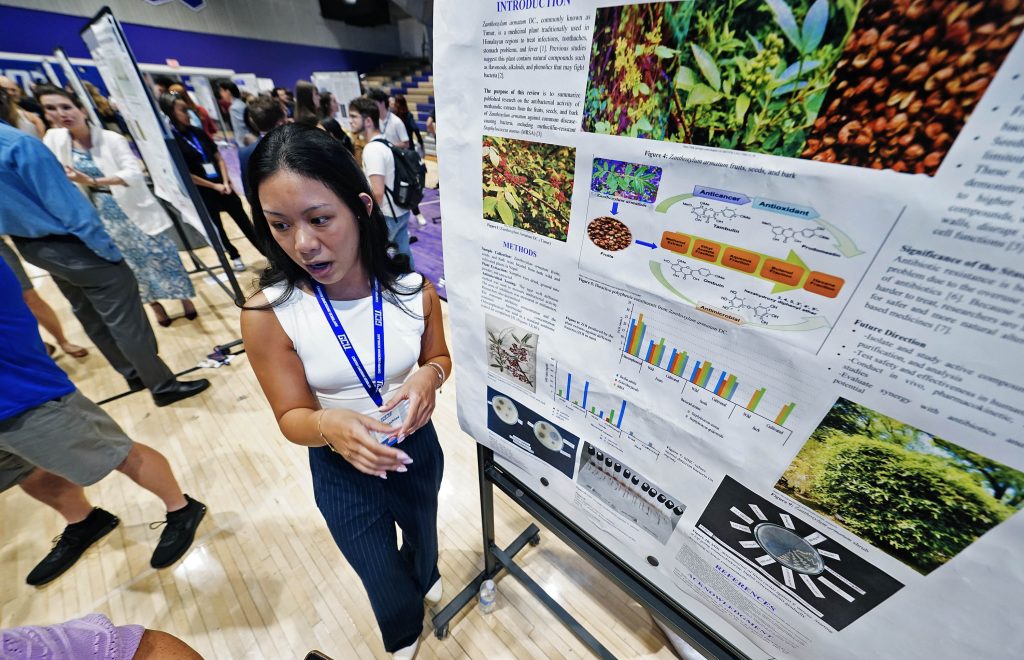
Trish Hachtel, a pre-med junior, did a theoretical review of in vitro studies on Zanthoxylum armatum DC in relation to MRSA, a type of bacterium responsible for difficult-to-treat infections.
Zanthoxylum armatum DC is commonly known as timur (Nepal pepper) or winged prickly ash. It is a medicinal, aromatic and culinary shrub found in the Himalayas. Parts of the plant are used for treating toothaches, indigestion and fever.
Hachtel looked deeper into a study completed by a previous researcher who tested the fruit, seeds and bark of the plant to look for its ability to fight off harmful microorganisms. She did a theoretical study, which is a scholarly article that analyzes, compares and synthesizes existing theories and models related to a specific topic.
Tests showed that, of the three parts of the plant, the fruit seemed to have the most antimicrobial properties, or ability to kill microorganisms, like MRSA.
Hachtel said, “For future research, it would be great to extract the part of the fruit that has the antibacterial properties instead of the whole plant,” she said.
Hatchel is new to the Antimicrobial Discovery Lab in the College of Natural Sciences, whose students have been exploring various plants to discover their antimicrobial properties. Monday’s poster presentations included a slew of such research into a variety of plants, from turmeric to tamarind to palo verde and native Colorado plants.
Hachtel, after speaking with her professor, Dr. Daisy Savarirajan, said, “I just thought that this (the MRSA-Nepal pepper project) was just a super cool project,” she said.
Horror, Disney and high school scholars
One section of the Canyon Undergraduate Research Conference poster presentations featured high school students whose schools partnered with GCU to get research experience.
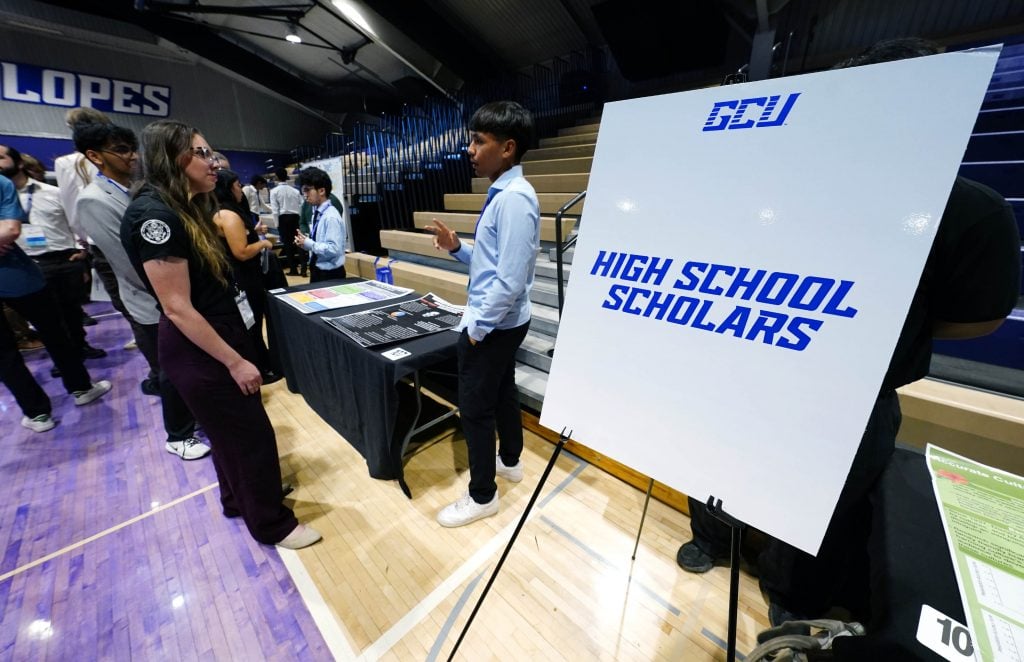
It’s where Salvador Gonzalez III of University High School in Tolleson, Arizona, presented his research on what it is exactly about horror films that fascinates movie-watchers.
“I’m a fan of horror movies,” he said.
He presented next to Uriah Malve, whose project was a contrast to Gonzalez’s. Malve researched “The Public Perception of Modern Disney Movies and How They Feel About Those Movies.”
Students from four high schools participated, including Paradise Valley, University, Mountain Ridge and BASIS Chandler high schools.
At least one high school group presented alongside a group from the College of Engineering and Technology, said Katalina Inzunza-Herrera, Ingram Honors College assistant director.
“These high school students want to engage with GCU,” said Inzunza-Herrera, “and hopefully, we can get them excited about joining our labs.”
Lana Sweeten-Shults, manager of internal communications, can be reached at [email protected] or at (602) 639-7901.