Photos by Ralph Freso/GCU News
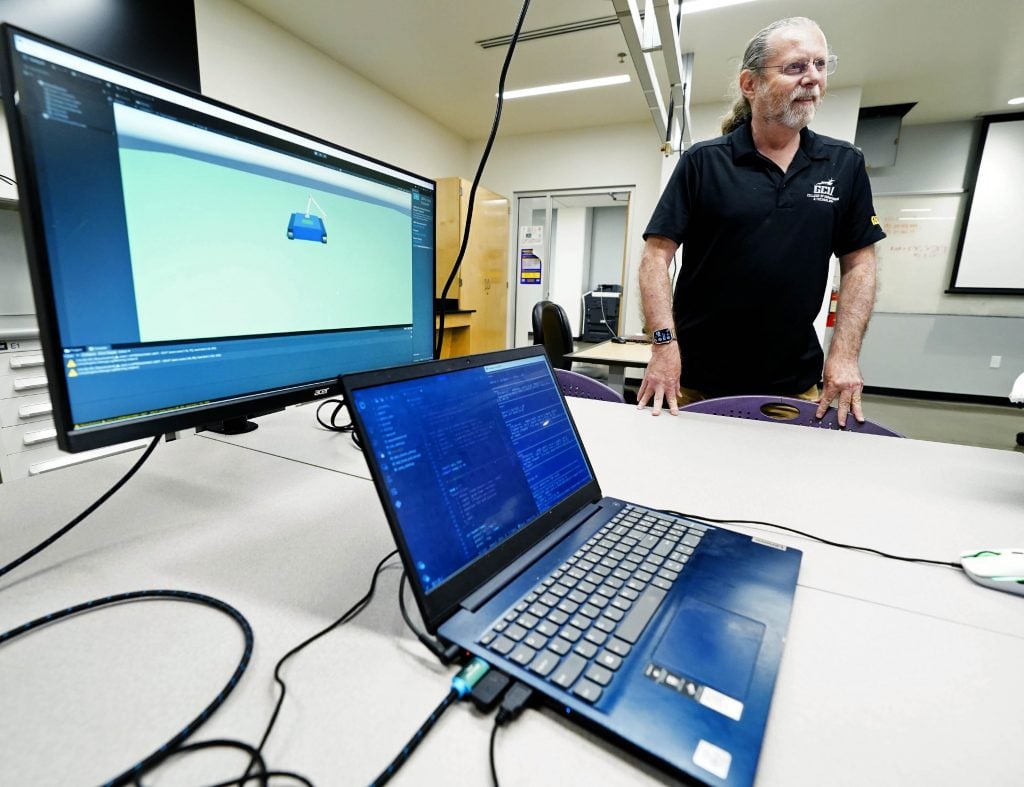
Dr. Isac Artzi is busy this summer in Grand Canyon University’s Artificial Intelligence/Virtual Reality Lab, where there’s talk – intense technophile talk – of a cutting-edge, 16-credit-hour curriculum that’s actually made up of a block of what was previously four courses.
Yep, 16 credit hours.
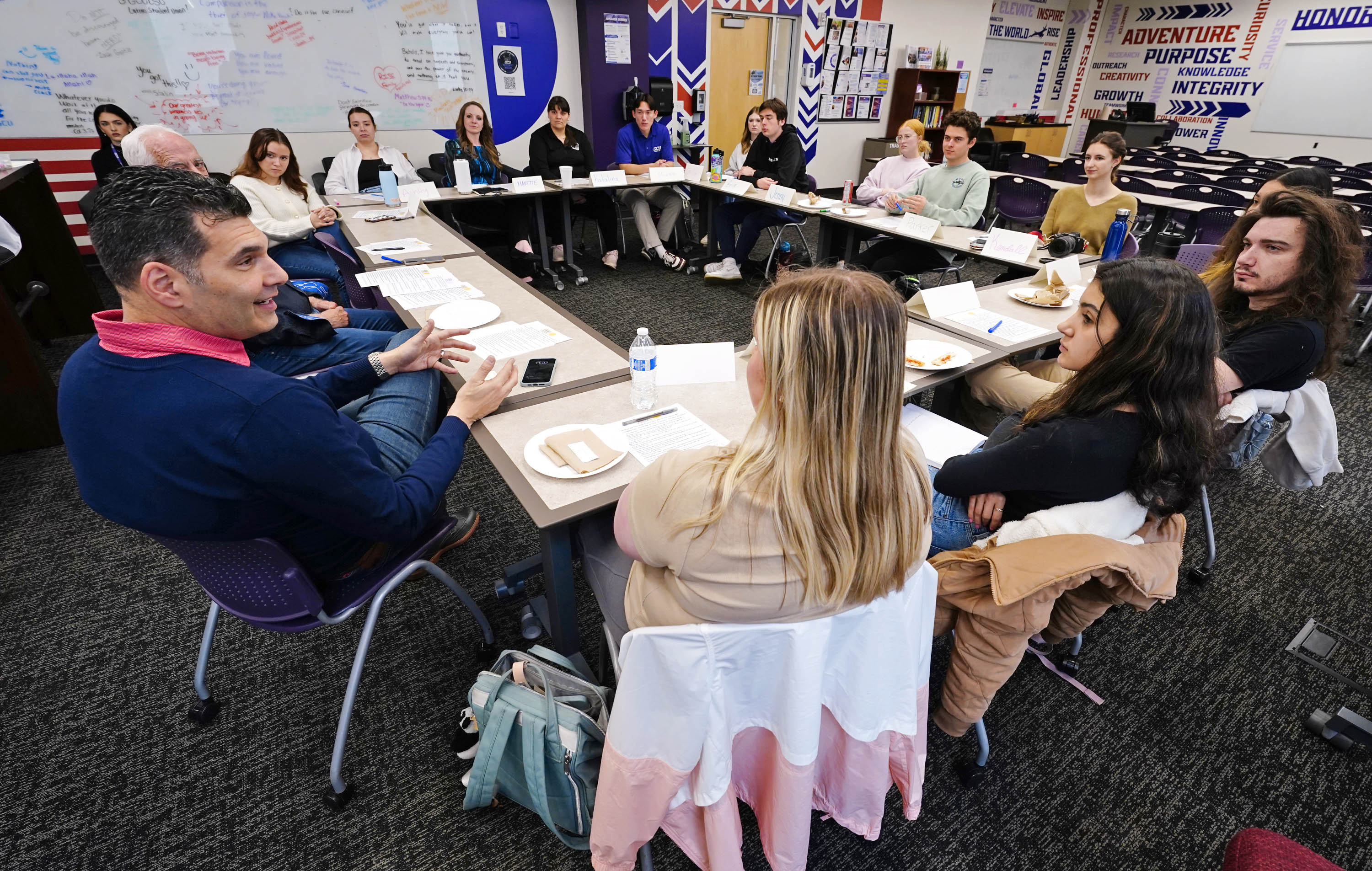
Innovation is central to these integrated learning blocks, designed to operate in a space that looks more like an office or shop floor than a classroom.
“Our mission is to educate students and give them the skills so they’re ready to perform immediately after graduation. So we are reimagining the classroom to look like the workplace,” said Artzi, associate professor and program chair in artificial intelligence, data science and game development.
He’s one of the faculty in the College of Engineering and Technology who’s looking at the classroom with a visionary lens as these integrated learning blocks make their debut.
The college is preparing to launch two such pilot learning blocks this fall, one in machine learning and the other in autonomous AI cyber defense.
This idea – an initiative advanced by Assistant Dean of Technology Dr. Rob Loy and Artzi – is that one of these learning blocks will replace four classes in which a team of students works on an immersive project using industry specifications.
Students will be in these workspace-inspired classrooms for 30-plus hours a week, as if they’re at a job.
They’ll do daily stand-ups, present to leadership, defend decisions and deal with priorities, timelines and budgets.
Their professor will lecture less and take on the role of a life coach, sounding board and mentor, while students learn via immersion in this new learning environment.
“It is more realistic to how you learn on the job,” the college’s dean, Paul Lambertson, said. “You do what you know. You look for resources where you may not know.”
What’s also different is that the final assessment for the students will be their finished project that they champion via an interview-style defense.
Instead of students learning concepts in silos, where they’re studying alone and might be taking a course here and, a semester later, taking a course there, they’re taking related courses as one block and working on a team.
The hope is they’ll connect those concepts more readily in this type of learning environment, Loy related.
“They work on a project that covers multiple skills across multiple courses,” Artzi added.
Students will receive a 30-40 page requirement document and they’ll be told, “You have to build this. … This is what this product has to do when it’s ready.”
They’ll have to apply project-based learning theory to analyze the task, then ask themselves, “What do we know? What do we need to learn?
“OK, you are in charge of this," Artzi continued. "We’re going to learn this. … In the end, the whole team is responsible for delivering the product.”
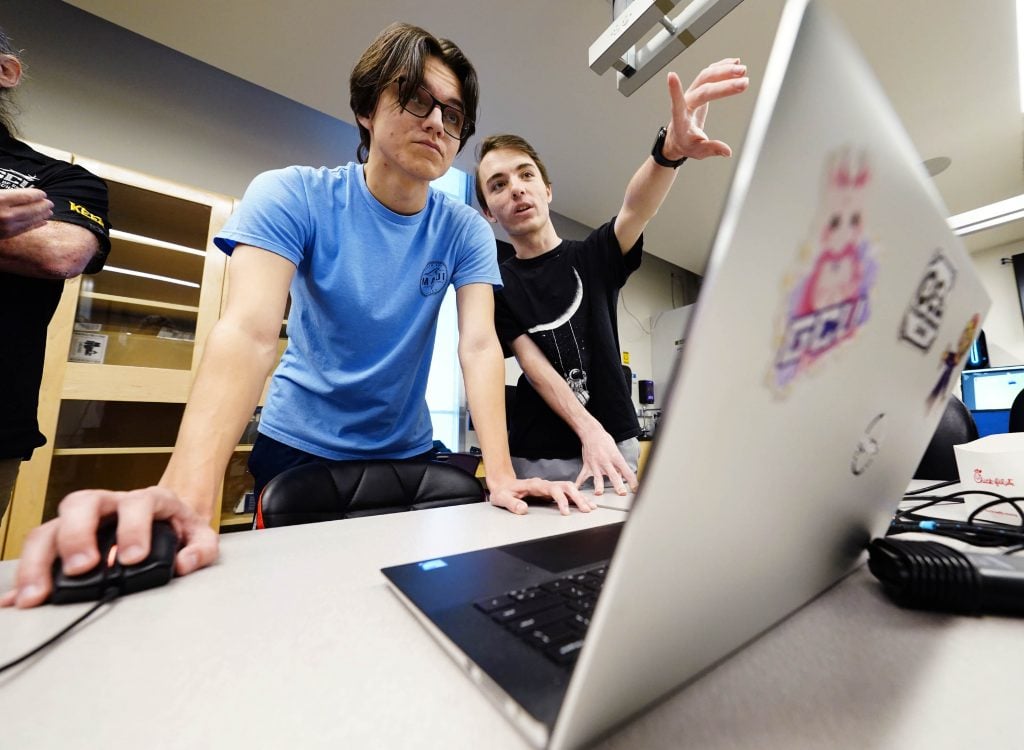
Student workers in the Artificial Intelligence and Virtual Reality Lab are in the earliest stages of helping bring that vision to life.
Our mission is to educate students and give them the skills so they're ready to perform immediately after graduation. So we are reimagining the classroom to look like the workplace.
Dr. Isac Artzi
Associate professor and program chair in AI, data science and game development
Mason Lohnes, who graduated in the spring with his computer science degree, and Christopher Luciano, a senior computer science major, are building a self-study guide for students who will be taking the 16-credit hour machine-learning block.
They’re also a mini focus group of sorts for Artzi: “We ask them, if you are a student in this class, what would you expect from a learning environment?”
The resource they’re building will replace the textbooks and labs – what students would normally turn to as resources in a traditional college course setting.
“It’s a guided, self-study environment for everything students need to learn to complete the project, because the (course) project is project-based learning,” Artzi said.
Lohnes clicks on his computer to pull up the learning modules he and Luciano are working on. Each module includes lessons, activities and coding challenges. The learning resource will keep track of how many lessons and exercises the students have completed and how many badges they’ve earned.
The guide will be a go-to supplemental resource that students in the machine-learning pilot will use when they feel they need that extra boost.
“The goal is that students will go to this instead of Google and AI,” Lohnes said.
He added, “I can confidently say that in most classes, I’m not using those resources,” said Lohnes. But in this case, where students are teaching themselves, “… This is helpful. If it’s something I’m learning from – something where I’m gaining insight on the topic, that’s pretty important.
“I feel like not a lot of resources do that.”
Artzi added that the vision is to eventually launch an AI assistant that will offer all the information a student will need. The advantage is that the information provided to students via AI always will be up to date.
“This one keeps being fresh,” Artzi said. “Each time there’s a new development … it’s updated. So it’s always the most recent version of everything related to that particular project or discipline.”
What Artzi has loved about the projects going on in the AI/VR Lab this summer is that, “We can do really cutting-edge things. We can build cutting-edge technology and tools in-house with students. That’s an untapped resource with unlimited potential, given time and resources.”
These 16-credit-hour pilot learning blocks are part of something even bigger.
Students can take just one of these academic blocks, receive their professional credentials – oftentimes certificates required to work in certain tech jobs – and start working in industry. Or, they can stack these 16-credit-hour blocks – two required blocks and three electives – and along with taking 40 hours of general education credits, they can earn their bachelor’s degree.
This initiative, “That’s a big change in the mindset,” Artzi said.
Although the concept isn’t totally new – it has been called a microdegree, certificate course or bootcamp – what’s new here is how the classroom will look more like where students will find themselves after graduation.
“This is where we really want to re-imagine higher education so that the classroom looks more like the workplace. … You don’t train them (students) in something that doesn’t look anything like the work environment.”
Loy added, “We keep telling students they need experience to get experience. Maybe the degree itself should solve that problem.”
Manager of Internal Communications Lana Sweeten-Shults can be reached at [email protected].
***
Related content:
GCU News: From rock climbing to the NBA, students display their deep learning at AI event
GCU News: Supercomputer, smart pillow shine at engineering, Technology Capstone event