Photos by Ralph Freso
Savannah Dixon is interested in teaching and in history, the former because students need to know someone cares about them, she said, and the latter because adults need to know someone cared about them.
“This happened to someone and that’s how we’re here now,” said Dixon, a senior history major at Grand Canyon University who wants to teach it after she graduates.
“Sometimes,” added Ann Brandes, “history is better than fiction.”
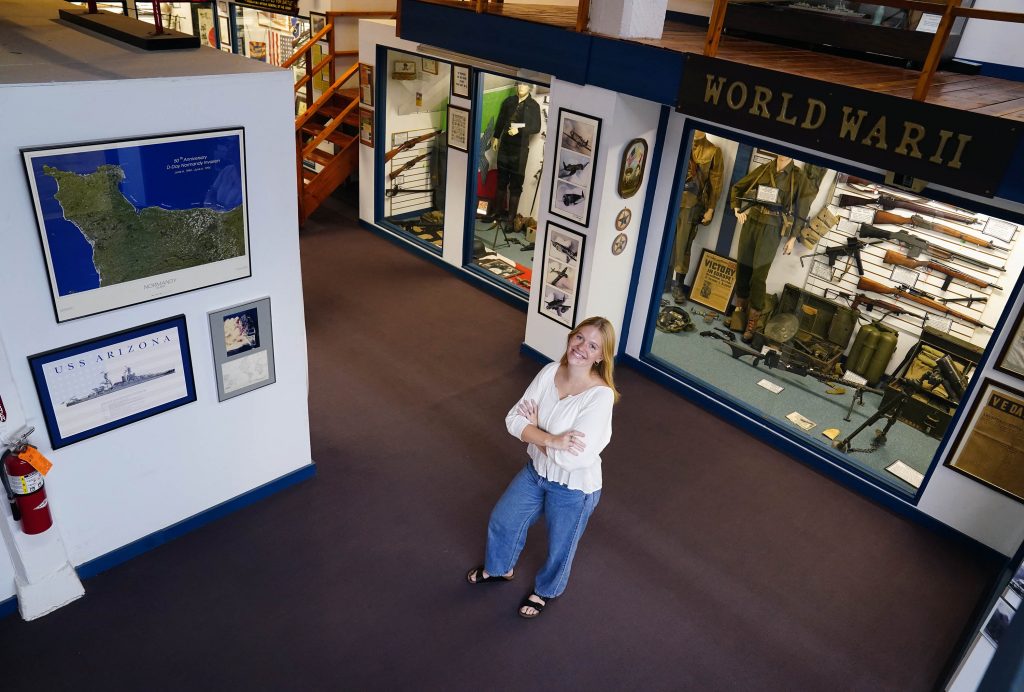
It’s the stories that captivate both women, volunteering side by side at the Arizona Military Museum on the Arizona National Guard Papago Park Military Reservation in Phoenix.
The museum has been closed for two years, and Dixon has had a rare opportunity to join Bill Hensell, director of the nonprofit Arizona National Guard Historical Society, and Brandes, a board member who looks at the military sacrifice chronicled there with a "mother's affection," to catalog and create exhibits out of thousands of donated items from 500 years of military history in Arizona, up through the recent wars in Iraq and Afghanistan.
The board asked GCU for volunteers early last year, so history department lead faculty member Kim Kennedy led students on a field trip to the museum. A handful of students volunteered to help refreshen its website, inventory items and build exhibits, though Dixon stayed on through the summer and will keep volunteering weekly.
“We are a great team,” Brandes said, outside a glass-enclosed exhibit with a checklist. “I’ve got a bad back and she can crawl back in there.”
History is full of connections, Dixon quickly learned.
“Last week you learned something,” said Hensell, who on this Sept. 11 day was remembering 24 years ago. “Her mom was a nurse in the Army Reserves … and when my unit got ready to go overseas to Afghanistan after 9/11, she was the one who gave us the shots.”
History also is “right in your face,” Dixon added about the Huey helicopter loaded with missiles in the Vietnam exhibit, looking much like it did when soldiers flew it in war.
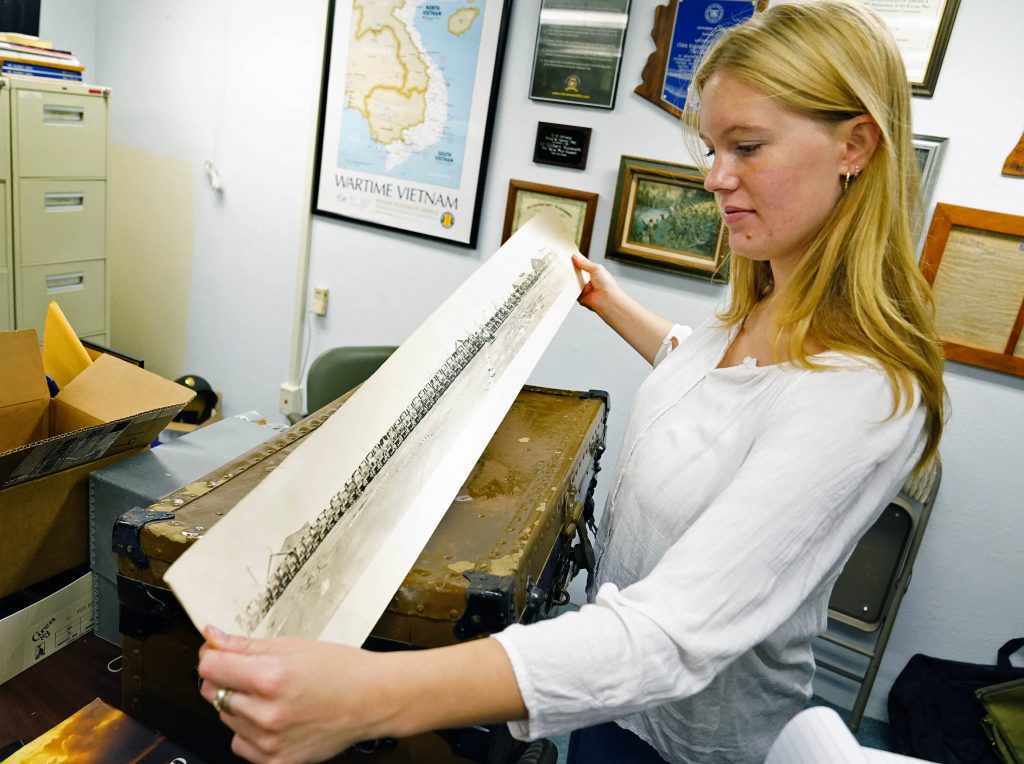
“I want to know all of it. For instance,” she continued, standing before a donated footlocker from 1916 that just arrived, “we have the story of a man. We have the story of his life.”
Inside were photographs of the man’s Army 392nd Motor Transport Company on the border at Douglas, Arizona. The man’s son has a helmet in a World War II exhibit and his grandson’s in another about the Vietnam War.
“There are all these family ties,” said Hensell.
The 1936 adobe building, the old arsenal building, opened in 1981 as a museum and closed two years ago as the guard wanted to take a deep inventory and freshen the exhibits.
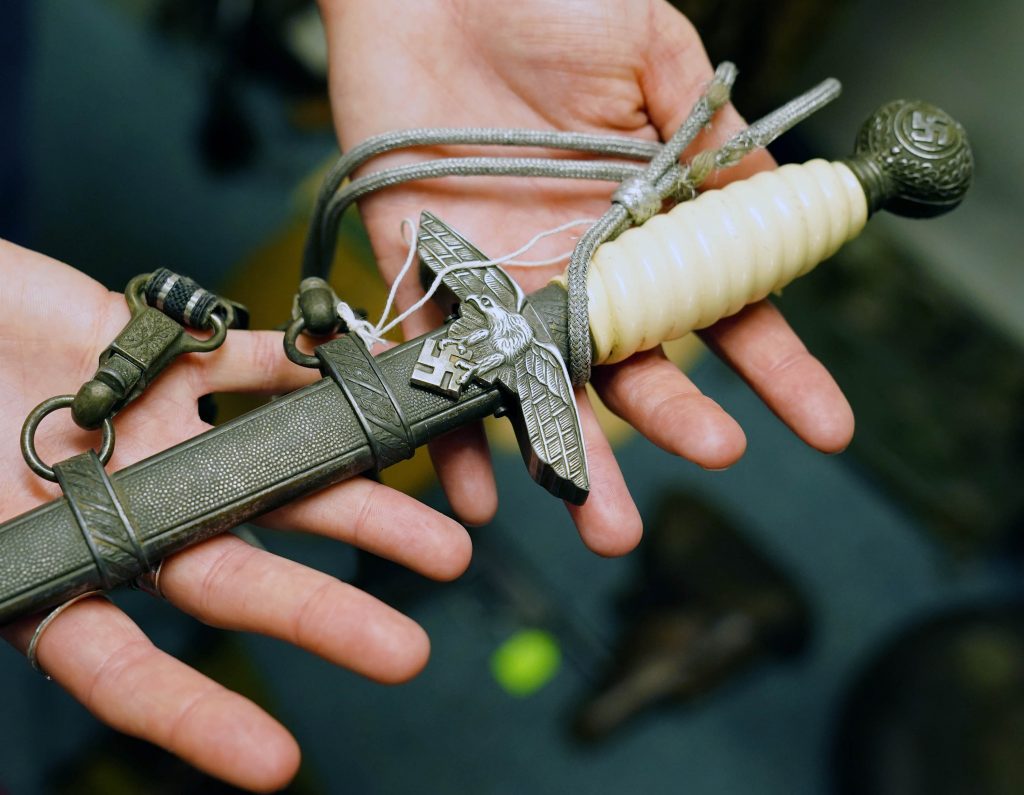
“I know the facts of the things here, but then you hold something they held in battle or it’s in their footlocker and you realize that is someone that fought for our freedom and dedicated their lives,” Dixon said. “I was in one display case and picked up a bayonet and it had someone’s name on it and we said, ‘This belonged to a real person.’”
Hensell said Dixon brings a bright enthusiasm and willingness to learn, while she said the experience will be invaluable to her future as an historian.
“It’s a really great opportunity for students. They get to have more ownership here than at almost any other museum,” said Kennedy, who is an Arizona National Guard veteran. “They are learning how to make amazing exhibits, so they are getting real-world experience.”
She will lead another trip to the museum later this month and introduce more students to opportunities to volunteer or get elective credit.
Dixon already knows enough to be a tour guide to the museum, showcasing 6,500 square feet of displays of uniforms, weapons and artifacts, as she explained exhibits that start with the Spanish conquistadors nearly 500 years ago (“Wow, this was in the hands of a conquistador.”)
Standing before the Civil War display, she held a bullet engraved with the words, “Dixie.”
“I thought, that was just like a teenage boy,” she said.
And before the World War II exhibits she connected it again to her personal history.
“My great grandfather fought in the Pacific and my grandmother and her parents were in France under Nazi rule, and (they) were part of the French resistance,” she said. “Look how hard people fought to overcome that, and it makes me really proud that I come from someone who fought like they did. They didn’t just lie down and let the Nazis take over.”
One day, little red caps were donated, and she didn’t know what they meant. Hensell told her that they were the caps of Hitler youth.
“Everything has a story behind it, like something as small as a little red hat,” Dixon said.
There is a large Nazi flag hanging from the ceiling, and Japan flags inscribed with the names of American soldiers who brought it home. And weapons, hundreds of weapons of war, that she had to learn.
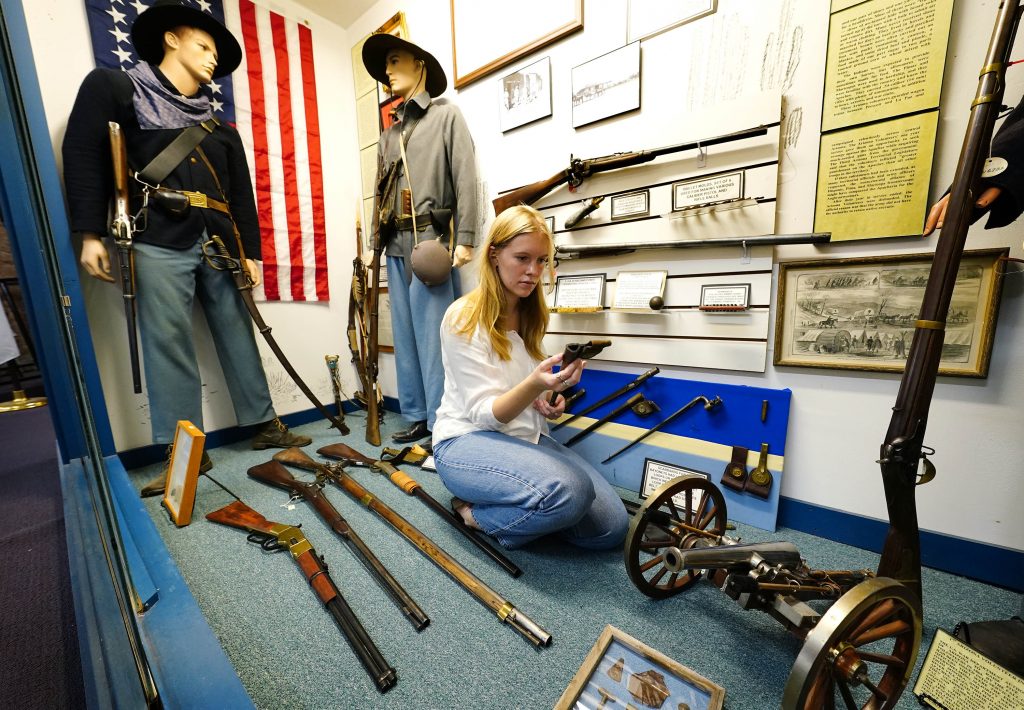
“I asked a lot of questions, and I’m like, ‘Is he gonna listen to this little blond girl?’” she said of working with a military veteran such as Hensell. “But I don’t think I could ever annoy him; he wants everyone to learn.”
She went past the Code Talkers exhibit, the Native Americans who helped win the war, and the old German grenades from World War I, the pistols with Nazi insignias on them, and her mind spun through the stories.
“It’s also just so sad because we just used that against each other,” she said. “It just puts things in perspective. Yes, it was a German, our enemy, but also you think about it like that it was a boy who was put in a war to fight against each other.”
The musuem's big library is her last stop, filled with materials she hopes to help her write a paper for her history class, and again thought of the value of her field and what she hopes to teach.
“Everything repeats,” she said, mentioning the Civil War in the 1860s and World War II 80 years later. “There’s been war and war, more and more, and you just have to remember that and remember to fight for peace.
“I mean, look, all this stuff is military and that is sad, but it happened. We have to study it, and you have to know this is possible. You can’t live in a fairy world, right?
“Like they say about 9/11. You can’t forget.”
Grand Canyon University senior writer Mike Kilen can be reached at [email protected].
***
Related content:
GCU News: How Jack the Ripper launched history, behavioral health fusion
GCU News: Army ROTC reinforces 9/11 remembrance