EDITOR'S NOTE: This story is part of GCU's history page. All the stories can be found here:
GCU History Page | The GCU story | Grand 'Construction' University | A campus culture like no other | GCU timeline | Then and now | Did you know…? | Brian Mueller and the 'Phoenix 50' | Pioneering online education | Rise of athletics | The next 75 years
When Grand Canyon College moved from Prescott to west Phoenix in 1951 to break ground on 90 acres of land surrounded by cotton fields, it wasn’t without its share of drama. Builder and trustee A.A. Wallace had less than a month to construct nine new structures before students arrived for the fall semester. So began the rallying cry of “a building a day” as students attended classes at First Southern Baptist and North Phoenix Baptist churches in the interim. Although he didn’t meet the insurmountable September deadline, he had faith, and the nine low-roofed, pumice-blocked edifices debuted just a month later.
The unassuming, no-frills buildings touted “no aesthetic appeal but great function,” declared the 2000 GCU book “The Miracle of the Desert: A Tradition of Excellence, A Future of Commitment.”
After making do in an armory building and adjacent stone structure in Prescott, where the college opened in 1949, and after bunking in neighboring tourist manors that served as dorms, students counted their blessings as they basked in the glow of the college’s first fast-and-furious, hair-on-fire construction boom.
It’s just the way things are done at Grand Canyon University and was a precursor to what would come 60 years later.
The renaissance
Fast forward to 2004.
Burdened with $20 million of debt, the university almost shut its doors. But the onetime modest, private Christian college found new life with an influx of capital after a small group of investors acquired the school and took it to the public markets in 2008.
That lifeline sparked the university’s renaissance, a whirlwind 15 years of transformation helmed by the architect of that revitalization, GCU President Brian Mueller.

Between 2009 and June 2022, GCU invested more than $1.7 billion in the modernization and expansion of its campus, triggering an unparalleled construction boom that harkens back to the fast and furious pace of the university’s Phoenix launch in 1951.
It’s a construction blitz that has culminated in 72 new structures and major renovations, including 30 of the campus’ 32 residence halls and apartment buildings, eight GCU-affiliated parking garages, five colleges, three administrative and support buildings, and about a dozen athletic, recreation and entertainment facilities. Those numbers don’t include the 32 on-campus dining options or various recreational fields or outdoor courts throughout campus.
Add to that the renovation of existing west Phoenix spaces, such as the 2016 facelift of a Quality Inn and Suites on Interstate 17 and Camelback Road, now the 152-room GCU Hotel, and the $11 million refashioning of the once-in-disrepair Maryvale Golf Course, which had been losing $250,000 per year as a municipal golf course. The course is now managed by the university as the GCU Golf Course and has become a popular golf destination in west Phoenix.
Those new builds and remodels have dramatically shaped GCU’s corner of west Phoenix as the university has become an economic catalyst for Arizona.
Because of that unprecedented growth, the campus now spills across roughly 300 urban acres, more than three times the size of the original 90-acre tract of cotton-dappled Phoenix farmland Grand Canyon College purchased.
The humble college once known for educating nurses and teachers has evolved into a comprehensive university on a sprawling, modern campus anchored by contemporary buildings that niche.com ranked as 17th out of 1,396 on its Best College Campuses in America list for 2023.
A new era
The construction boom ushered GCU into a new era, with the completion in 2010 of the College of Education Building, the Student Recreation Center (now called the Lopes Performance Center) and Canyon Hall.
When GCU contacted Pono Construction owner Butch Glispie about building Canyon Hall, “That was it. Off to the races. We haven’t stopped since,” he said, and he hasn’t.
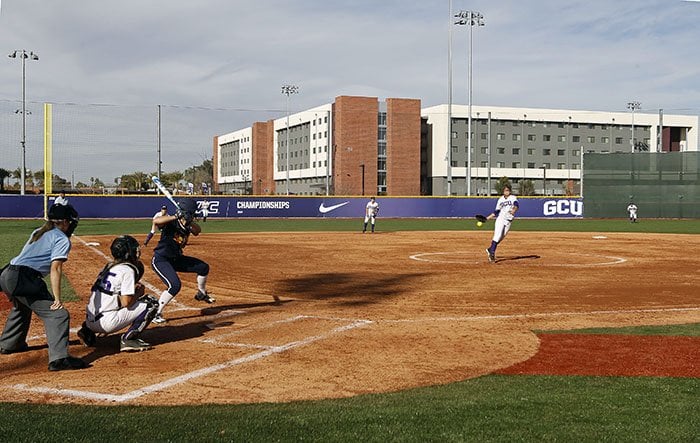
Except for GCU Arena and the Lopes Performance Center, Pono has built every new structure on campus since then, including all 32 residence halls and apartments and all eight GCU-affiliated parking garages. Glispie also has been involved in every major remodel, including the Lopes Performance Center expansion in 2016 and 4,000-seat GCU Ballpark in 2018.
Those builds in 2010 would be followed over the next six years by a rapid-fire succession of projects, among them GCU Arena; the College of Science, Engineering and Technology; the College of Arts and Sciences (now the College of Natural Sciences); the Student Life Building; the remodel of Maryvale Golf Course and clubhouse; a slew of eateries on Lopes Way and in the Student Union; and seven more residence halls and apartments.
Then in 2016, the university announced its “GCU 10 in 2” initiative to build 10 new athletic facilities in two years as it transitioned to NCAA Division I athletics.
New builds on campus became such a fixture that students declared GCU “Grand Construction University,” and the campus embraced it.
Caroline Lobo of suoLL Architects (pronounced “soul”) recalls her early talks with campus leaders about how they wanted the university to look.
When she started working on university projects, only a couple of buildings from the 1950s and 1960s remained. “I think when (GCU President) Brian Mueller moved over, he always wanted the sense of these buildings being rooted in the university’s history and giving us a sense of time,” she said.
Lobo incorporated a red brick base into each of her designs to honor the past and represent the strong Christian foundation that grounds the campus. At the same time, those brick foundations support Lobo’s contemporary architectural designs — the rectangular shapes inset into or jutting out from certain buildings, or the color blocking on other edifices.
Those modern elements represent how Mueller and his team “are always looking ahead,” Lobo said.
Another important component that Glispie said campus leaders emphasized: keeping the buildings cost-effective and adaptable over time to changing curriculums.
Most of the structures that Pono Construction and suoLL Architects have completed for GCU are apartments that reflect the campus’ modern aesthetic and have earned consistent top-10 rankings on Niche’s Best College Dorms in America, including the No. 5 ranking for 2023.
Twenty of the 32 campus housing structures are apartment-style residences far more advanced than those old-school, two-to-a-single-room dorms. They feature four single-occupancy bedrooms per suite, complete with a kitchenette, common living space and two bathrooms.
Including the seven-story Copper and Santa Cruz apartments that opened in fall 2023, the campus living areas encompass nearly 19,000 beds. More than 70% of GCU’s traditional students in fall 2022 called the university’s residence halls home. It’s a rarity among college campuses and feeds into the vibrant community culture for which the university is known.
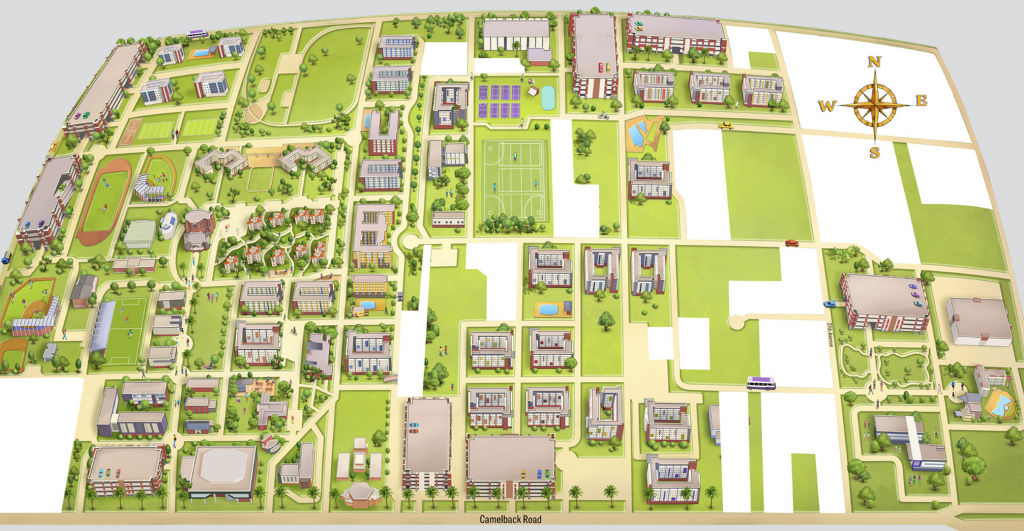
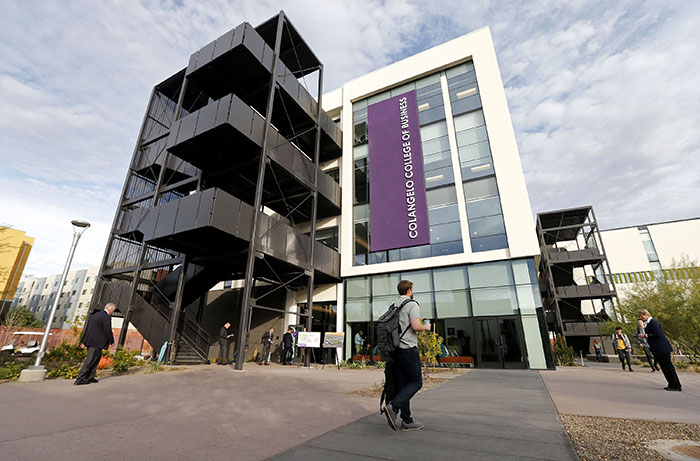
Copper and Santa Cruz are just the latest additions on the east side, where GCU’s growth has been concentrated since 2016. The 150,000-square-foot Colangelo College of Business, one of GCU’s largest colleges with ground and online enrollment of more than 20,100 students, beckons from just outside the Colter Street pedestrian access gate.
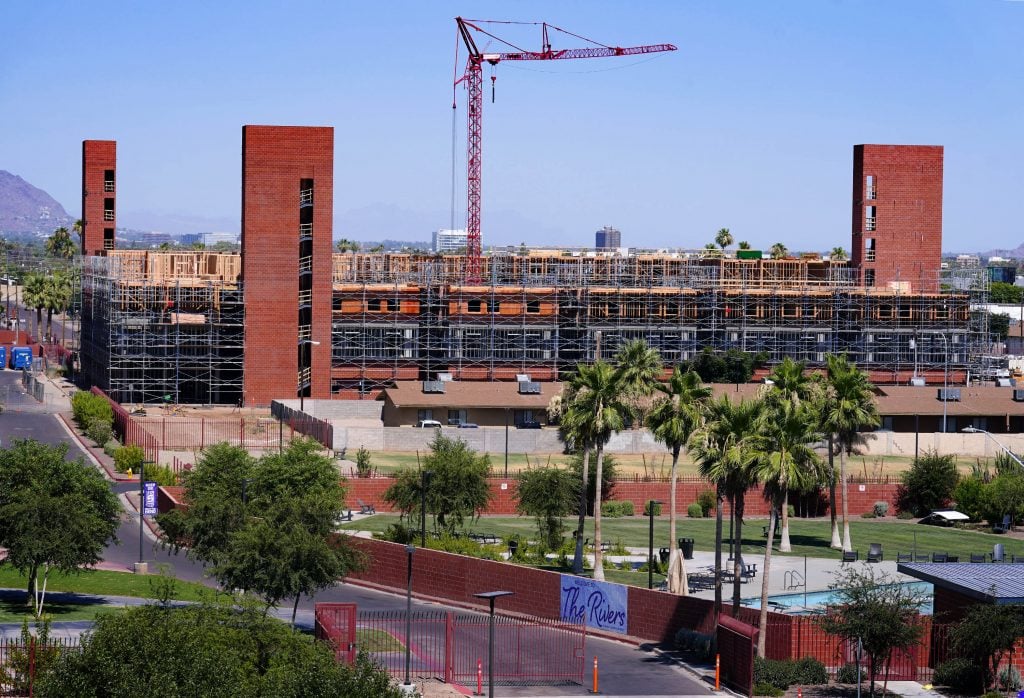
Completed in 2019, the college is the prelude to a symphony of east campus apartment buildings — 16 of them. The residences span from Agave, which debuted in 2016, to The Rivers (Agua Fria, Salt River and Verde River apartments), completed in 2021.
When students feel the need, they can head to the 10-court, 136,000-square-foot Canyon Activity Center, a student gathering space finished in 2018 that includes a rock-climbing wall and, just outside its doors, an outdoor roller hockey rink and skateboard park.
Those facilities are just a block from the campus’ community and business hub at 27th Avenue and Camelback Road, home to GCU Hotel and Cañón 49 Restaurant, as well as the university’s Canyon Ventures business incubator, the Learning Lounge academic help center and the GCU CityServe warehouse, which distributes household goods to those in need. The 27th Avenue complex also includes Grand Canyon Education’s offices.
Considering the phenomenal campus growth over the past 15 years, the university now stretches from its western border at 35th Avenue to its eastern edge near Black Canyon Freeway in a bustling urban community no longer surrounded by cotton fields.
And there’s the promise of more in 2023: the official opening of the Havoc House restaurant at GCU Arena, the debut of Grand Canyon Theological Seminary’s physical space, and the university’s sixth Accelerated Bachelor of Science in Nursing site at the 27th Avenue business complex.
It’s a vision of success that, by sheer will and faith, has never faded as the campus continues to grow, fast and furiously.
Concrete legacy
Not everyone can look out their window and say they’ve built almost an entire university.
Butch Glispie can.
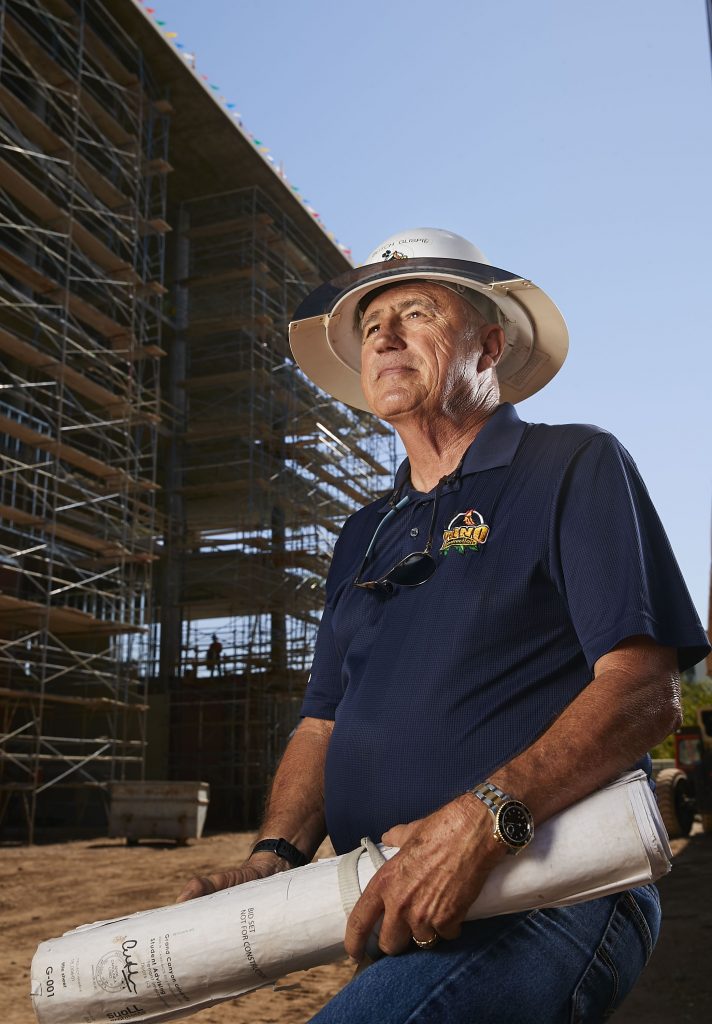
He has left his fingerprints everywhere on the Grand Canyon University campus, on just about every building, every nook and cranny.
The Pono Construction owner built his first GCU housing complex, North Rim Apartments, in 1986. Sitting on a tree-shaded, grassy oasis across from Lopes Way at the heart of campus, it was a successor to the 60-bed Bright Angel Hall women’s dormitory, built in 1960, and Kaibab Hall men’s dorm, constructed in 1963, and is one of a handful of the university’s remaining legacy structures.
Then came Cypress Hall in 2003.
But GCU’s builder really cemented his legacy in 2010 with the construction of Canyon Hall, which would mark the beginning of an unparalleled construction boom that hasn’t stopped. He has been involved in each of the 72 major renovations and new builds since 2010, except for two, GCU Arena and the Student Recreation Center (now called the Lopes Performance Center, though Pono was involved in its 2017 expansion). That includes the construction of all 32 campus apartments and residence halls and eight GCU-affiliated parking garages.
Glispie and his team have erected those structures at a cyclonic, breakneck pace. They typically wrap up a student apartment in just 11 months and, in the case of Ocotillo Hall, a dizzying 145 calendar days, bringing to life the contemporary designs of Caroline Lobo of suoLL Architects.
Alongside Lobo, he has made the vision of a modern university a reality.
Glispie said he and his team go-go-go at such a fast pace that it’s hard to find time to look out the window, step back and marvel at what they have built.
“But when I do,” he said, “it’s humbling.”