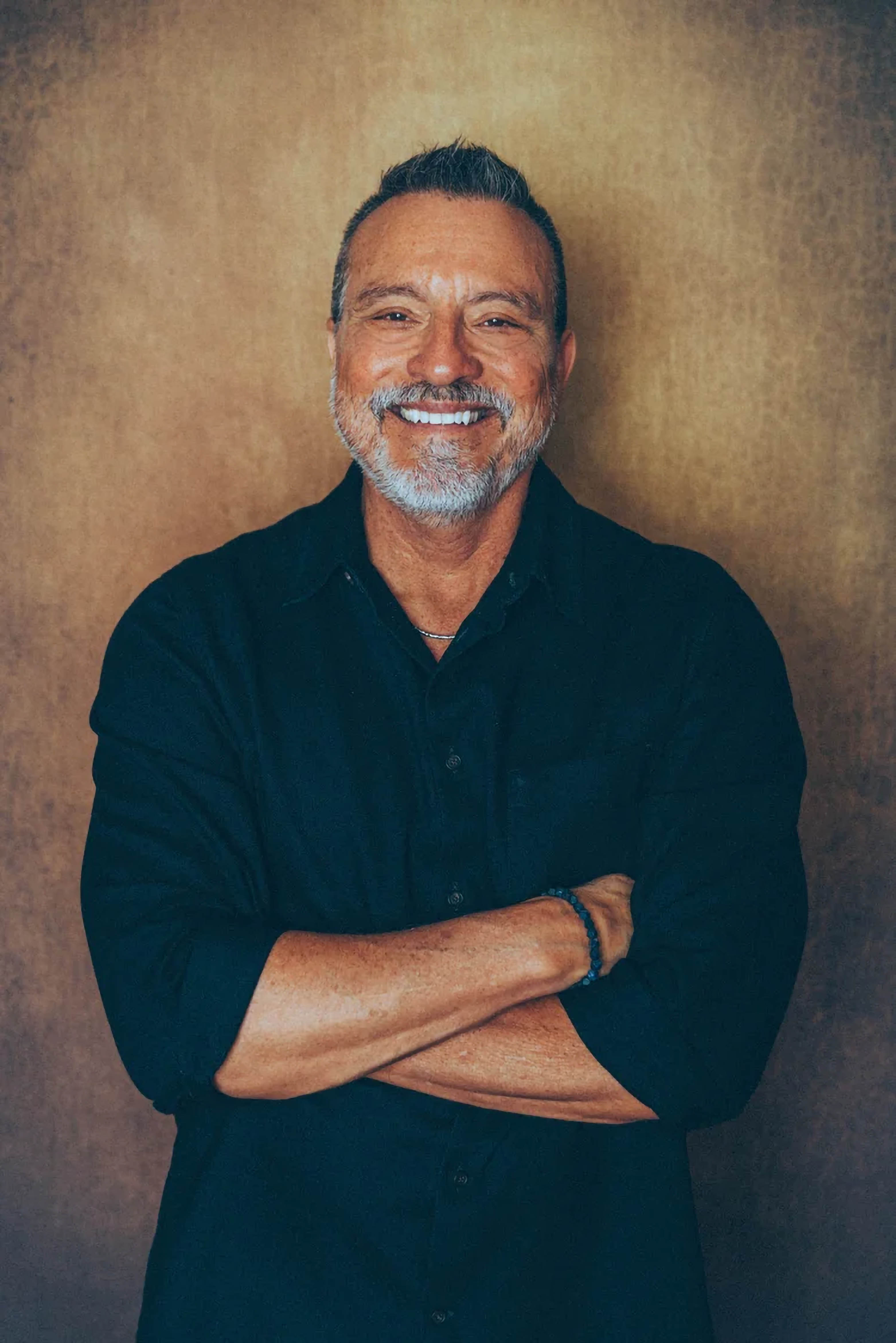
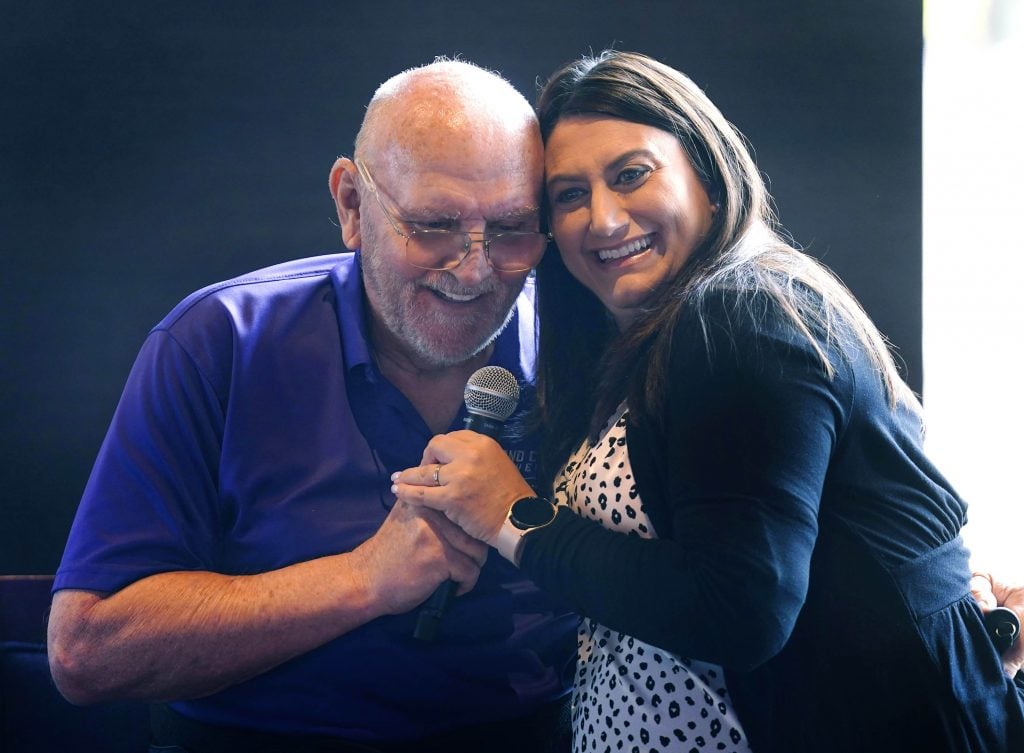
He leaves a legacy as one of GCU's most skilled problem solvers
View the slideshow.
It might be the most famous Dr. Mark Wooden anecdote on campus, when he got Grand Canyon University out of a jam.
The University of Arizona had been supplying the campus with cadavers, so when it decided to end its contract with GCU, Wooden hopped on the phone. After several calls, the University of Kansas stepped up.
But it had one caveat.
“We need to meet you first. We need to know who we’re dealing with,” they told Wooden, dean of GCU’s College of Natural Sciences, who shared the story from his office, with its collection of human skulls and famed skeleton, Tecumseh.
So he flew to Kansas, where KU representatives agreed, "Yeah, we can do the deal." Soon afterward, Wooden, known for his humor as much as he is for his candor, was happily cruising down the highway, hauling four cadavers back to Arizona.

“Brian (Mueller, GCU president) likes that story,” said Wooden, a bedrock of the university since his arrival in 2004.
Wooden, who’s been called one of the university’s best problem solvers, also knows the anatomy of GCU better than anyone when it comes to structure, processes, efficiencies and building a university with a strong entrepreneurial foundation.
After serving GCU for 22 years, he’s retiring this month and paving the way for his successor, Dr. Jon Valla, the college’s associate dean, to continue to evolve the science college.
A leap of faith
While everyone might know the cadaver story, they might not know that Wooden didn’t start his journey in higher education until he was in his 40s.
The third-generation Arizonan worked at a paint store when he was 19. By the time he was 22 and a manager, he was part of a team that helped the business go public.
Two years later, Home Depot acquired the company.
With that job falling out from under him, he started his own contracting business, hanging wallpaper and putting down tile. It gave him the flexible schedule he needed when he had two children in grade school.
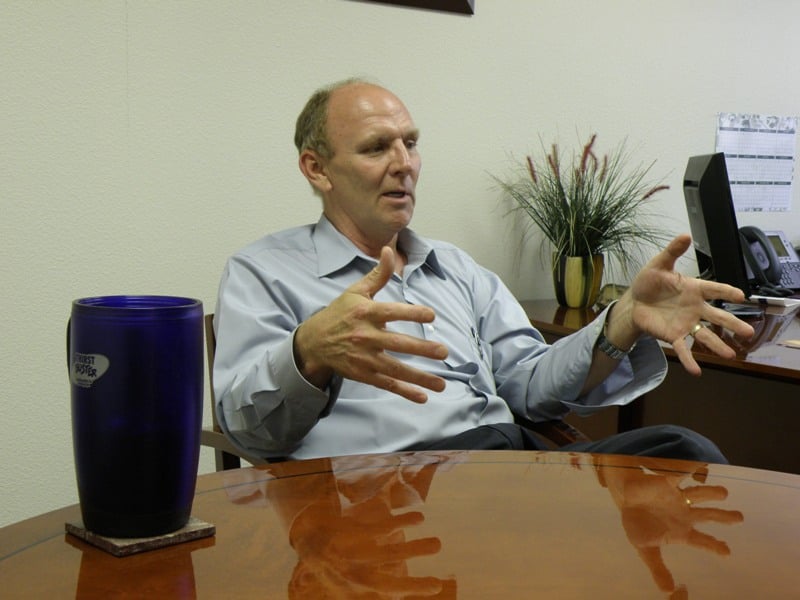
Then, when Wooden was 30, his father died.
“My whole life fell apart,” said Wooden, who also struggled with drug use.
“I went to get help because I was upset about my father. They said, ‘We can’t help you until you get off drugs.’”
So he went into treatment and started to think about what he enjoyed. He remembered as a kid wanting to be a marine biologist.
He’d been a straight-A student, but back then, he said, “I wasn’t thinking about my ability.”
In his 30s, when he began to focus on his abilities and what he wanted to do, he leaned in on wildlife conservation biology and earned a degree in the field.
“I just wanted to go out and be in the forest and be with nature. But as I was going through that curriculum, I took a physiology class. It just amazed me, the human body,” Wooden said.

By the time he was in graduate school, he was studying physiology, with the idea that he would go into research. But as he started his Ph.D. – his doctorate is in biology with a focus on integrative and comparative environmental physiology – he got to teach and “found a love for teaching and sharing information about the body and God’s miracle.”
Wooden interviewed at alma mater Arizona State University, Midwestern University and GCU; all three made him an offer.
“I came to GCU and spent one day here with the faculty and the students, and I fell in love with it,” said Wooden, whose grandmother attended GCU three decades earlier.
Though the pay is always slim as an educator, “It (GCU) really touched who I was. I saw they had a good anatomy and physiology section, biology students going to medical school, so I saw an opportunity to jump in and do that as an instructor.”
Without the bureaucracy of a mega university, “There was a freedom of how you do that here.”
Wooden said GCU is a “can-do” university, with projects often barreling forward in little time. An initiative can go from here to there in weeks instead of years.
“I loved being a part of that,” he said.
Teaching would never be a job for Wooden, who views it as a vocation – a calling.
“It was a leap of faith,” Wooden said of this second act in life. “I didn’t have a clue about where it was going. I just felt like God was leading me in that direction.”
Building a university
When he accepted a teaching position at GCU in 2004, it was during a precarious time. The university was $20 million in debt and its enrollment had fallen to 1,000 students – far from today’s GCU, a behemoth of a Christian university with an enrollment of 25,000 ground students and 108,000 online students.
Investors had just come in as the university was transitioning to a for-profit.
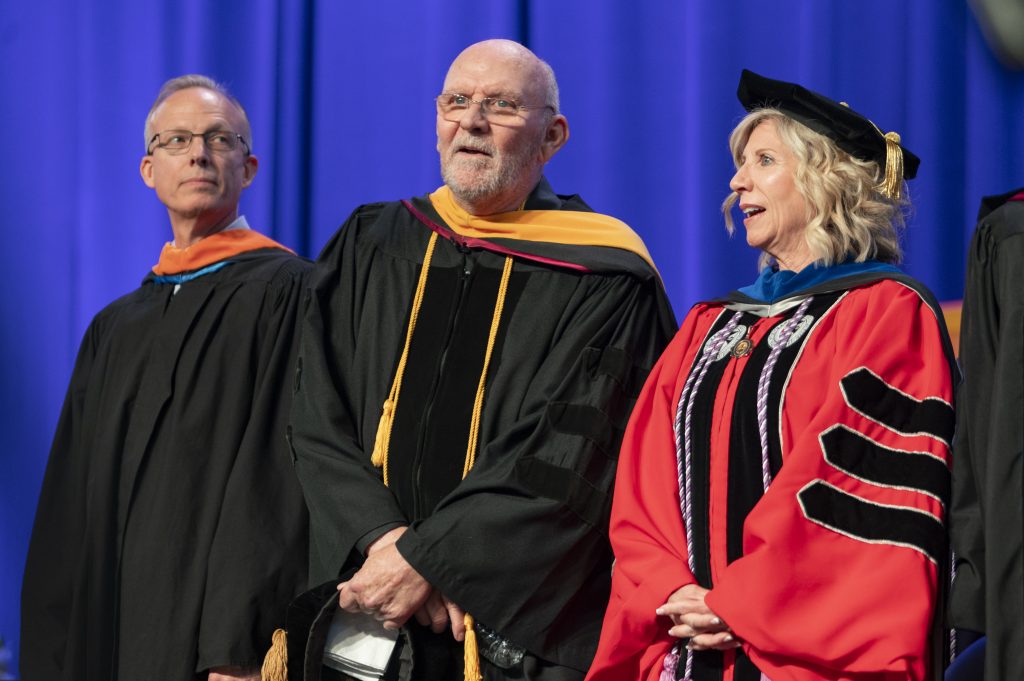
“I wasn’t really too familiar with all the dynamics around that,” Wooden said. “But it didn’t matter. I came here and I loved the place. … I came in excited about anatomy and physiology and building that program.”
And he built it with a strong faith foundation.
Mueller said of Wooden, "To get somebody who is both a science person and a Chist follower is hard to do … he absolutely never wavered in that. There was never any question about that. He was public about that, he was sure about that, and he was confident about that. And I think that's what built the confidence in his faculty."
After just a year in the classroom, Wooden became assistant dean of the College of Liberal Arts and Sciences.
“They needed somebody that could help find new faculty and hire them … They needed somebody that could go establish donations for cadavers, so I started doing all that for them because I loved it. I didn’t feel like it was a burden. It was something I wanted to do.”
Just two years later, he was named dean of the College of Health Sciences.
That would mark the beginning of his two decades as dean of the science college, which over the years would be paired with other colleges that he would help usher into the fold.
The college would evolve into the College of Arts and Sciences and, finally, the College of Science, Engineering and Technology.
“I helped to initiate those engineering and technology programs, but I’m not an engineer. I’m not a technologist, so I could only take that so far,” Wooden said of overseeing CSET.
Invariably, Nursing and Health Care Professions, Humanities and Social Sciences, and Engineering and Technology would split from science into their own colleges.
Since 2023, after the CSET split, the sciences returned to being a stand-alone entity, the College of Natural Sciences.

GCU leaned on Wooden, with his business background. He has been called a skilled problem solver who had processes in place for such things as managing adjuncts and standardizing curriculum.
“I recognized the model,” he said of GCU’s economic-based approach. “We needed to grow. Our return on investment needed to be there. We couldn’t just sit around and talk like a traditional university.”
Wooden knew the “GCU way,” bringing in those other colleges that were paired with his college so that they, too, were well-versed in that entrepreneurial model.
“I’ve touched a lot of faculty. I’m blessed to have so many connections at this university,” Wooden said of his reach extending beyond the walls of the sciences.
What he loves about GCU is that everybody works together to get to the same goal.
“The way we do it here, it’s smart,” and he credits Mueller for much of GCU’s success. He’s “a blessing to the university,” Wooden said, in his ability to grow GCU while still keeping its core Christian, community and entrepreneurial values.
Student focused
Dr. Sherman Elliott, dean of the College of Humanities and Social Sciences, served as Wooden’s assistant dean when he was part of the College of Arts and Sciences.
He remembers his first week on the job, when he called a faculty meeting and forgot to tell his boss. When Elliott mentioned it in passing, Wooden asked, “There was a meeting?”

Elliott thought, “Oh, no! I did the wrong thing.”
“Did everyone come?” Wooden asked.
“Yes,” Elliott replied.
“Well done,” Wooden said.

“I thought I was going to be chastised,” Elliott said. “But he was very supportive.”
Often, Wooden would get to campus at 6 a.m., after already putting in an hour at the gym. He liked hearing everyone’s opinions at meetings, Elliott shared. He also was disciplined and regimented, which served him well as dean – or as Elliott calls him, “King Among Deans.”
But no matter how packed his schedule, “He’d sit across from me and say, ‘How was your day?’” Elliott said.
He showed the same kind of care for his students.
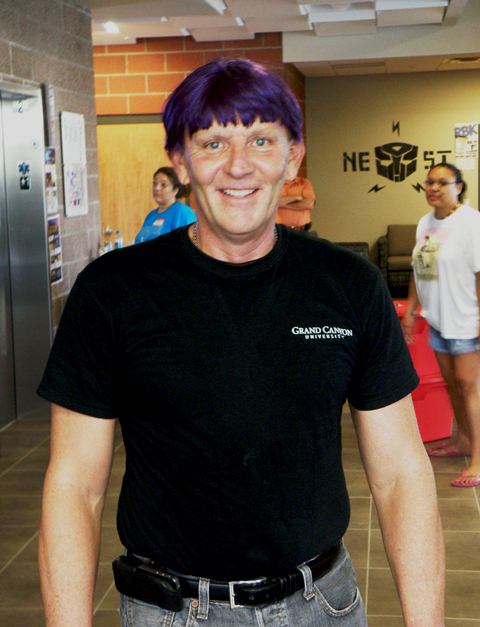
“He’s always focused on the students,” Elliott said, adding how, because of busy schedules, we’re not always in the moment. But for Wooden, “He was in the moment with students.”
Claude Pensis, who teaches in the College of Arts and Media and is the former dean of that college, said he remembers Wooden figuring out class block schedules, like when a class is taught on Mondays and Wednesdays.
“We owe a lot to Mark,” Pensis said of Wooden, “a get-it-done kind of leader.”
“He is a dedicated and devoted and very fine teacher; he is an anchor.”
One of the things Pensis said he’ll fondly remember is the halftime show at basketball games called The Dancing Deans.
“He was an enthusiastic contributor to that group,” Pensis said.
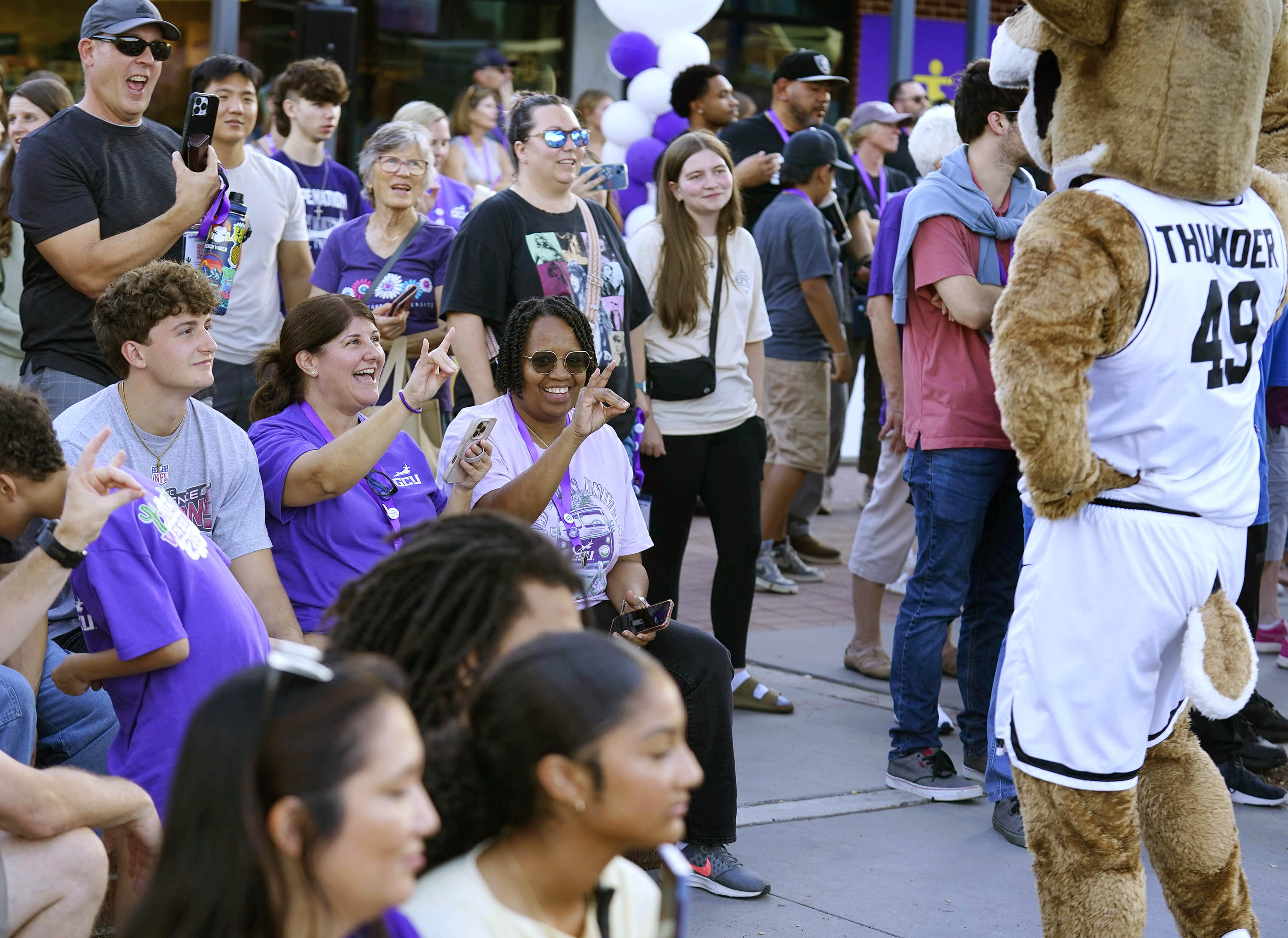
Not only was he a Dancing Dean, but he played Santa Claus and the Easter Bunny for campus events. He’d dress in costume for the fall festival, give out candy, hold babies and take pictures.
At a pool opening, he dressed in a duck costume and jumped in the pool, not realizing the costume was going to be so heavy, “I could barely get out of the pool,” he said with a laugh.

For now, Wooden doesn’t have a feeling for what he’s going to do in retirement. He has struggled with health issues over the years that have made it difficult for him to give 100% to his job.
What he does know is that it will be a challenge to move on, away from his GCU family, “But I trust God,” he said, and that it’s his time to retire.
Wooden added that he’s most proud of “being able to do whatever needed to be done” at the university, a place he’ll remember the most for its sense of community.

“This is what brings people joy,” he said of those times he played Santa Claus or was a Dancing Dean. “I wanted to help wherever I could. I feel like I got back 10 times that, just because of the feeling here, you know? It’s just a beautiful place to be.”
Manager of Internal Communications Lana Sweeten-Shults can be reached at [email protected].