EDITOR'S NOTE: This article originally appeared in the August issue of GCU Magazine, available in the purple bins around campus or digitally here.
When Grand Canyon University sought the president and CEO of Rounds Consulting Group to study the economic impact of the university, he figured it would be the typical financial report.
But it wasn’t.
What Jim Rounds discovered about GCU – about who the university is – goes beyond the typical economic impact study.
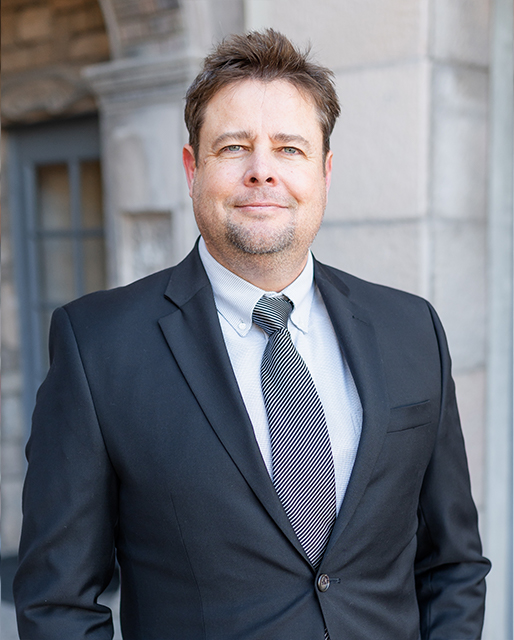
“Part of their mission is to reach out to the community. It’s core to how they manage. It’s core to their overall plan and vision,” said Rounds. “That ended up being a bigger piece of their impact. … We could have written something really simple. But digging into it, it (community) became its own major section of the report. They have a focus on these types of things beyond any other university that I’ve seen.”
Rounds uses a socio-economic term in the university’s study he doesn’t often use: inclusive development.
It means to make sure everyone shares the benefits of progress and growth – that no one, regardless of their background or circumstances, is left behind. That when one rises, so do the rest.
He boils down his consulting group’s 28-page report to this: While GCU knows the importance of higher-wage jobs or a qualified workforce, “If I had to reduce it down to something, it would be that GCU understands how to build an economy by helping to build the individual, the family, the neighborhood and the surrounding community first.”
***
Mariza Barron knows about building a neighborhood.
Her church, Reborn Church at 31st Avenue and West Indian School Road, jumped in this summer to help former GCU basketball star Gabe McGlothan with his basketball clinic for youth from low-income families.
When a shoe donor backed out, Nathan Cooper, director of GCU CityServe, called her and Reborn stepped up.
Her church partners with CityServe (one of more than 100 faith-based organizations to do so), which supplies vulnerable populations with donated goods. The church drops by the nonprofit’s warehouse about once a week to fill community requests.
“If it weren’t for GCU, there is absolutely no way that Reborn Church would be able to bless as many people as we do,” Barron said. “We don’t have the funds. We are a tiny church and we don’t have the donors.”
Reborn is in a neighborhood full of challenges – a “beautiful mess,” as Barron describes the immigrant and refugee area, which struggles with poverty, high unemployment and crime – where few want to visit in person, even to hand out goods for the church’s weekly Bless the Block.
But GCU is there.
When Reborn needs help picking up donations to the church, even if they’re not from CityServe, the GCU staff will volunteer to do that.
No doubt, Barron said, GCU is making an impact.
She shared the story of one church member she had called to ask if she needed a sofa from CityServe. The church member said, “If you saw the couches we sit on right now, you would be like, ‘wow.’”
Since 2021, GCU CityServe has distributed over $15.3 million in essential goods to over 74,000 families in need. This was made possible through 44,300 volunteer hours valued at $728,900. . . . This is equivalent to 21 full-time positions working on the initiative annually.
– Jim Rounds study
“Why didn’t you ask me for couches?”
“They’re for people who need them.”
The couches were in such bad shape the family had to throw blankets over them to sit comfortably. When they received the sofa, “She called me just crying; she could not stop crying.”
Barron said CityServe has been a godsend.
“It has blessed countless people. Countless. … It’s unbelievable how we’re a little but mighty church because of the help that GCU provides.”
***
Eric and Eileen Bolze also have been a little but mighty force working for community change.
Their custom manufacturing and fabrication shop, E2 Innovations, is nestled in a west Phoenix business complex on 28th Avenue. The Bolzes moved there in 2000 because it’s central to the Valley with easy access to the freeway.
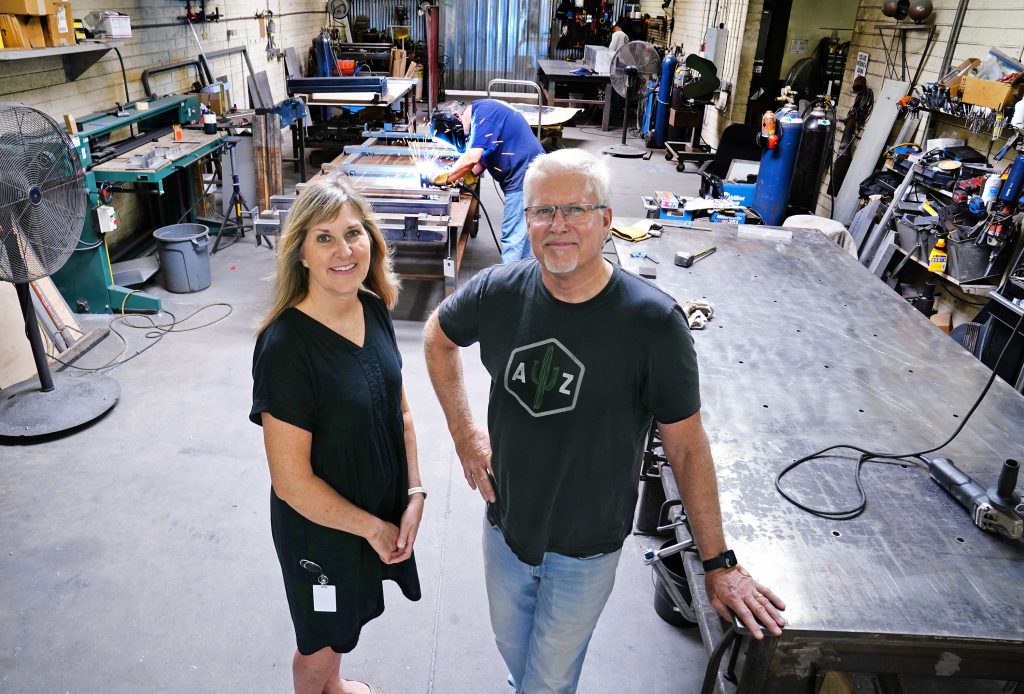
“It’s a great spot,” said Eric in a meeting room accessed by old barn doors, the space decorated with metal artworks.
But they saw the neighborhood start to change, and a decadelater, witnessed drug use and prostitution brazenly out in the open, experienced break-ins and watched a neighboring business on fire because of criminal activity.
Those owners who watched their company burn said, ‘Hey, we’re done,’” and were part of a business exodus.
Businesses will benefit from 10 hours a day, seven days a week patrol services, with access to immediate dispatch support for enforcing no trespassing policies. Over 12 months, 27Collab organizations will contribute over $200,000 to fund private security patrols, with GCU providing $10,000 of the total.
– Jim Rounds study
But not the Bolzes.
“We just took the position of, we refuse to accept this as the normal. We thought, what can we do to have an impact? That’s when we pursued GCU.”
Not that the Bolzes hadn’t been fighting for their neighborhood before then.
Working with the city of Phoenix, they formed a business alliance in 2017 and were involved with the city’s Community Safety Plan.
“Eric’s been a proponent in this area. He’s really been active as far as trying to make a change and get businesses onboard before there even was a business alliance,” Eileen said.
GCU, too, had been partnering with the city on its Neighborhood Safety Initiative, an 11-year, $2.2 million partnership from 2012-23 that saw a 37.7% reduction in crime, according to FBI statistics. That’s 661 fewer crimes annually, a savings of more than $65.6 million through those efforts, according to the Rounds study.
A little more than a year ago, when GCU started the 27Collab – a coalition of about 80 neighborhood groups – the Bolzes were in.
“We’re big fans of GCU,” Eileen said. “We’re Christians, we’ve had two girls go through GCU, we have season (basketball) tickets, so personally, we’re invested in the area, we’re invested in the school.”
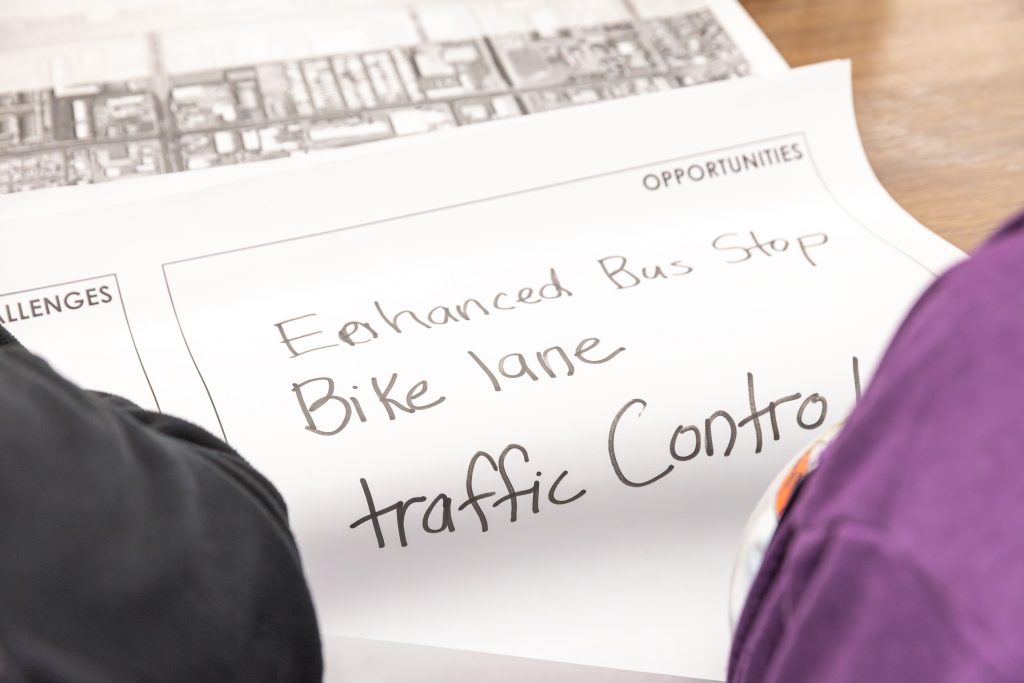
What has been a game-changer is the 27Collab’s Private Security Collaborative, in which organizations pool their resources and pay a monthly fee for a private security patrol 10 hours a day, seven days a week.
The Bolzes haven’t contacted police since patrols began in June.
“That’s what’s great – we don’t have to be (in contact),” Eric said, and added that local police officers who spoke with him “couldn’t say enough great things about the collaborate effort with GCU.”
Eileen added, “What they (GCU) are doing is, they’re putting light out into a community in the dark, so it’s really powerful.”
***
Jeff Spellman has lived in his Phoenix home for more than 45 years and remembers when he planted his first pine tree on the property. It now towers 30 feet high.
He and his wife have put a lot of love into their home, though it hasn’t always been easy to be there, like the time his elementary school-aged son watched a man drop off a prostitute nearby.
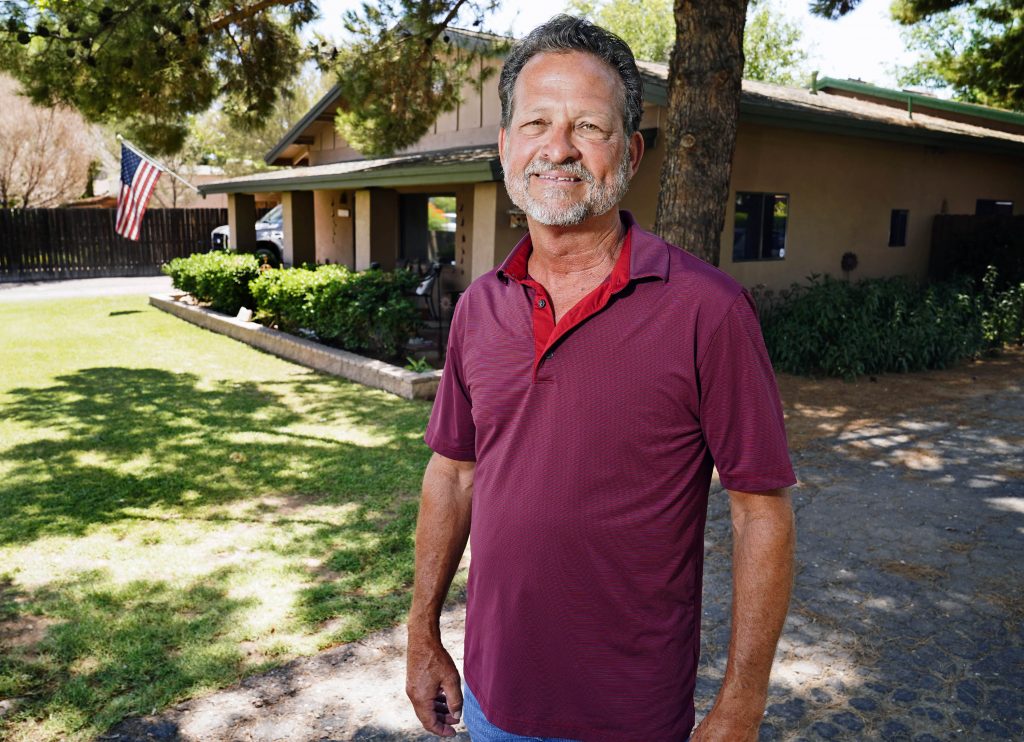
“How do you explain that to a kid?” said Spellman of that time in 2014, when prostitution and other crimes were “in your face every day” and rampant along 27th Avenue.
His wife told him, “Let’s just move.”
“But I said, we’re not moving. They’re moving.”
So when police ended its Violence Impact Project, which targeted that type of crime, and sought someone to lead a community group with a similar mission, Spellman took it on.
That community coalition, which goes by the same name, has moved mountains in its 10 years, primarily through zoning. “When a developer came into the Planning Department, they’d ask them, have you talked to the Violence Impact Project?” Spellman said. “Developers have learned that working with the community is beneficial to them.”
“With GCU, the whole is truly greater than the sum of the parts when it comes to economic, fiscal, and community impacts. … The extent to which GCU provides community services at this scale reduces the need for governmental expenditures on these areas, thus saving the taxpayer even more dollars than are displayed under the benefits calculated in this report.”
– Jim Rounds study
It’s how the group has helped shape the community, trying to make sure vacant buildings, which attract crime, are occupied by enterprises beneficial to the community.
It scored a big win advocating for the five-years-in-the-making Innovation 27, an old Kmart being transformed into a hub for high-tech industries and job training. The group also put its weight behind the Haven, the site of the old Phoenix Inn near 27th and Northern avenues that’s now a shelter for unhoused seniors.
Despite those successes, “None of us, individually, has been able to have the total impact (we want) on the entire 27th Avenue corridor by ourselves. … We don’t have the bandwidth to pull all those things together.”
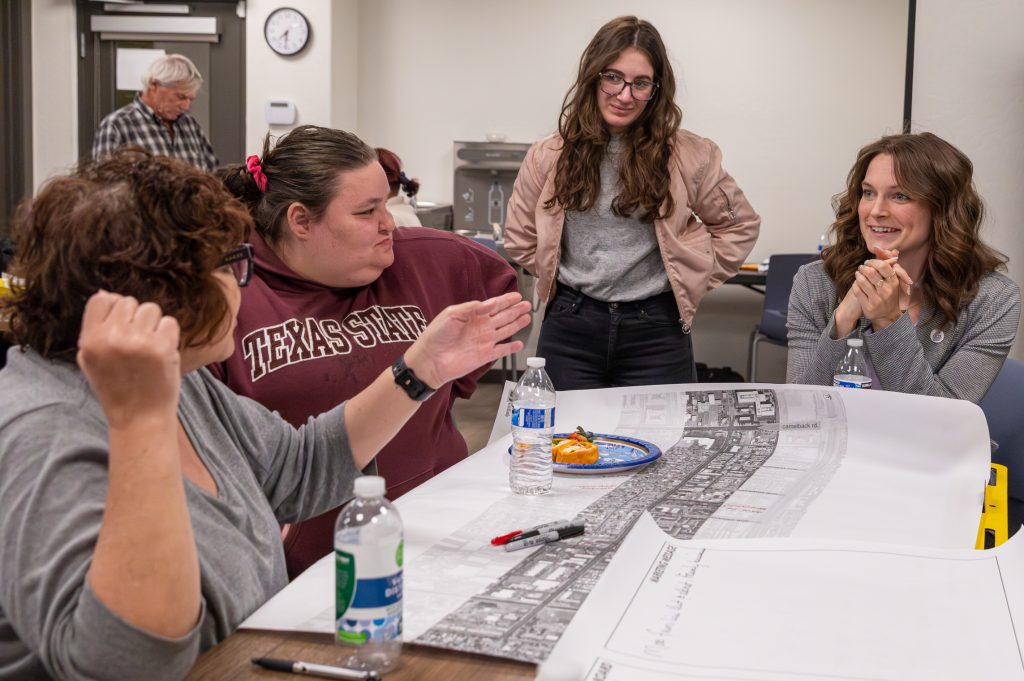
That’s where Andrea Northup, GCU’s assistant director of state and community relations, comes in. When she met with Spellman for the first time, she asked him, “How can we help?”
Spellman said she told him GCU didn’t want to take over existing efforts or start something new, “We want it to still be what the community wants.”
She organized meetings, workshops, goal-setting sessions and events, like a Saturday market, and has kept the conversation going.
Spellman said, “Andrea’s been the glue that’s been able to bring us all together.”
***
Gwendolyn Relf, founder/CEO of Rehoboth Community Development Corp., has worked in the neighborhood near GCU for two decades.
“The demographics have changed tremendously. … It’s very diverse, even at Rehoboth Place, we have a microcosm of the area,” she said of the affordable housing facility and its neighbor, Rehoboth Place II.
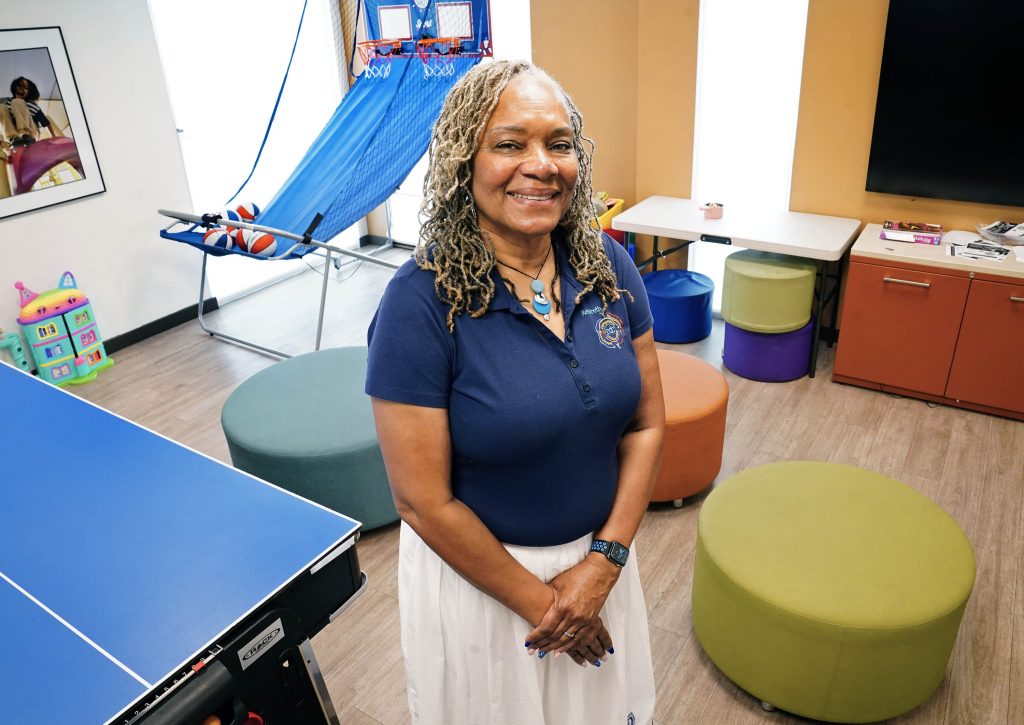
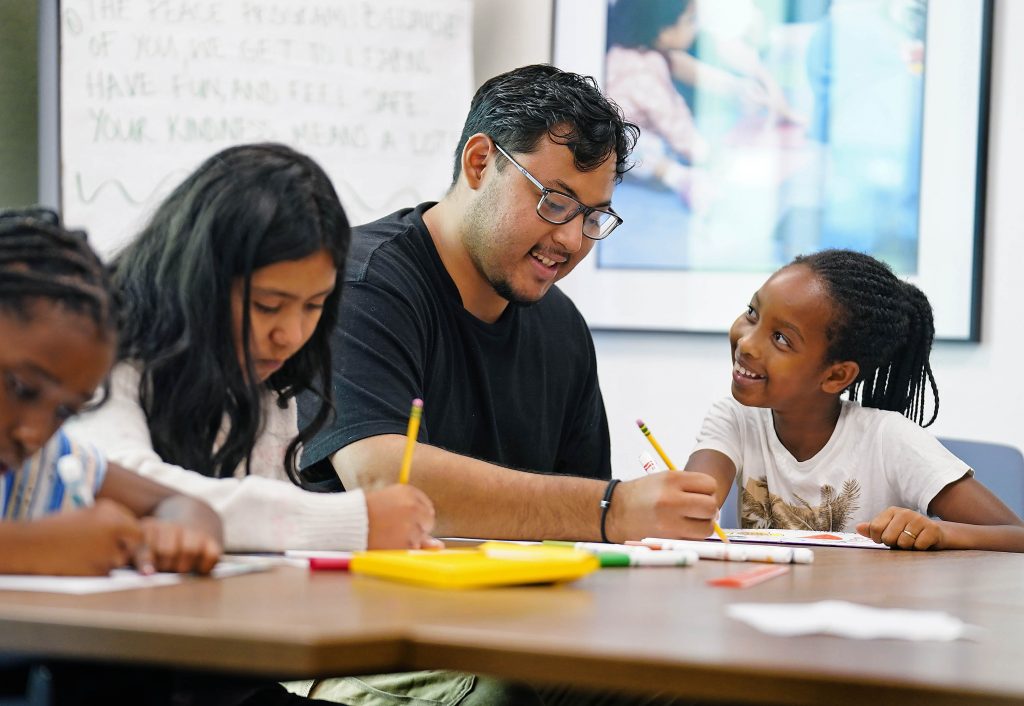
Rehoboth is one of the neighboring places where GCU students volunteer to play with children, work alongside them in the gardening ministry or tutor them.
“The impact that GCU is having on just the residents who live in our apartment community, especially the youth, has been tremendous,” Relf said.
She likes to tell the story of Jaden, who told his mom he wanted to work at a doughnut shop.
“It was just his vision of what he wanted to do,” said Relf.
“Between 2010 and 2020, the neighborhood surrounding GCU has become more diverse, as the white population share declined from 57.3% to 38.1%, while individuals identifying as two or more races increased from 4.0% to 17.2%. While this economic diversity is normally associated with more modest income growth due to poverty disproportionately impacting minority groups, household incomes have actually improved over the decade.”
– Jim Rounds study
But being around GCU students, and after having visited campus, “he realized the possibilities of what he might be able to achieve and told his mom he wants to be an engineer,” Relf said. “It changed his whole view of things.”
GCU has done the same for K-12 youth through initiatives like the Learning Lounge tutoring space and Canyon Rising (the former Students Inspiring Students) scholarship program, which has “transformed lives and communities, with 218 to-date graduates generating an estimated $1.2 million in annual state and local tax revenues,” according to the Rounds study.
Relf said the pastor of her church, Rehoboth Saint Center, wanted to minister to the community outside the church’s four walls, something GCU does.
“We both have the vision of doing ministry outside of the boundaries we have. We make sure that we’re intentional, and I think GCU is intentional in that manner,” she said.
“It’s more than just work; you’re building community.”
***
Several years ago, Shirley Dieckman’s home, just across Camelback Road from GCU, got a window upgrade, thanks to GCU and Habitat for Humanity-Central Arizona.
The community partners replaced her old-timey, crank-style, fire-hazard windows, which didn’t open far enough, if at all, to allow for escape.
They also painted her home and replaced her window wall, which offers a spectacular view of the back yard and its jaunty grapefruit tree.
Dieckman is grateful for the upgrade.
Repairing the window wall would have cost double or more what she and her husband paid, since a portion of the cost is covered.
“That (the repairs) really helped bring up the property value for those homes without displacing any people who currently live there,” which in turn added wealth to individual households, said Luis Cordova, senior vice president and chief operating officer of Rounds Consulting.
“The rise in value across the 537 renovated homes (repaired since 2015 as part of a Habitat for Humanity and GCU partnership) alone contributes approximately $946,200 annually in local property tax revenues. … (That) does not account for surrounding properties, which have also likely experienced value appreciation due to GCU’s efforts.”
– Jim Rounds study
Dieckman said she heard Mueller say how the university could have moved to another part of Phoenix with less crime, less poverty, less need.
University leaders chose not to.
“He said, ‘Why move, when we’re right here in the middle of a mission field.’ … I was so impressed when he said that,” said Dieckman, a former GCU adjunct who leads the Alhambra Neighborhood Association, which has worked with the city Gated Alley Program to add gates to alleyways, often sites for criminal activity, and is trying to start a sports team at a local boxing gym.
Dieckman said her neighborhood, once a white, middle class area 45 years ago when she moved in, has seen an exodus in part because of crime, in part because her generation is getting older and moving on.
Three empty houses dot her street alone.
But she and her husband have chosen to stay here.
“Faith has got a lot to do with it,” she said of her love for her community. “I’m just wanting to help my neighbors feel safer. … I’m wanting to keep people motivated to make the neighborhood better – to tell them there’s a way to solve it.”
E2 Innovations business owner Eric Bolze remembers reading an article about the increase in home values around Phoenix.
“The greatest increase in the value was in the area just south of GCU,” he said. The Rounds study, released in the spring, reported an 842% increase in median home values within the 85017 ZIP code since 2011.
“I’m like, wow, that says a lot about what GCU has done,” Bolze said.
For Rounds, GCU’s greatest contribution is clear.
“It’s what happens off campus, and that’s supported by the argument that they do have an impact on the community,” and it’s not a negative impact, he said, but a positive one: “It’s lifting the community.
***
GCU's economic impact
The university’s presence in the Phoenix community supports:
- 21,248 full-time equivalent jobs, locally and throughout Arizona
- $1.1 billion in labor income (aggregate employee-earned wages)
- $2.8 billion in economic output each year generated by GCU operations
- $80.7 million in state and local tax revenues
– Source: Elliott D. Pollack and Co.
.