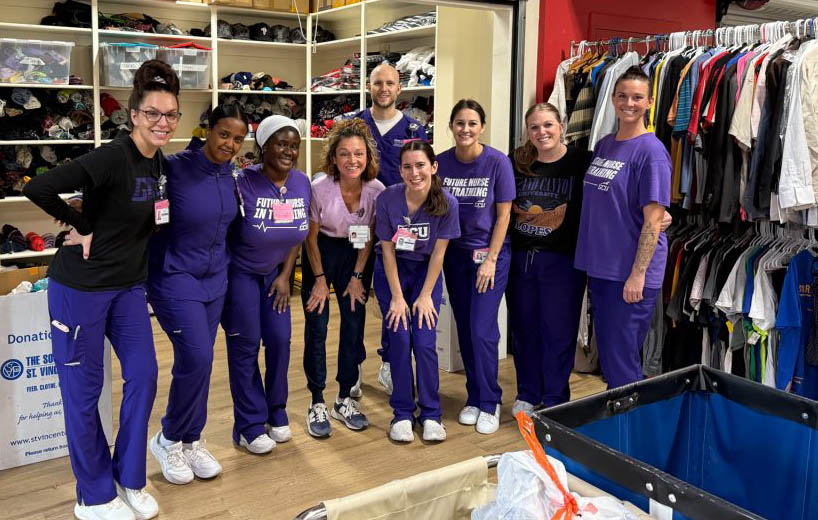
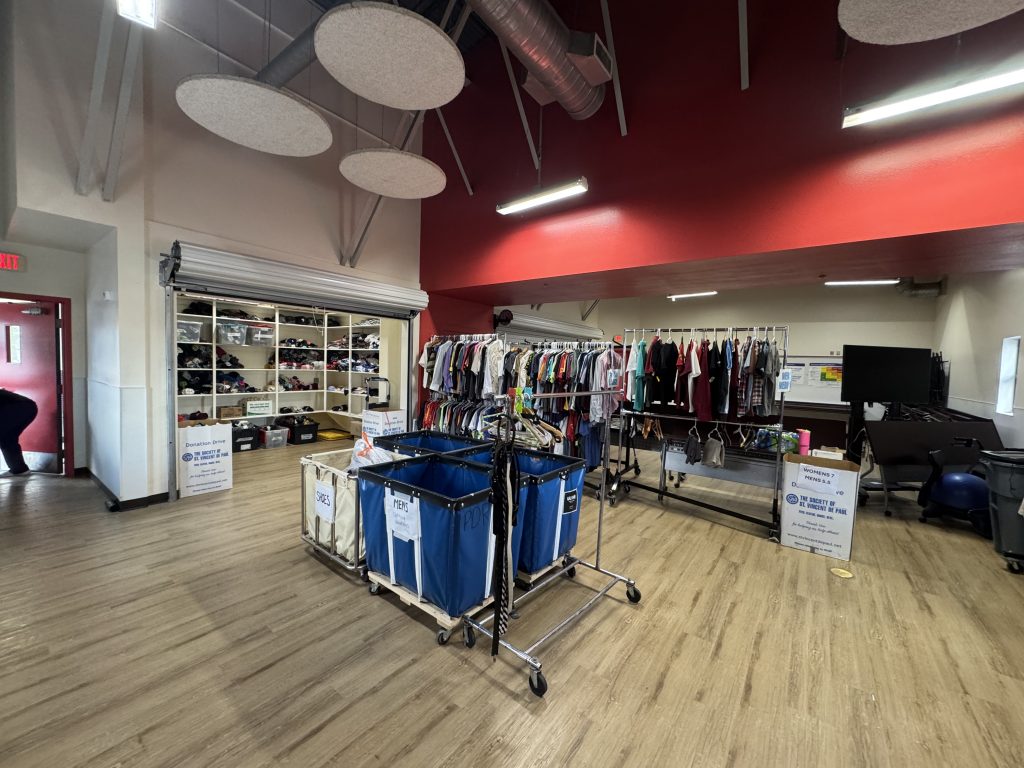
It took just five weeks to get to a happy ending for eight Grand Canyon University Accelerated Bachelor of Science in Nursing students who organized a clothing bank for Phoenix's St. Vincent de Paul.
“We actually were just shown the room and were asked to help organize it a little bit,” said Ali Nischan, one of the eight students from the university's ABSN site in Chandler, Arizona, who were involved in the project. "And just as we were doing it, the thought came out of my mouth unintentionally that, hey, maybe this could be a project that we could get going."
The students, who all were on their public health clinical rotation, cleared the project with Dr. Tristan Palmer, the College of Nursing and Health Care Professions' director of clinical operations. She had them thinking about the program and discussing why providing clean, usable clothing was a key component of quality public health.
The spark of an idea
In the class, students are required to promote health and well-being through an education project. The idea behind the clothing bank is to serve clients who are unhoused or impoverished.
“(It was) understanding the need for clothing and how it can protect bodies, skin and their health and their well-being,” Nischan added. “And then also just informing them about the availability of resources, like the clothing closet and different resources within the community.”
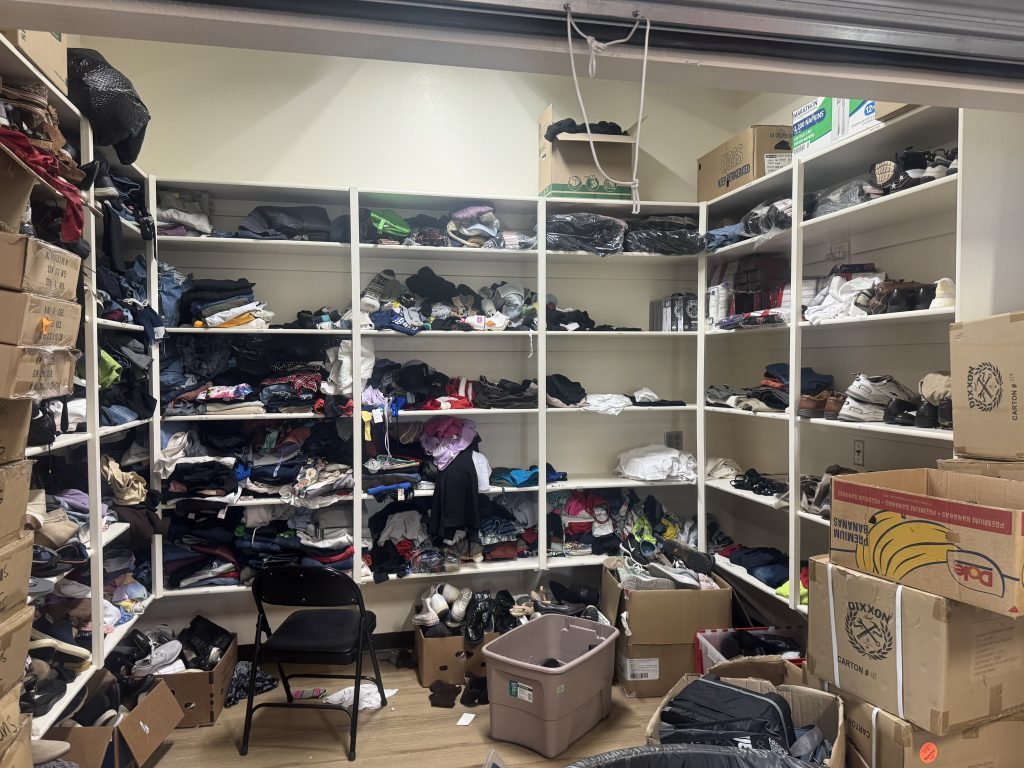
Even before the clothing bank was completed, clients would stop by the fledgling closet – a modest-sized room with open floor space and shelves – and already were asking if they could get clothes, said one of the students, Breanna Crouch.
“People would walk in. Alexandra (Johnson) and I were in there at one point. Some guy walked in and was like, ‘Is this available?’ type of a thing.”
Those early interactions provided the team with focus.
Johnson said that the clothing bank experience gave her a perspective she can use if she ends up teaching nursing.
“Then, as we kept going, it was very apparent that not only did we see that they needed it (a clothing bank), but they actually wanted it as well,” Crouch said.
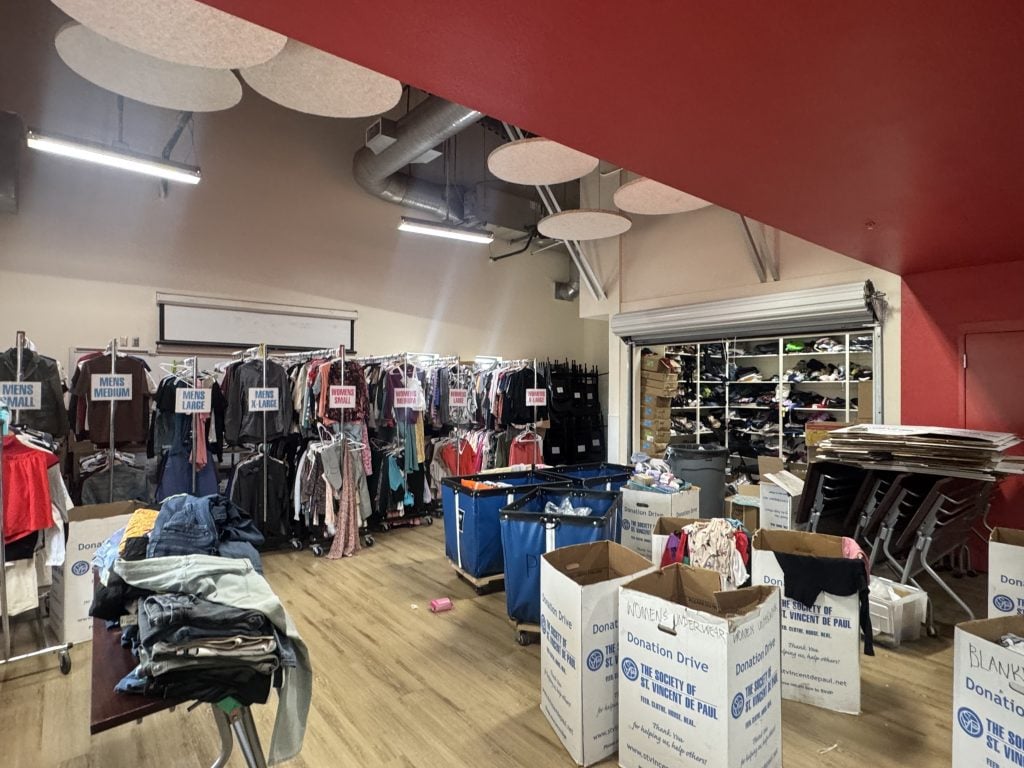
Another goal was to organize the clothes closet like a conventional retail store.
“We wanted them to come in and pick out their own clothes. Usually, clothes were picked for them,” said Ashley Gordon. “It gives them confidence, maybe even the confidence to go get a job and feel like themselves again.”
Organizing chaos
The team plowed into the room, where hundreds of clothing items were haphazardly stored in bins, boxes and shelves. It began as a simple idea, but the students faced numerous challenges, including being on site only one day a week.
“I think one that was a little bit frustrating is that each week when we would come back, the organizing that we had done either a few days ago or the previous week had kind of been set back,” said student Faith Stewart, who wants to work in a pediatric or adult cardiovascular ICU. “(When we were gone), another group would come in and move some of the stuff we had organized around, or more donations would come in, which was great.
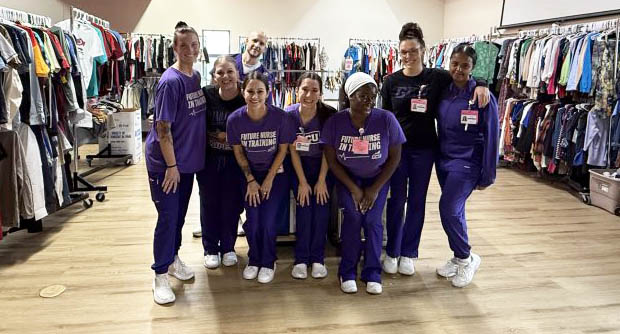
“So then as we went along, we kind of put little notes like, ‘Leave this here, we’re using this on Monday or this day,’ or whatever it was,” she said.
From the day they started, the clock was running. Since the clinical rotation is just one day a week for five weeks, students had to come up with the project, implement it, and complete it in the equivalent of working for five days.
“Another challenge ... would be time,” said nursing student Suado Abdullahi. “... Thankfully, we finished it, but it was a lot, especially in the short amount of time that we did have.”
Abdullahi said that they had to tackle more incoming clothes inventory while trying to focus on what was already there. Every week, the students faced new piles of donations. They also learned to function as a team.
More importantly, they learned that nursing and compassion extend beyond health care facilities.
Personal growth, professional career
For the seven women and fellow ABSN student Bryce Hicock, the experience meant more than five weeks of hard work. It reinforced their personal growth and connection to their field.
Students who are part of the ABSN program – GCU operates 11 ABSN sites across eight states – have previous college credits and often are re-careering into nursing after having worked in other careers. Through the hybrid accelerated program, which combines online didactic learning with on-site, hands-on study, students can complete their studies in as little as 16 months.
“Nursing is my second career. I’ve been in corporate America, (and nursing) is where I’m meant to be. We care for people in their most vulnerable moments,” Crouch said. “So I think that rather than looking 10 years down the line for me, I'm kind of just like, ‘Let’s see what I can do now each day and go from there.’”
The one-on-one human connection through bedside nursing is what draws Gordon to her path: “My boyfriend’s mom was a bedside nurse for 35 years, and I’ve been really inspired by her stories and the people that she’s come across over so many years. And not only as a nurse, but all of her human connections that she made with patients.”
Nischan spent a decade as an elementary school teacher before entering the program. She loves the versatility of it.
“I think that’s the greatest part: that we don't have to know our future because there are so many different opportunities. (Nursing) just allows you to grow and explore your passions and desires for caring and serving others.”
The entry into nursing was different for Johnson, who was a stay-at-home mom for 13 years.
“I’ve had a few experiences with emergency trauma kind of situations in the past, and that’s just where I thrive. But I know I’m just excited to get to develop my own career for the first time in my life.”
Lily Ayitey has persevered in working toward her nursing career, having attended college since 2017 to be this close to earning her degree. Her goal is to do bedside nursing and "see what comes along."
Stewart said, “I've known for a long time that nursing is a calling that God placed on my life, and so I've kind of just taken the steps to be obedient in that calling. I have so many interests, and I've loved every clinical rotation that I've had, so that’s just been really difficult to know what I want to do long term.”
The clothing bank experience opened a new door for the group in several ways. One was the understanding that public health nursing can be more than direct patient care. The second is how to function as a successful and productive team.
Building a team
“We're such a great team, especially with organizing the closet," Ayitey said. "Ali was so wonderful for bringing the idea. We're just such a great team, and we did it together.”
When the project concluded earlier this fall, the group prepared instructions for volunteers that explained the organization, system and restocking procedures. The clothes bank was to be open twice a week. By November, St. Vincent de Paul staffed it with volunteers so that it is open throughout the week.
For five weeks, the eight nursing students worked diligently to complete the project before the end of their rotation. They built a close team relationship.
“We listened to music, we danced, we acted like fools,” Gordon said. “We laughed, made memories. It was really fun.”
GCU News senior writer Eric Jay Toll can be contacted at [email protected]
Related stories:
GCU News: GCU building well-rounded students through clinical rotations
GCU News: Critical care instructor guides nursing students through life and death