
Testimonies from California education partners celebrate GCU in credentialing process
Grand Canyon University has cleared a key step toward offering California-specific teacher-preparation programs.
The College of Education won commission approval to advance in the state’s review process with support from 28 California education partners. The California Commission on Teacher Credentialing unanimously approved GCU’s Stage 2 submission, allowing the university to proceed to Stage 3 of the five-stage initial approval process.
The decision moves GCU closer to offering three programs tailored to California requirements. These tracks include a master’s in multiple-subject teaching, a master’s in educational specialist preparation, and a bachelor’s program combining the two credentials.
The university plans to submit its Stage 3 materials in early 2027. If approved, GCU could begin enrolling California students in these new programs during Stage 4, a trial period in which it would track student progress and program outcomes.
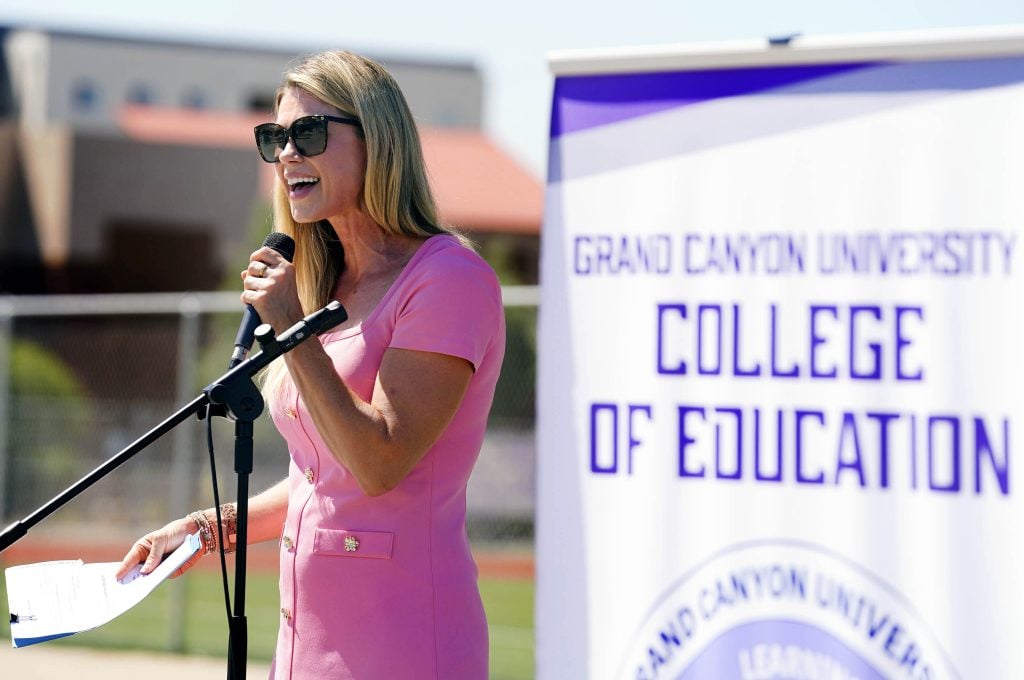
“This was really important, and I’m so glad that we went in person. I believe CTC needed to see how important this was to Grand Canyon University,” said Lindy Guadiano, an assistant dean in GCU’s College of Education. “We want to ensure that we are continuing to provide opportunity for those California students.
“This is only going to help to further grow that enrollment specifically in California, and it really will be the first of its kind where we have three state-approved programs for one specific state.”
Guadiano and Dr. Cameron Whitcomb represented GCU before the commission, with GCE regional director Matt Nalan supporting the audience. COE Associate Dean Emily Potter joined remotely. Hart Boyd and Frances Kellar, GCU’s commission liaisons, introduced the agenda item and outlined the Stage 2 submission and staff recommendation before Guadiano and Whitcomb answered commissioners’ questions about the proposed programs and GCU’s work in California.
The 28 written public comments of support were a standout moment at the meeting in Sacramento, held the same day as the COE’s fall kickoff event. They came from California education leaders who described their positive experiences with GCU. Rick Crosby, a superintendent with Duarte Unified School District in Los Angeles County, spoke live during the meeting and urged the commission to let the university proceed.
“I’ve been working with them and with our district for the past seven years and (always) appreciate their support and work with our district,” Crosby said. “I am in full support of Grand Canyon University moving on to Stage 3.”
That support reflected relationships built over many years.
University enrollment teams began working with California schools and districts about 15 years ago, developing partnerships and tailoring professional development and academic pathways to local needs.
The goal, Guadiano said, has been to meet schools where they are and help address needs, such as special education and technology teachers.
GCU students in teacher licensure programs currently complete programs aligned to Arizona requirements. The proposed programs would be developed around California standards, creating a more direct path for students seeking to teach in the state.
“They truly would be able to enroll in one of the California-specific programs,” Guadiano said. “Once they’re done with their coursework … they can go right to CTC and they’re done.”
The programs are designed especially with online learners and working adults in mind, including people already working in schools. COE Dean Meredith Critchfield said the university currently has more students in California than in Arizona and more than 3,000 California candidates in its education-preparation programs. The programs, she said, would give candidates the standards and curriculum they need to serve students in California schools.
“Our mission really was to try to figure out what can we do to help streamline their path and help them get the best education possible,” Critchfield said.
The state-specific approach is an undertaking, requiring new curriculum and continued reporting to the commission. GCU’s Stage 3 materials will include more detailed documentation of program design and implementation, including California-specific clinical-practice materials.
The approval process has already involved extensive work. Stage 1, an institutional review that required detailed information about the university, took about two and a half years and was nearly 600 pages of work, Guadiano said. Stage 2 focused on academic and student-support processes, including clinical practice and student grievance procedures. The next stages will assess how the programs operate and how students progress.
GCU’s California effort involves teams across the university, Guadiano emphasized, including curriculum, clinical practice, credentialing and faculty.
“It truly is a university-wide collaborative effort to move these three programs forward,” she said.
The commission meeting was a high-stakes moment for the GCU team. Representatives had prepared over several weeks, meeting regularly to anticipate questions and coordinate their responses. They arrived in the morning and waited through much of the day before presenting.
The 28 comments of support helped demonstrate the breadth of GCU’s California relationships and the positive impact of the university.
Critchfield called the response a point of pride.
“We just weren’t sure how it would go,” she said. “So we’re happy. There’s more process to go … but this is a big deal.”
GCU News senior writer Jason Gonzalez can be reached at [email protected].
***
Related content: Theology, education colleges earn multiyear accreditations