EDITOR'S NOTE: The following story was originally published in the November edition of GCU Magazine, available in the purple bins across campus or digitally.
Photos by Ralph Freso
A Valley man in recovery doesn’t have a driver’s license, so he pedals his bicycle 16 miles each day to work and back. He’ll soon get an e-bike with pedal assist to make his life much easier.
A middle school boy wanted to visit his dad in the hospital but couldn’t fall behind in his homework. He brought his Chromebook to the bedside and kept up in his class.
A 20-year-old from Scottsdale couldn’t ride the bus to get to a job because it was too noisy and chaotic for someone on the autism spectrum. He got an e-bike to put him in the running to change his life.
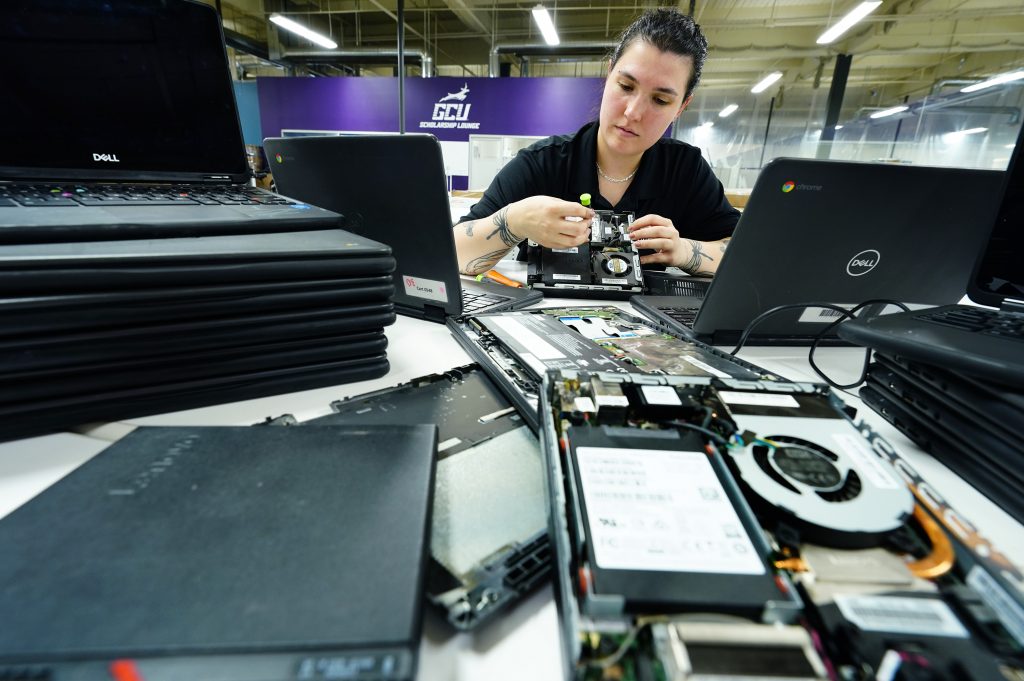
The technologies to help those people in need come from Grand Canyon University CityServe Tech, a growing arm of the outreach ministry that started in 2021 by distributing millions of dollars of household goods and necessities to Arizonans.
When CityServe Director Nathan Cooper met Tom Mehlert, Mehlert was part of a nonprofit that fixed old laptops to distribute to Arizona schools and nonprofits. It sounded like a perfect fit for CityServe, so the two organizations began working together in fall 2024. Mehlert joined GCU as its circular economy manager in January to run the program through CityServe at its headquarters in Building 66 at the university’s business complex on 27th Avenue and Camelback Road.
“Where individuals are lagging in technology, that’s a barrier,” Cooper said.
For a middle-school child in a school where a high percentage of the students come from families in need, even if they are issued a Chromebook, parents don’t have the money to keep them operating, he said.
The technology also can help people who are in distance learning, who need to digitally apply for jobs or who simply need to set up an email account to communicate with potential employers.
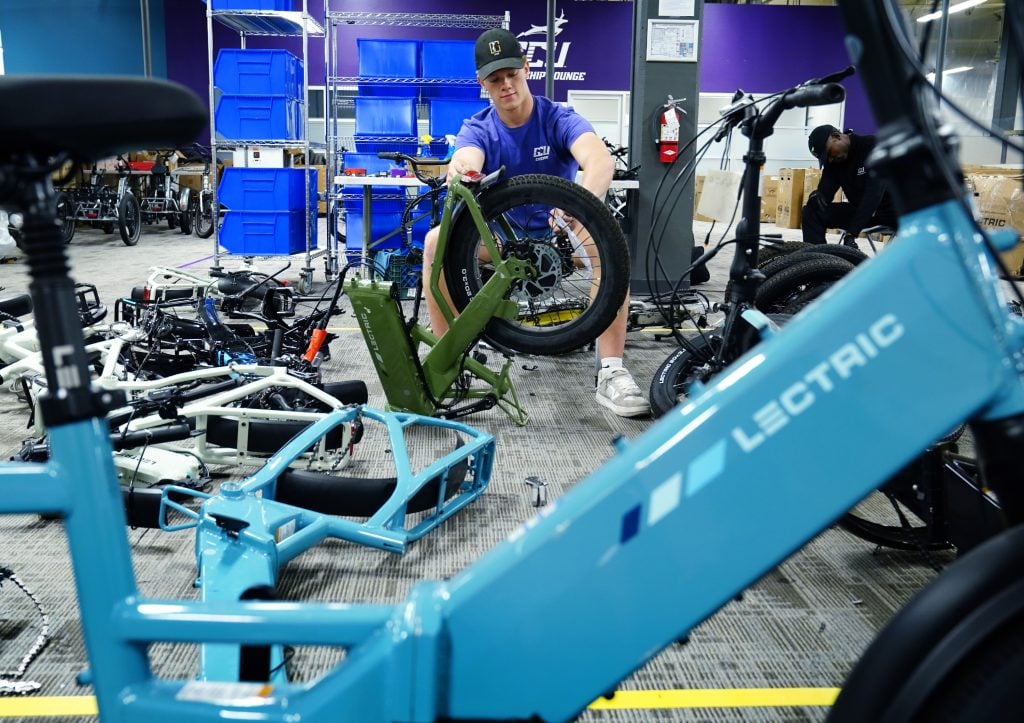
Student workers and volunteers from GCU, many who gain valuable skills as engineering or technology majors, help wipe the data, refurbish the computer and add necessary software.
Hundreds of laptops and Chromebooks have been issued in the program so far, though there is a recent shortage of donated laptops.
Then a sizeable donation dropped in CityServe’s lap, which will allow Cooper to double the number of volunteers and student workers and help remove another significant barrier to those in need.
Lectric eBikes co-founder and GCU alumnus Levi Conlow, whose Phoenix-based company produces the Lectric XP, one of the nation’s top-selling e-bikes (according to trade publication Electrek), had a warehouse full of e-bikes damaged in shipping.
Did CityServe want them?
A new idea was born that helped create the CityServe Tech arm of outreach: Just like with computers, they could fix up e-bikes and donate them, this time to help solve the transportation barrier.
“Phoenix is so spread out that if you address some personal mobility, it does a lot for their quality of life,” Mehlert said. “I’ve been a cyclist forever, and I just got my first e-bike, so I was familiar with it, and I was like, ‘Yeah we can do this.’”
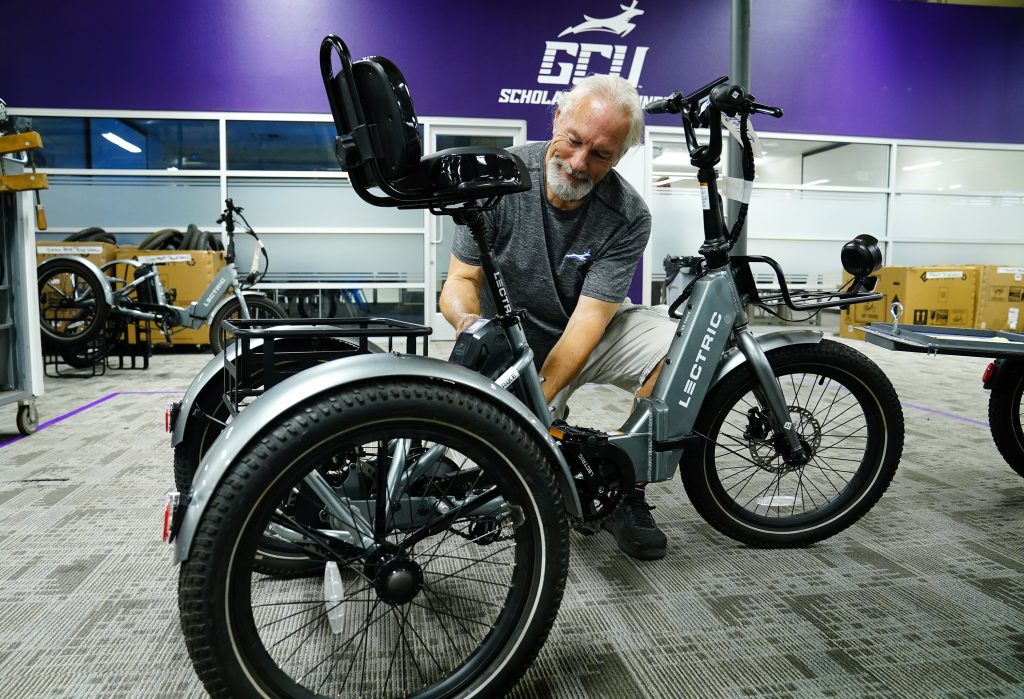
More than 700 boxes of e-bikes soon filled the corners, nooks and crannies of Building 66, and student workers and volunteers got to work.
Already, 150 e-bikes have been donated to dozens of partner organizations that work with CityServe and distribute them to those they serve.
One was an aging pastor of a small rural congregation who found it hard to get around the church grounds and back and forth to his home. It kept him at the pulpit and the church alive.
Another was an aging farmer in the Navajo Nation who had trouble getting around the farm but could use the e-bike to continue farming.
“We’ve got tons of those scenarios,” Mehlert said.
Conlow visited the facility on a late September afternoon, a bit of nostalgia for Cooper and Conlow, who built an electric skateboard company in the same building as GCU students. (“Has it been 10 years?” mused Conlow).
He was impressed with CityServe Tech, which had just expanded to the northwest corner of the building, lined with boxes of e-bikes, piles of parts and newly refurbished Lectrics.
Graduate assistant Kaitlin Martin had created a white board flow chart for the process of when an e-bike needed repairs or needed to be scrapped for parts or was set to be tested by several GCU departments, like the mail center, which rides them to ensure they’re ready to donate.
Even Conlow’s cousin from Minnesota was there. Brooklyn Johnson is a sophomore at GCU and student worker helping with the e-bike restoration.
“I thought it was great that they give them back to people in need, so I love what they are doing,” Johnson said.
The group also worked out problems on the spot. They asked Conlow what to do about finding enough e-bike chargers. They have 60 e-bikes ready to go but not enough chargers.
“Come to me,” Conlow said. “I have, like, 10 in my car. … And we can order them and give them to you guys so you will have an inventory you are sitting on.”
“I want us to be helping but not a drain,” Mehlert told Conlow.
“No, it’s more butts on bikes,” Conlow said, shaking him off.
“We were just scrapping (the e-bikes), but they’re actually salvaging them, taking this part or tweaking that, and it’s rideable and is donated to the community,” Conlow continued. “And that adds one more person using electric transportation – and that, to me, is a total win.”
***
Related content:
GCU News: CityServe's laptop initiative computes with the community
GCU News: From assembling beds to food distribution, GCU CityServe Day fed the spirit
GCU News: The story behind a donation to GCU that's more than its parts