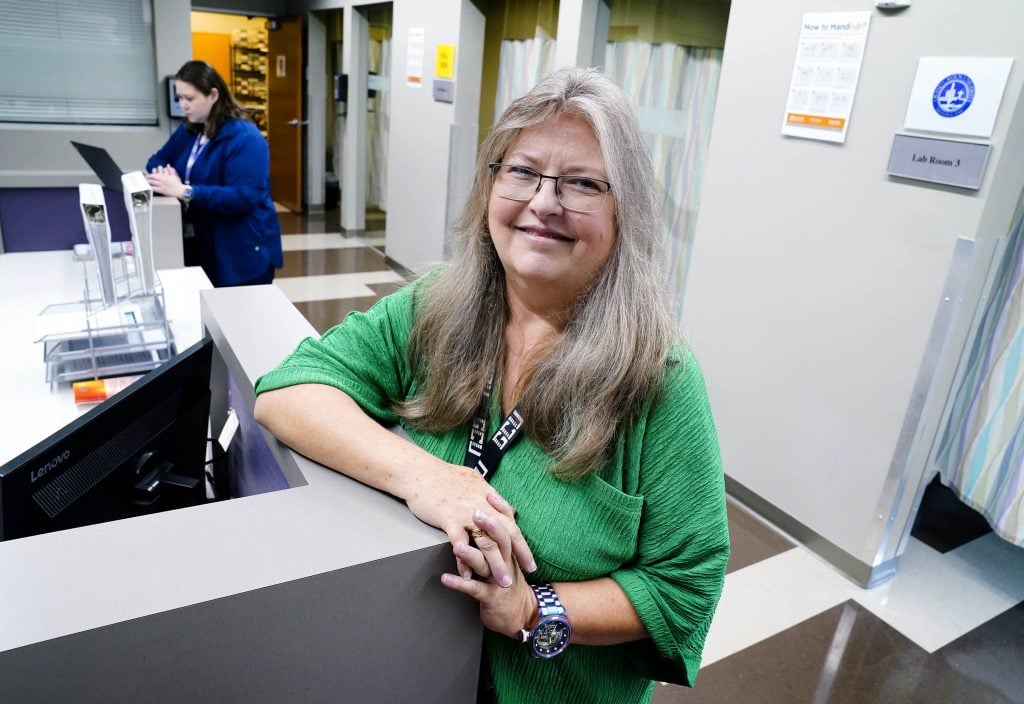
“It’s like the phone rang and you answered it,” Becky de Tranaltes said when describing the nursing profession and the passion she has for it.
De Tranaltes, part of the nursing faculty for the prelicensure bachelor of science in nursing program at Grand Canyon University, said that it’s not easy to teach someone to look at nursing as something that comes from deeper inside a person, she said.
“It’s not like dad saying, ‘take over the family business,’ or something like that. Students are drawn to nursing,” said de Tranaltes, honored recently with a prestigious DAISY Award, a recognition program by the DAISY Foundation that honors nurses – including nursing faculty – for their exceptional work in the field.
De Tranaltes decided to go into teaching after the challenges of COVID on the profession, when she saw health care breaking down.
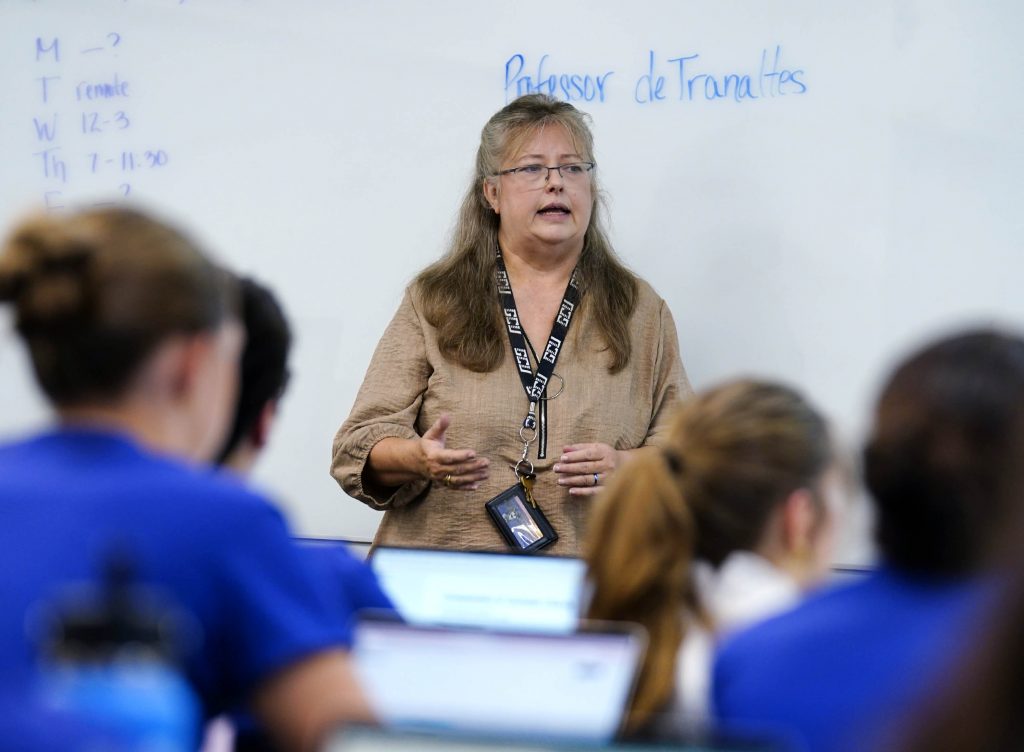
She returned to school and earned a master of science degree in nursing education and joined GCU 2 ½ years ago to teach critical care nursing.
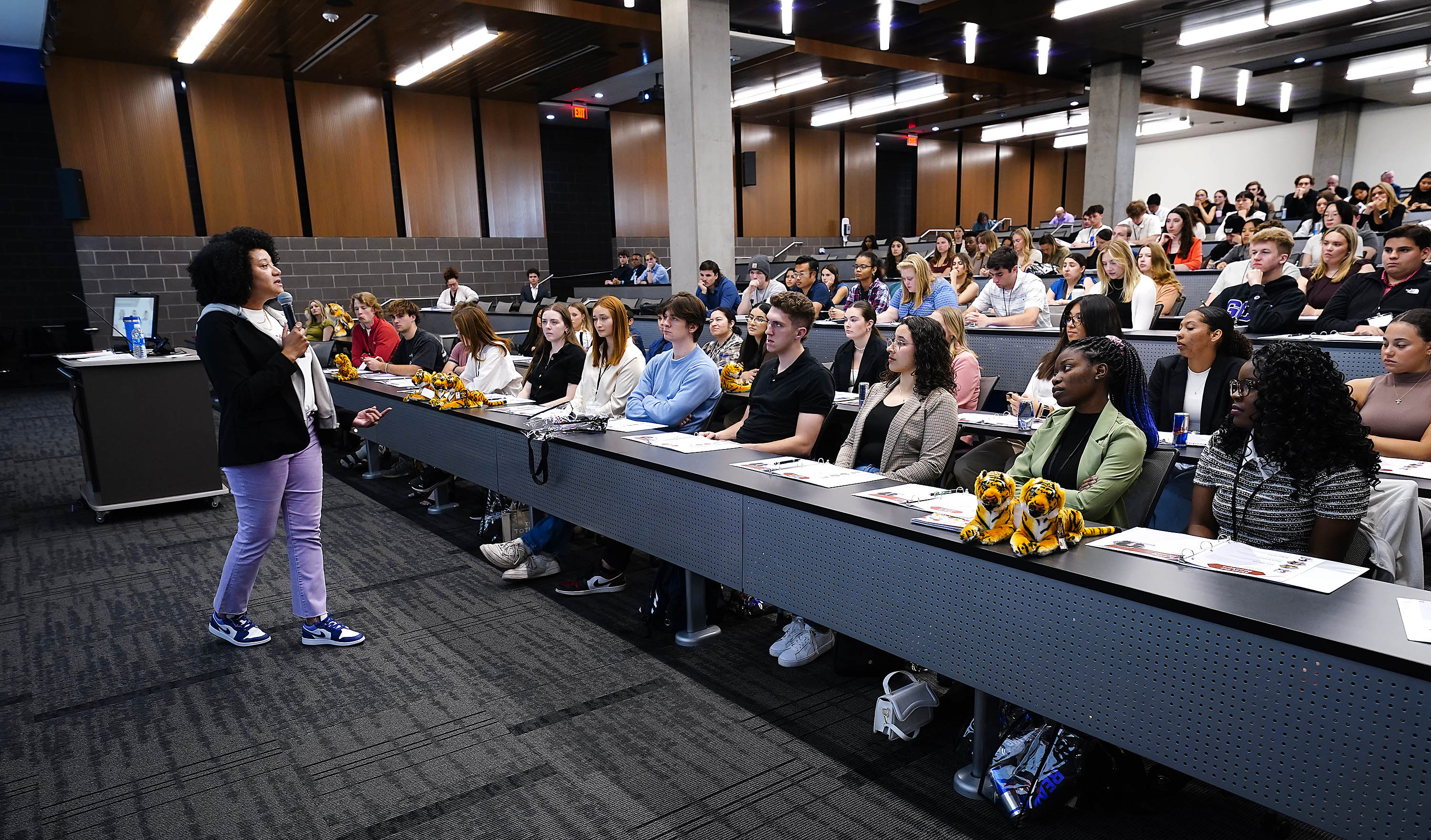
“‘Crit’ is what the students call it,” de Tranaltes said. “They get very excited because we're teaching them how to be (intensive care unit) nurses."
Students are drawn to critical care because of its fast-paced environment, and a student has to do more because the patient is critical, said de Tranaltes. She also said they have much more interaction with the patient's family.
De Tranaltes said she can’t teach students the calling, but she can instill passion in teaching a better patient experience for her critical care courses.
Sometimes, it gets challenging.

De Tranaltes de-stresses outside of the classroom by hitting the open road with her husband – they're empty-nesters with two children who are doctors (one a plant geneticist and one a physician) who love to go four-wheel driving.
They’ve been all over the Four Corners region in Colorado, Utah, Arizona and New Mexico. Colorado is one of their favorites.
“We’ve sat in the Ouray (Colorado) Hot Springs when it’s been snowing,” de Tranaltes said. “It's so neat to sit in a hot spring and be hot below and snowing above.”
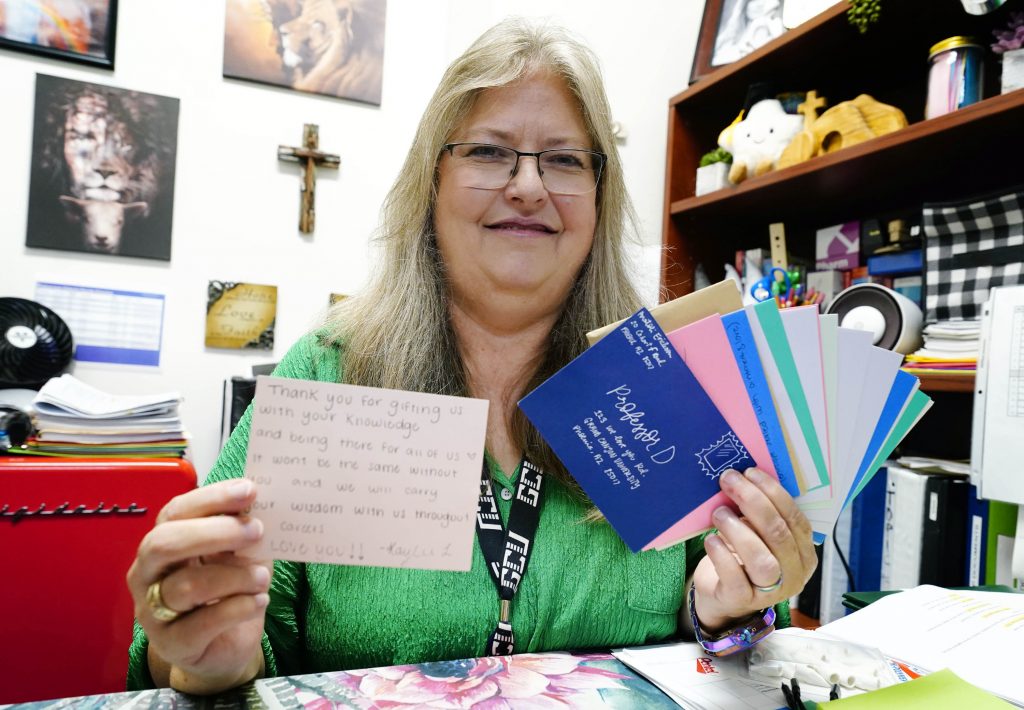
She also de-stresses another way, picking up a stack of colorful note cards and a thick scrapbook she keeps to remind her why she does what she does.
“I've only been here 2 1/2 years, and this is my thank you book from all the students' cards, everything that they have given me,” she said. “I keep that here because when I have hard days where I just didn't get through to them or it was difficult, I'll take this book out or I'll take the stack of cards out and I'll read it and I'll remind myself, ‘OK, you had a bad day. You're doing a good job.’ I don't let one bad day get a hold of me.”
Her students have shown more than just their appreciation with cards. Her students were the ones who nominated her for the DAISY Award, which comes with a certificate and trophy.
God called me to be a nurse, but He also has a plan for me, and in that plan is evolution into education ... I felt like I could do more for more people in education.
Becky de Tranaltes, GCU nursing faculty
“It's a big thing that I've hoped to win for about the last 10 years,” she said. “It really is just mind-blowing that a student would nominate you for something like that.”
Instilling a commitment to service and a Christian worldview for nursing is one of the reasons she likes teaching at GCU.
“I go from a place of God,” she said. “God called me to be a nurse, but He also has a plan for me, and in that plan is evolution into education. A lot of nurses follow that path. Before I became a nurse, I wanted to teach. As a nurse, I (thought I) was going to end up in one of two different areas, either hospice or education, at the end of my career. I felt like I could do more for more people in education than I could do in hospice.”
One aspect of critical care teaching where de Tranaltes counsels her students is facing patient deaths for the first time. Her experience in hospice made her realize that the one guarantee is that a patient will die.
In the ICU, she said, not only will students deal with a patient who is critically ill, but they will also be dealing with a critically concerned family. It creates an emotional bond with both, especially if the patient dies.
“Students need a good concept of death,” she said thoughtfully. “The experience that I give my students is more about storytelling and letting them know how I felt and what they might feel. Sometimes (as a nurse), you feel guilt, you feel guilty.”
Letting students know they have not failed when a patient dies is part of the classroom education to prepare them for clinical rotations, particularly in the ICU.
“I really believe that everybody has a finite number of days, and that day was their day. It's hard to reconcile that, though, when you work in trauma like I did, (and) see a young, vital person getting in a motorcycle or car accident or something (and die).”
She brings that life experience into the classroom and reminds nursing students that there are significant resources available to help deal with losing a patient.
Hospitals have chaplains, offer debriefings, counseling and other services to support nurses in processing their experiences, she said. She looked thoughtful for a moment and continued, “I know our faith is ‘don't question God, don't question why.’ But sometimes you ask why, why this poor person (died), and especially when I dealt with kids as a medic, that was really hard to process their deaths.”
She said, "That's where my faith comes in."
Senior writer Eric Jay Toll can be reached at [email protected].