
Photos by Ralph Freso
What some Grand Canyon University students saw as a crime?
Just how old-school forensic science and law enforcement data systems can be.
“We saw the errors that happen with digital evidence,” said Mia Lissner, who spent months alongside her teammates building CaseClosed, a digital evidence security management system.
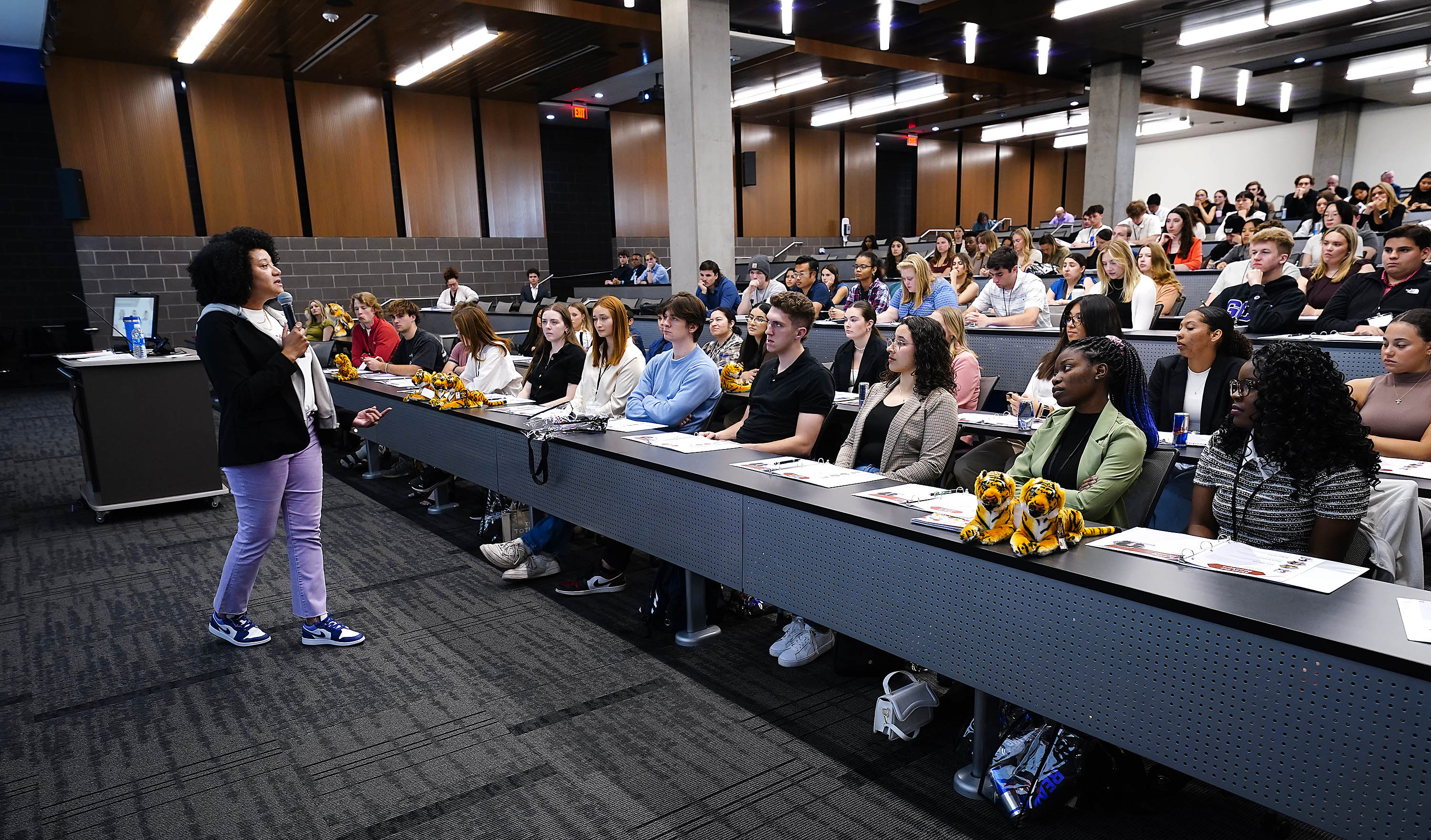
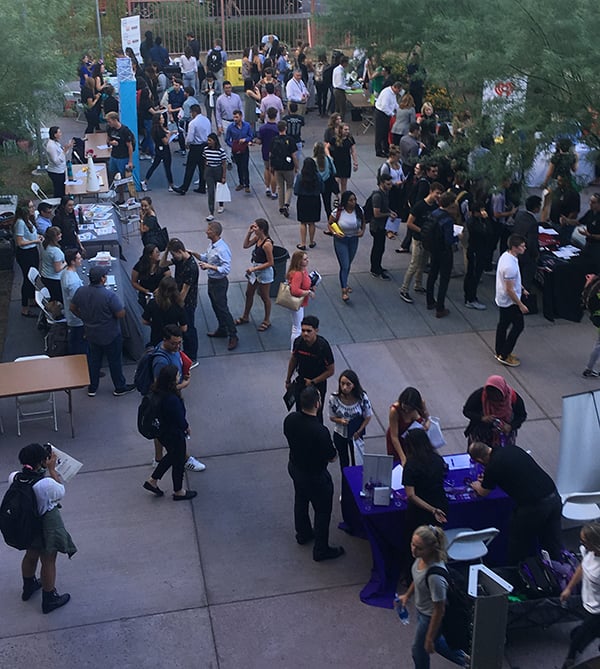
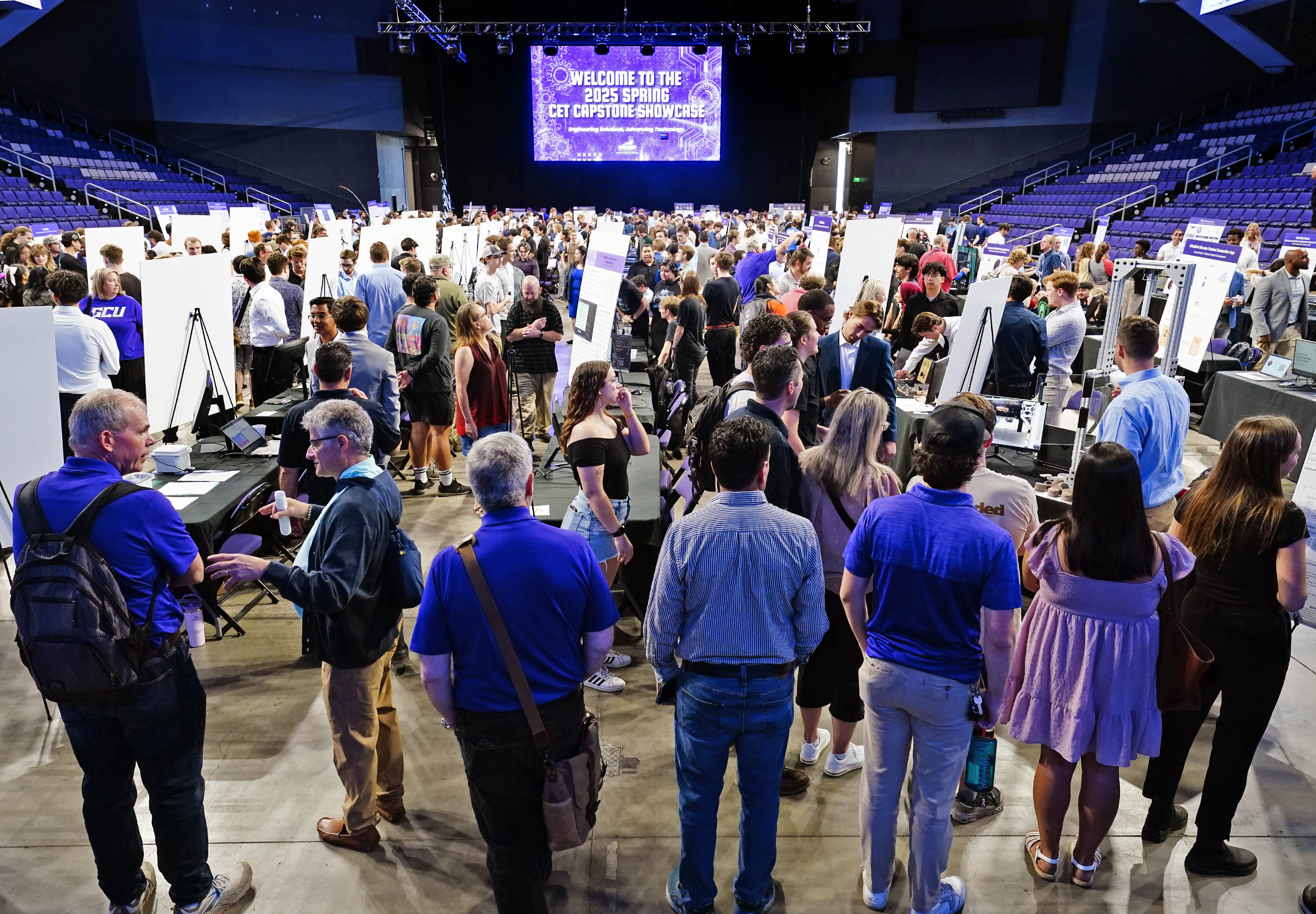
It was just one of a dozen capstone projects presented by IT and cyber students at the College of Engineering and Technology Capstone Showcase on Friday in the Cyber Center of Excellence.
"I'm super proud of all the hard work the students and their professor, Dwight Farris, put into the projects this semester," said Samantha Russell, director of interdisciplinary capstones.
During the capstone process, students take all they’ve learned at GCU and put their skill and know-how into a degree program-culminating project.

Hunter Hinsey, a CaseClosed team member, shared how his team was inspired, after taking a digital forensics class, to create a more efficient way for investigators to store collected digital data related to criminal cases.
“It (forensic science) is in a super weird spot. Things are mislabeled all the time and misplaced,” Hinsey said. “We thought, we need to make this new."
According to the team’s research, in 2022, 66% of forensic examiners agreed that digital evidence has become more significant than physical evidence in solving cases.
The team, which also included David Anderson and Victoria Moore-Mora, reached out to local police departments to see what kind of challenges they have with their current systems and what they would do to improve those systems.
The students determined that what they created needed to be highly secure, protected from unauthorized access and legally complaint at every stage.
Lissner at Friday’s showcase demonstrated CaseClosed, which can be navigated via dashboard that divides evidence into such categories as open cases, awaiting prosecution, closed cases and a progress chart.

Users can see information, such as which detective is assigned to a case. Investigators also can upload evidence and view the logs of all the people who have accessed each piece of evidence to establish a chain of custody, which is a process that tracks evidence from collection to presentation to ensure its integrity and prevents tampering so that evidence is admissible and reliable in court.
As Lissner pointed out, “our biggest threat is going to be insider threats.”
Hinsey said this project tested the team again and again: “There were many times where there were issues that took weeks (to solve),” and even five minutes before guests walked into the showcase, the team was fixing an issue.
They had the system back up and running. In five minutes.
“We still find bugs to this day,” he said. “But we did the best we could in the time allotted.”
Another student team at the capstone event also investigated how to modernize a process for forensic investigators.
Connor Gillespie was in class when he heard about the Arizona Outsole Database project that GCU students collaborated on with the Phoenix Police Department Crime Lab. Students created a shoeprint database to assist crime investigators in identifying shoe impressions left behind at crime scenes.
While those students collected shoe impressions for a database, Gillespie and his team, which included Jared Whitney, Vanessa Estanislao and Allison Reeves, went one step further.
They created a way for investigators to analyze those shoe impressions quickly, thus their project, Solehound, an automated footwear impression analysis app. It uses machine learning to perform reverse image searches of footwear impressions found at crime scenes, identifying potential similarities across numerous databases.
Whitney’s father, a police lieutenant, also gave the team insight into how slow the process can be to analyze a shoeprint.
Jared Whitney said the process of going through a shoeprint database can be archaic, with investigators flipping through pages back at the station to try to match what’s in a database to a crime scene shoe impression.

With Solehound, they can be on the scene and do an analysis in real time.
It can take weeks to do a manual examination of a shoeprint, Gillespie said. “If we can do it in 15 seconds … and on top of that, it’s all digital.”
Gillespie demonstrated how investigators can take a tablet into the field and use the app to do a quick analysis.
Outside of the forensic science realm, a third capstone team designed an open-source honeypot, which is a decoy system set up to look like a real website to catch cybercriminals in the act and to divert cybercriminals from real assets.
The goal was to create an easy-to-use honeypot for small businesses.
The project: HoneyMesh.
“It allows companies to be able to study the attackers and their attack methods,” said cybersecurity senior Levi Knoll of the HoneyMesh team, which also included technology students Andrew Syverson, Cody Turner and Rylan Ibach.
At the showcase, the team was running a system to mock a health care company. The health care market is a lucrative one for cybercrime, with 2023 smashing previous records as 168 million health records were exposed or stolen, according to an Oct. 26, 2025, article by the HIPAA Journal.

Syverson said the team was inspired to create HoneyMesh because, “We were looking for ways to help small businesses” by helping them gather real threat and intelligence information.
“It’s really hard for people to build honeypots,” Syverson said.
There were some 1.3 million brute-force attacks on the team’s HoneyMesh system – those are when attackers use automated tools to guess passwords and other credentials to gain unauthorized access, with the most attacks coming from The Netherlands and China.
Knoll said the best part of the capstone process for him?
“Seeing it (HoneyMesh) in action was a very fun aspect.”
It was a sentiment shared by Cole Monday. His team, which included Benjamin Pfortmiller, Michael Pitts and Ryan McQuillin, built a firewall called WAFFLE, or Web Application Firewall for Lightweight Environments, to help small- to medium-sized businesses.
The most exciting thing for Monday: “That it worked!"
GCU internal Communications Manager Lana Sweeten-Shults can be reached at [email protected].
***
Related content:
GCU News: From rock climbing to the NBA, students display their deep learning at AI event
GCU News: Support for women in engineering, technology STEMs the gap