Photos by Ralph Freso
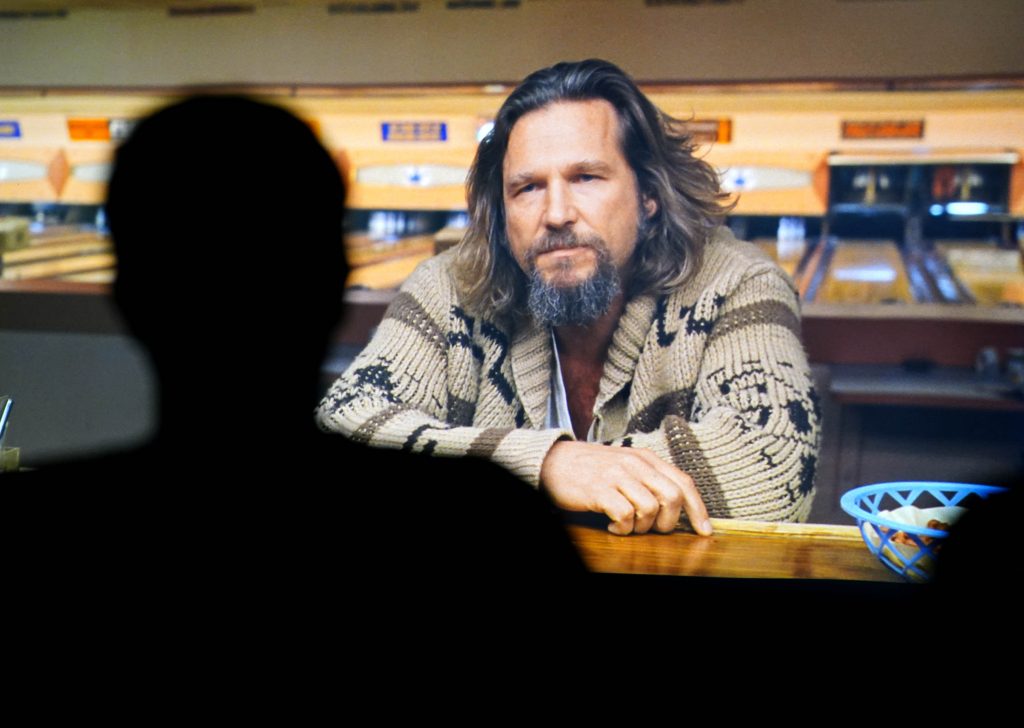
There’s a lotta ins, a lotta outs, a lotta what-have-yous to why an English professor sits in a dark classroom every Monday afternoon and rolls a film, and if you recognize the first words of this sentence, you know the film is “The Big Lebowski.”
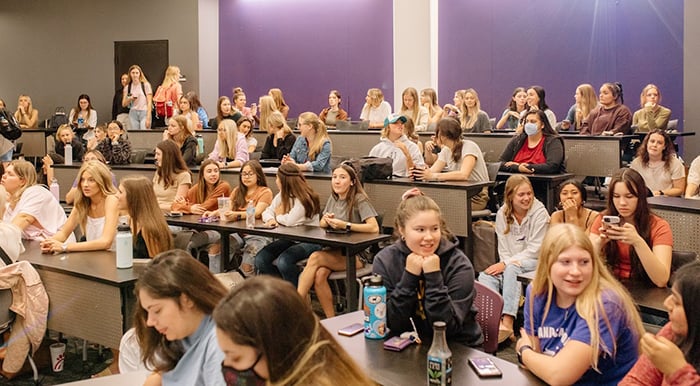
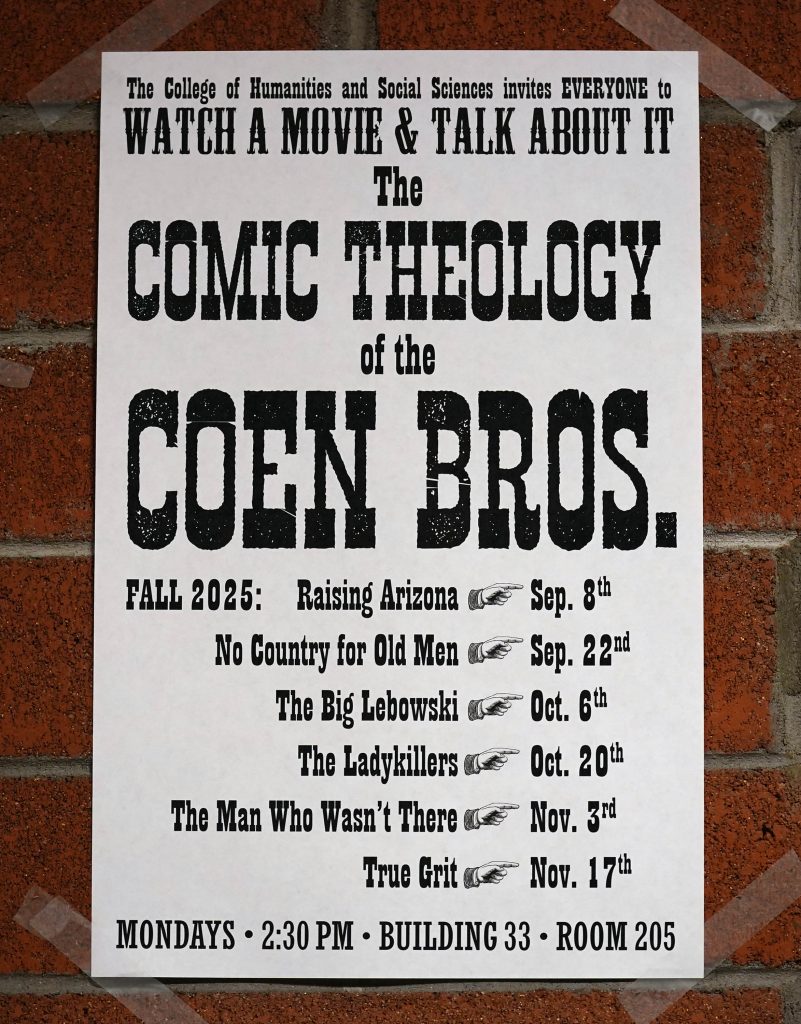
The “in” might be that Grand Canyon University's Dr. Jonathan Olson delights in stories – to think about as much as enjoy – and the “outs” are what viewers get from it, the interpretations of the story they learn from whomever wants to show up in the Education Building, Room 205, at 2:30 p.m. every other Monday.
The what-have-yous is the wide range of films in six years of this free co-curricular offering, "Watch A Movie and Talk About It," ranging from those centered on AI subjects or movies about movies to this year’s series featuring the films of Joel and Ethan Coen. The subtitle: “The Comic Theology of the Coen Brothers.”
All of their movies have philosophical and theological elements, Olson said.
It surfaces as the film rolls, as do quiet chuckles or Olson’s hard laugh, on an October Monday with a handful of students. “The Big Lebowski” is the story of Jeff Lebowski (Jeff Bridges), a laid-back L.A. burnout who likes to be called “The Dude” and is on a bowling team with Walter (John Goodman) and Donny (Steve Buscemi).
The Dude stumbles into a mystery via mistaken identity that involves ransom for a kidnapped gold digger and other absurd twists and iconic movie lines that have made it a cult classic.
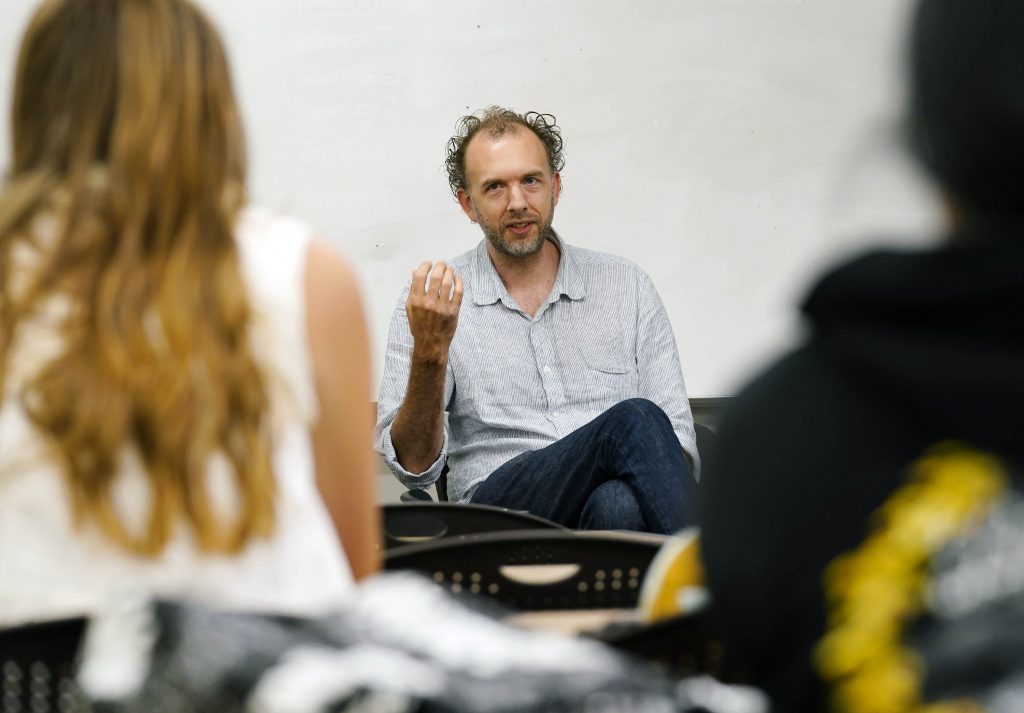
But after the credits roll, Olson digs in to connect a rolling theme. The first song of the movie is “Tumbling Tumbleweeds,” he notes, and there are the rolling bowling balls that are part of the alley scenes but also Lebowski’s weird dreams.
Meanwhile, The Dude gets beat up, used as a stooge to carry fake ransom, his apartment is trashed, his car gets smashed and finally set on fire …
“And he just rolls with it,” Olson said. “I guess that’s a thing about bowling is, let’s roll. It might be that rolling was more about rolling with the punches. I guess that’s The Dude’s philosophy.”
The theology?
The Dude doesn’t retaliate, always takes the punishment, rarely gets mad, even though he’s everyone’s scapegoat. Even the landlord hounding him for rent, Lebowski shows up at his absurd dance recital.
“You know, The Dude abides, and (the cowboy narrator) says, ‘it makes me feel better, knowing The Dude’s out there, takin’ it easy for all us sinners,’” Olson said. “I think that’s part of what’s inspired the so-called Christological interpretation of the movie – that The Dude is kind of a messianic figure, sort of a Christ figure.”
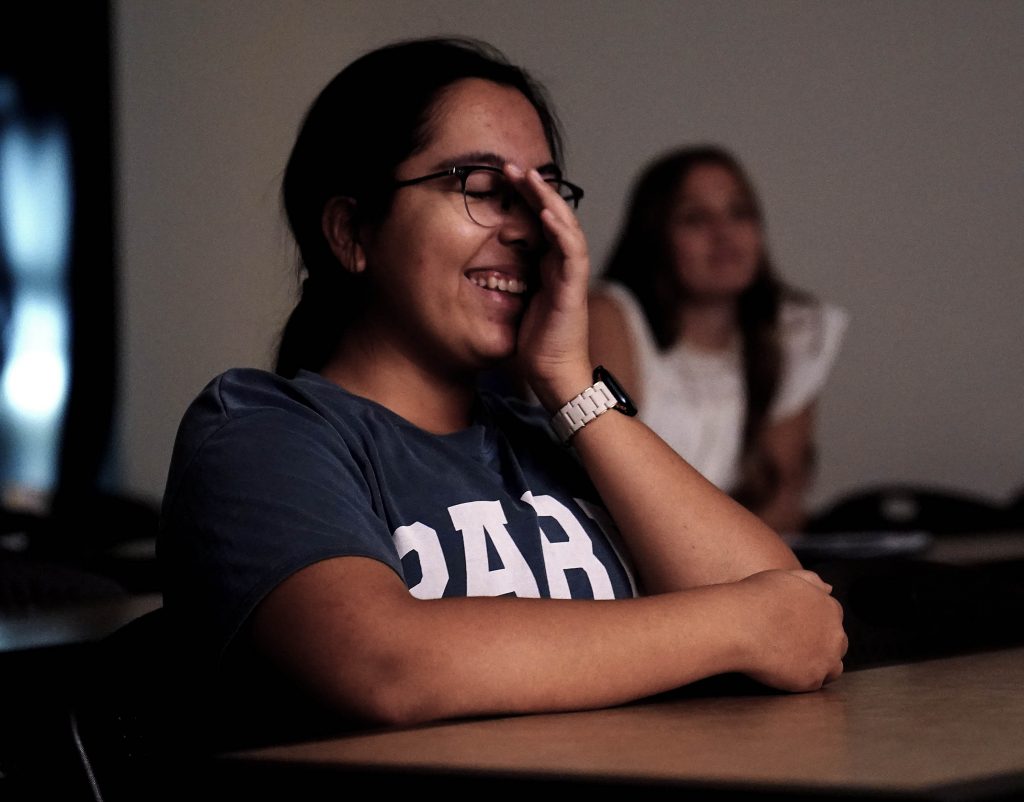
It’s that kind of discussion that deepens movies for junior Ava Clark-Paglinawan, who studies secondary education/English. This is her third year of coming to the movies.
“(Olson) helped me change the way of looking at movies as something more than entertaining,” she said. “They have deeper messages to them, and he has a way of bringing them to life.”
Olson said he also learns from the students – in fact on that October afternoon.
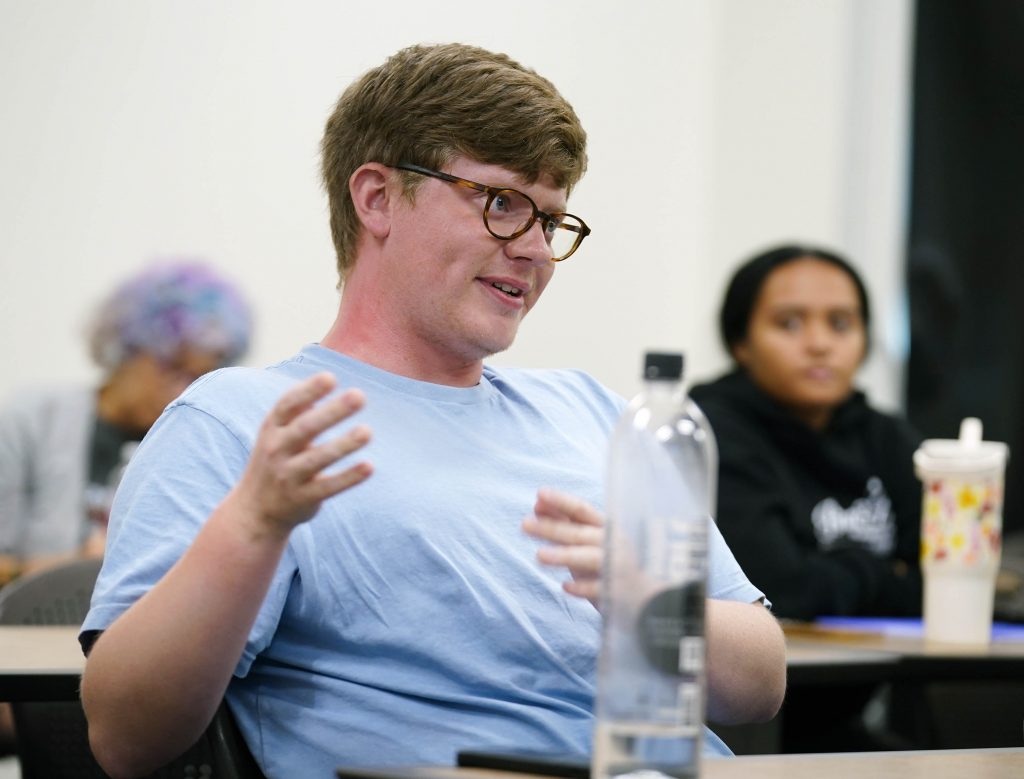
Blake Schultz, a music major, was attending Olson’s series for the first time, attracted by his love of the Coen brothers’ movies that he says have depth and smart humor, “compared to the standard superhero movies with cheap laughs.”
He shared an interpretation that made Olson’s eyes light up.
“There’s a theory that Donny was actually an imaginary figment of Walter’s imagination, that he was a Vietnam War buddy, since nobody ever addresses Donny throughout the movie besides him,” Schultz said.
It’s what Olson loves about movies – a hobby he shares with his wife – that talking about it afterward can reveal as much as watching it.
“I’ve changed my opinions based on what students have said about a movie,” he said.
Movies are fine as superficial entertainment, but the great films can have deeper insights to talk about. He’s pairing Coen brothers’ movies together for themes, whether they are comedy or tragedy.
He paired the dark “No Country for Old Men,” based on a Cormac McCarthy novel, with comic “Raising Arizona,” the series’ opener, because “they’re both about thieves and death and the way death comes like a thief. They’re both hounded by a sort of specter of the apocalypse.”
Clark-Paglinawan’s favorite so far has been “No Country” for that interpretation of death chasing its main character, while Schultz’s favorite is “Fargo” for its dry humor and vibe.
But in the series’ opener with “Raising Arizona,” the discussion among a couple dozen students afterward quickly got around to talking about the good-vs.-bad fight within.
The film stars never-do-well H.I. (Nicolas Cage) and Ed (Holly Hunter) stealing a baby from the rich car dealer who has too many children (quintuplets), complicated by his jail-breaking buddies (John Goodman again) who want a piece of the reward.
“They all treat the baby initially as this object that they can co-opt or manipulate or use for some other purposes and then the baby changes that,” Olson said. “They have fallen in love, and they have a change of heart. Their hearts are softened and they become better people almost supernaturally. It’s like the baby is an agent.”
The baby is literally called an “angel from heaven” who can change people’s hearts.
The hapless Coen brothers’ characters caught up in schemes, in inner fights with their good and bad sides, may have those elements of the theological, but Olson said they also serve to take viewers on a tour through film history by making connections.
For example, the 1998 “The Big Lebowski” has a film noir influence, the 1946 “The Big Sleep” with Humphrey Bogart. And a film just released in theatres that is said to be a lock for an Oscar nomination, “One Battle After Another” with Leonardo DiCaprio, is influenced by Lebowski, and not just because of the robes and sunglasses.
“I think that can be a way to get students interested in earlier cinema but via current interests, so the steppingstones are less and less drastic to take tiny steps backwards,” he said.
As he continues through the academic year with the Coens, from Monday’s showing of the “The Ladykillers” and “True Grit” near the end of November to next semester with his favorite, “Hail, Caesar!” and others, Olson will carry his coffee mug, dim the lights and enter a story.
“I hope other people want to join me,” he said. “Then that’s all the better.”
Grand Canyon University senior writer Mike Kilen can be reached at [email protected]
***
Related content:
GCU News: Marathon reading shares 'evergreen' 200-year-old novel