Photos by Ralph Freso
Grand Canyon University’s efforts to cultivate more pastors received a significant financial spike recently, thanks to a $9.9 million grant from the Lilly Endowment.
The gift will support GCU's Flourishing Pastor Network, a transformative initiative led by Grand Canyon Theological Seminary that will enable the university to substantially increase the number of churches and partner organizations that host high-impact pastoral residencies to develop emerging pastors.
One church that matches well with the program is Midtown Presbyterian Church.
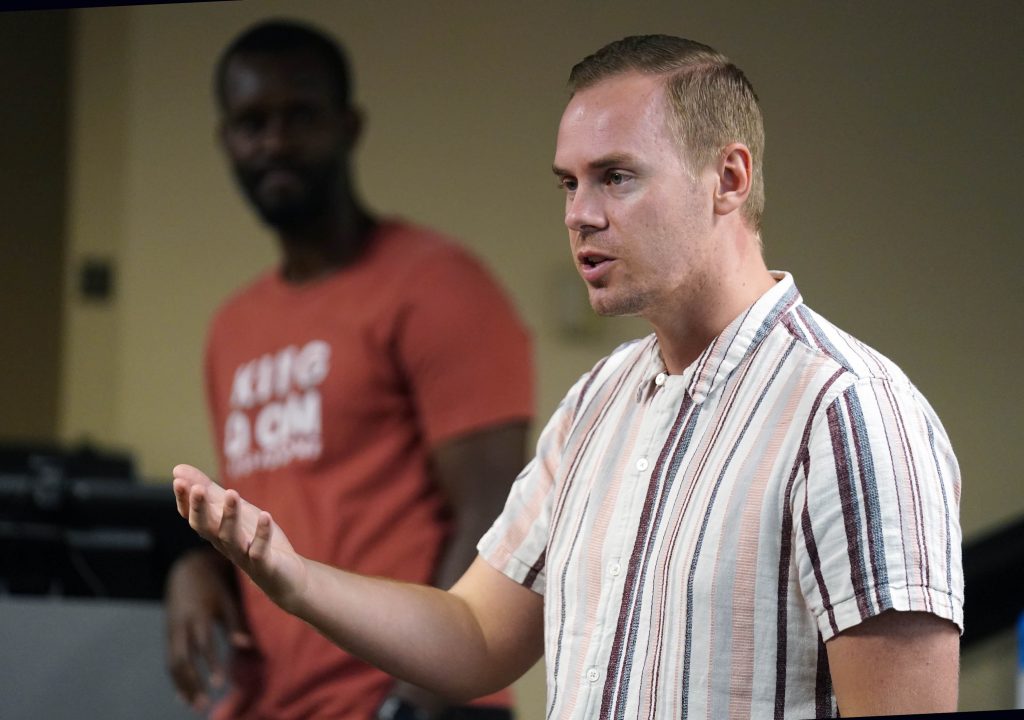
“We’ve got a lot of younger folks who are drawn to our church,” said pastor Clint Leavitt, who also serves as an adjunct professor in the College of Theology. “We’re a predominantly Gen Z and millennial church. About 75% to 80% of our church falls into that demographic, which means we've got a lot of young leaders who are eager to get to use their gifts in pastoral ways, and we want to help provide some structure for that to happen in ways to give them real responsibility.
“Not like the stereotypical intern who gets coffee for the staff, but a real responsibility in leading, stewarding and facilitating meetings, and all the ins and outs of ministry.”
It will help undergraduate students by giving them a chance to serve at a church to earn credit, as well as graduate students in the seminary who are learning specific curriculum.
The substantial funding allows GCU and local churches to teach more students in more detail as they become a fully formed pastor.
“It’s probably much closer to some of the things you would find in the medical industry than what we’re doing now,” College of Theology Dean Dr. Jason Hiles said.
The grant spans five years, and GCU will lead the first part of a network that will include five theological schools – GCU's seminary, Northwest Nazarene Divinity School, Palm Beach Atlantic University, Southwestern Baptist Theological Seminary and Trinity Anglican Seminary – and Made to Flourish, a parachurch group designed to empower a growing network of pastors.
“We strive to prepare students who have answered God’s call on their lives,” GCU President Brian Mueller said in a statement. “Thanks to the Lilly Endowment’s generous support, we can strengthen our shared mission of equipping the next generation of godly leaders for a lifetime of faithful ministry.”

This network intends to invite more seminaries to join as secondary collaborating partners over the course of the grant term.
“We’ve had some Venn diagram opportunities to overlap with what GCU is trying to do educationally with what we’re trying to do pastorally, and that has led to some cool relational connections,” said Leavitt, who has worked with Made to Flourish. “Some of our best leaders have come through these GCU connections, which is great.”
Hiles compared the process to an aspiring surgeon who has attended classes and lectures and is ready to practice. In the case of GCU's theology students, that person leaves the seminary and “continues his or her education in teaching churches or a church where a current pastor will mentor them and guide them and let them practice things, really fully immersed in the life of the congregation but with the understanding the student isn’t going to be very good at first. But they will have to learn these things in actual live situations,” Hiles said.
“It's super healthy as far as an onramp into ministry,” Hiles added. “And it gives the student the ability to learn, and also, in some ways, interview informally for their denomination or their congregation.
“They may well land positions as a result of this, which is very positive. We’re going to scale this in a way that only GCU might think of, but this will actually be much larger than the current number of residencies.”

That will be made possible through the grant from Lilly, which has committed more than $700 million to support 163 theological schools in an effort to bolster their educational and financial capacities and to aid 61 schools in growing large-scale collaborative pursuits, such as the Flourishing Pastor Network.
“Just imagine working with local churches,” Hiles said. “It’s kind of a small thing for most seminaries. It is for us right now.
“This is going to be a scalable network. We’re going to increase the ability for more students, more churches to participate in this as real partners with the seminary and the education process for these emerging pastoral leaders.“
Grand Canyon Theological Seminary plans to add two staffers in leadership positions and an assistant within the next three months – well before the network's first meeting. Those staffers will manage the project under current leaders, such as Hiles and his college's assistant dean, Paul Smith.
The seminary will seek a replacement for former Director Dr. Josh Anderson, who will take over as the theology college's assistant dean. Anderson replaces Dr. Peter Anderson, who will serve as executive director of the Canyon Center for Character Education.
GCU News senior writer Mark Gonzales can be reached at [email protected]
***
Related content:
GCU News: Grand Canyon Theological Seminary conference theme: Relax, make time for God
GCU News: $10.7M Kern Family Foundation grant to cultivate Christian character campuswide
Press release: Grand Canyon University receives $9.9 million Lilly Endowment grant to launch Flourishing Pastor Network