
Photos by Ralph Freso
The pupils in Kristen Palamaruk’s earth science and AP and honors biology classes can count on an assignment to start the school year.
But it will have little to do with molecules.
They will be “deep-diving into their own character,” said the Maryvale High School teacher, “and creating virtue goals.”
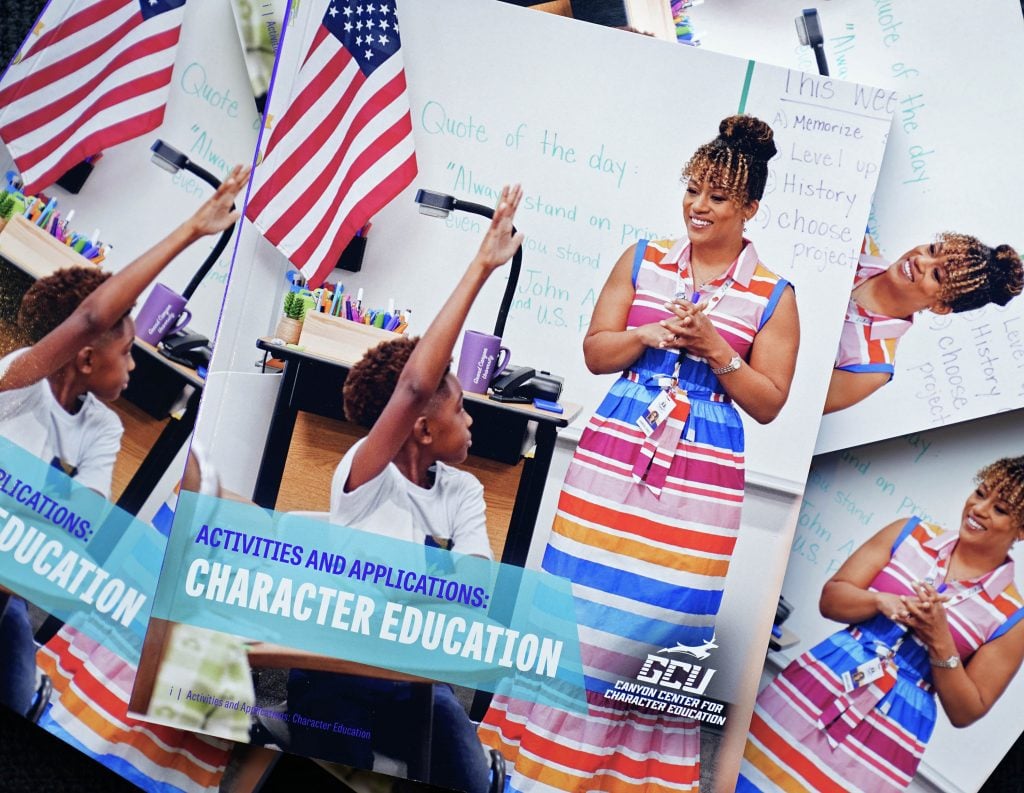
During the first week of school, she will be turning to the experts at Grand Canyon University’s Canyon Center for Character Education. She’s using Program Director Emily Farkas and Assistant Director Dr. Ashley Brandon's new book, “Activities and Applications: Character Education.”
“We will discuss what character is and why virtues are important,” Palamaruk continued, using different activities in the book for each age group.
She will help them set up a virtues journal, per one of the book’s activities that highlight reflective journaling, as well as other activities for older students “to help them decide on the virtues they want to build for their character.”
It’s right there on page 19, and it’s a doozy: You’re having a birthday party at some future time (20, 30, 40?) and your best friend pops up to give a speech. “What would you like them to say about you?”
Last year was Palamaruk’s first to implement character education in her classroom, and there was a learning curve. This year, she has the book.
“It’s been a life-changing tool,” she said. “I hope it inspires more people to utilize the tool and implement character education within their classroom.”
There’s a lot of theory and research behind character education. But Farkas and Brandon knew in the past three years of working on character education with K-12 schools that teachers often ask the same questions:
“What can I do right now?”
“Do you have curriculum for it?”
So they give them tangible exercises, using the framework of CCCE skills on how to live a virtuous, flourishing life.
With graduate degrees in character education and on-the-ground experience at conferences and working with schools, Farkas and Brandon thought the best book would include activities to explore moral, civic, intellectual and performance virtues.
“It’s ready-made, they don’ have to think about it,” Farkas said.
A teacher can use it for their own growth or for students in their classrooms, and school leaders can use it for professional development. It’s free on CCCE’s website (or printed copies are available upon request to CCCE).
“It’s literally for anyone who wants to put character education activities in place -- our main audience is the K-12 space -- but these activities can absolutely be differentiated for higher education spaces,” Farkas said.
She said it could be a supplemental resource for established character education programs in schools or be something “to get the ball rolling” in schools without them.
It’s part of CCCE’s mission to advance character education globally, working on an extension of a three-year grant from the Kern Family Foundation.
To do the book, they enlisted 10 character education experts from across the country to contribute activities.
"It is often easy to view character education as 'something else to add to my plate' among the mound of duties, reports and responsibilities that we have as classroom educators," said contributor Lance Forman, a Lipscomb University College of Education assistant dean and CCCE advisor. "But what we need to understand is the character is not something else to add to the plate, it IS the plate. Character education and development is the foundation of exceptional teaching and leadership. The book is a great resource for educators because it provides concrete ways to integrate character education elements into the classroom."
Each section breaks down the intended audience, focus, materials needed and the step-by-step procedure. Numerous aids are used, from literature to videos of TEDx talks, from Aesop's Fables to Psychology Today article links.
An activity on courage is supplemented by links to a talk by a researcher and lecturer about courage, followed by discussion questions and other activities. A section on gratitude includes a link to happiness expert Martin Seligman's article and prompts to write three blessings from you day. Compassion, patience and integrity are explored form all angles.
“There’s plenty of opportunities for reflection throughout the activities,” Farkas said. “There’s a lot of focus on different virtues, such as empathy, which I think is needed currently.”
It’s all centered on personal growth.
“It’s really thinking about how your character impacts not only yourself and your growth, but how your character impacts those around you,” Brandon said. “That’s a pretty important lesson for little ones.”
Grand Canyon University senior writer Mike Kilen can be reached at [email protected]
***
Related content:
GCU News: Character summit: 'It is all about promoting the common good'
GCU News: Faculty friends lead fast-growing group on how to spread friendliness