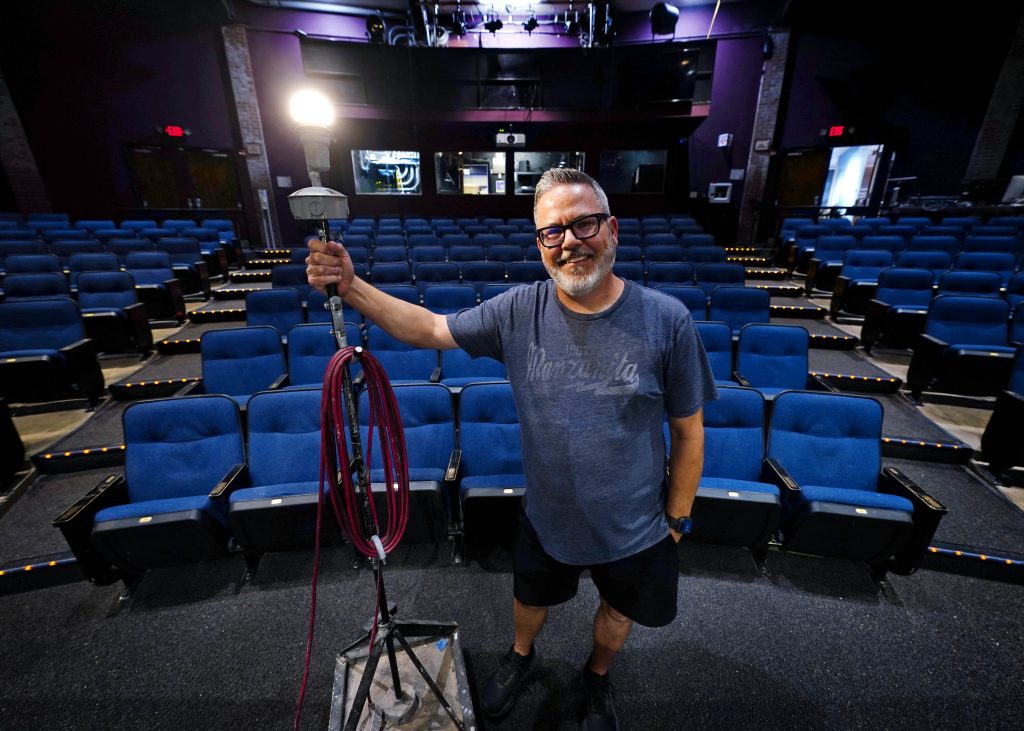
EDITOR'S NOTE: This is the second in a series of "Get to Know" profiles on GCU's College of Arts and Media faculty.
From fishing and hunting to playing baseball and cycling, William Symington never expected to build a career in theatre. Now as the assistant dean of theatre and dance at Grand Canyon University, he cannot imagine himself doing anything else.
Though originally an English major, Symington earned his bachelor’s degree in creative and performing arts from Grand View College (now Grand View University) in Des Moines, Iowa, and a master's degree in theatre with a focus in design and technology from Arizona State University. Symington has played an integral role in building GCU’s theatre program since arriving on campus in 2010 and working alongside of one of the university’s longest standing faculty, Claude Pensis.
1. You have been the assistant dean of theatre and dance at GCU for 15 years, with various theatre and stage design roles before that, but growing up, you couldn't even picture yourself in an acting class. What was the turning point that sparked your passion?
A lot of our students have the classic story of “I was born dancing and singing,” but that is not me at all. Theatre was not even on my radar. I started out as an English major in college because I wanted to pursue writing. I changed that to journalism for like five minutes. Then I switched to art, because I had always drawn, but I was still not super motivated.
One night in college, all the artists were hanging out, and the art department was in the same building as theatre. A group of theatre students came to us, saying they have a show opening in a few days and desperately need help painting it. They asked us art students to help them.
We stayed up all night painting this show and had a great time. One of the theatre students said I should try this acting class with them. I laughed and said no, but I did it. At first, I was super uncomfortable and terrified of being onstage, but in this class, I somehow started to not only get over it, but really love it. This was the starting point of my theatre career.
2. What is a play you watched that made you fall in love with theatre?
My last year of college I played George in Thornton Wilder’s “Our Town." It’s such a touching, important story about life. There is a scene in it where someone dies, and my character had to cry, but I never had to do that in a play before. My grandmother had passed away not too long before that show. We were very close.
The first night I had to cry for real in a rehearsal, I sort of dredged up that memory to make me cry, and I could not stop crying. I learned after that how to cry as an actor without really hurting my feelings. That play will always be in my heart. I have a deep love for that show because it made me feel like I had figured out what I was doing.
3. As the head of the theatre program, every year you sit down with your team to plan the Ethington Theatre season for the upcoming academic year. What does that selection process look like? How do you keep theatre alive, new and interesting?
One of the hats I wear is artistic director, so I oversee the quality and types of storytelling that goes out there. I have to think about shows that serve our students.
I meet with all theatre faculty and staff to review an initial list of 150-200 plays that we narrow down to four or five. We go through a list of criteria, such as the available students and their fit for specific roles, the size of the cast and the practical considerations of production. We consider the university's mission. Of course, there is the audience. We take into account what they want to see, what's engaging and whether the story is meaningful and timely.
It takes a lot of debate and input from the costumer, technical director, designers, directors, and we discuss the learning opportunities, the experience, the challenge, the practical ability to produce it.
Theatre both entertains and offers insight into life, which is why we value all its aspects.
4. It is no secret Ethington Theatre is a small space. How do you navigate the space you have when using large sets and props?
One part of theatre training is that scrappy, figure-it-out attitude. Creativity is a way of solving things. We look at the problem, saying, OK, there’s a bunch of different angles to this. It’s taking things apart and seeing how they work. We use every inch we have. Any designer and storyteller worth their salt can find a way. This is an incredible lesson to teach our students. The goal is to turn our students into creative problem-solvers and excellent storytellers. This is a great laboratory for them, so we don’t look at it as a limitation.
Ethington is a really great, intimate space, and so you emphasize the positives. Here, the audience is really close. The sight lines are excellent, there are no bad seats in the house because you are never far from the action. We simply utilize the space to the max.
5. What is one of your favorite aspects of our theatre program?
I am most proud of what this does for our students. I am less interested in my feelings about designing a show myself than I am about watching students design something.
We are going to do “Little Shop of Horrors” this fall, and there are going to be puppets and a massive mechanical revolve (a revolving stage). In my early days, I would have been proud of making those things, but now I am excited to teach and watch the students make those things.
The student outcomes are what I am most excited about, such as watching them learn from making stuff or to say these projects have led them down unexpected paths like graduate school, internships or jobs they had not considered.
In my office, I have a huge corkboard covered with thank you notes from students from over the years, and I keep that up as motivation. I get super excited about projects mainly now from their perspective.
6. What is one tradition done before or after every show?
Haircuts after opening day. We have a running joke around here that you know it’s a show’s opening day when everybody has a haircut. We all start looking a little scraggly as we work on the show but then suddenly, everybody’s looking clean and fresh.
7. Do your students have a nickname for you?
They call me Bill Sy the Theatre Guy, and they occasionally sing it to me just like "Bill Nye the Science Guy."
GCU staff writer Izabela Fogarasi can be reached at [email protected]
***
Note: "Our Town" will be performed Sept. 12-14 and Sept. 19-21, and "Little Shop of Horrors" will run Nov. 7-9 and Nov. 14-16 at Ethington Theatre.
***
Related content:
GCU News: Get to know GCU College of Arts and Media's chair of film
GCU News: Theatre program brings Disney magic to life with unique costumes and set designs
GCU News: GCU announces season of 'Little Shop,' Shakespeare, bluegrass
GCU News: Ethington Theatre has hit its mark as a GCU mainstay over its 50 years